Author: way0utwest

  • Backup Data Security

    It seems there is no end to the insecure ways in which people manage data. I haven’t seen this one before, but I’m sure it’s happened. In fact, I bet it’s happening right now in more than one company. A company was using rsync to keep data files copied between two insecure servers. Insecure because of a lack of username and password on the systems. In this case, the problem was a subcontractor that dealt with confidential US military personnel data.

    I appreciate that many of you are talented scripters that solve problems and build great solutions. I wonder how many of you actually think about security and the potential implications of small mistakes in configuration that others might make. When you build that PoSh script to copy backup files, are you ensuring the transfer takes place in a secure manner? Do you assume that because you use an IP address or server with no DNS entries to receive data that no one else can find it?

    All too often I find that sysadmins and developers make assumptions about the security of their process. They think because discovering the process or information would be hard for them or they wouldn’t bother, the data will be secure. And we find that time and time again that the ways in which we build systems without considering security aren’t secure. Someone will find a way to access the data, often with a fairly simple technique. Steal a laptop that’s unencrypted. Get a user to click on a link that installs keystroke logger or uses phishing to gain credentials. Scan a server for known software running with un-patched vulnerabilities or default accounts. I can’t tell you how many times I’ve logged into Oracle database servers with “System” and “Manager” in various organizations.

    Certainly our software platforms haven’t been well designed with security in mind. All sorts of expected, happy path behaviors are assumed by software developers, many of which are susceptible to attacks. While modern platforms are better designed and patches are becoming widely available, far too few companies apply these patches and consider security in the software they build on top of the OSes, databases, and other frameworks used for software. As an industry, we are far too guilty of granting more security than needed, opening more ports than necessary, re-using accounts too often, and assuming that our network paths are secure.

    Good security comes from having layers that don’t open our systems to a single mis-configuration or simple attack. Disks should be encrypted, minimal privileges granted, accounts not re-used across systems, and network communications, even for simple copies, secured. I know this can slow some development and be painful to implement, but as we become used to using secure credentials and techniques in all of our work, the complexity will fade into the background, and it will be as easy to deploy a secure system as an insecure one.

    Steve Jones

    The Voice of the DBA Podcast

    Listen to the MP3 Audio ( 4.2MB) podcast or subscribe to the feed at iTunes and Libsyn.
  • More #SQLintheCity–Behind the Scenes

    I posted this, but here it is again. A a shot from our engineer, behind the scenes of my live talk today.

    //platform.twitter.com/widgets.js


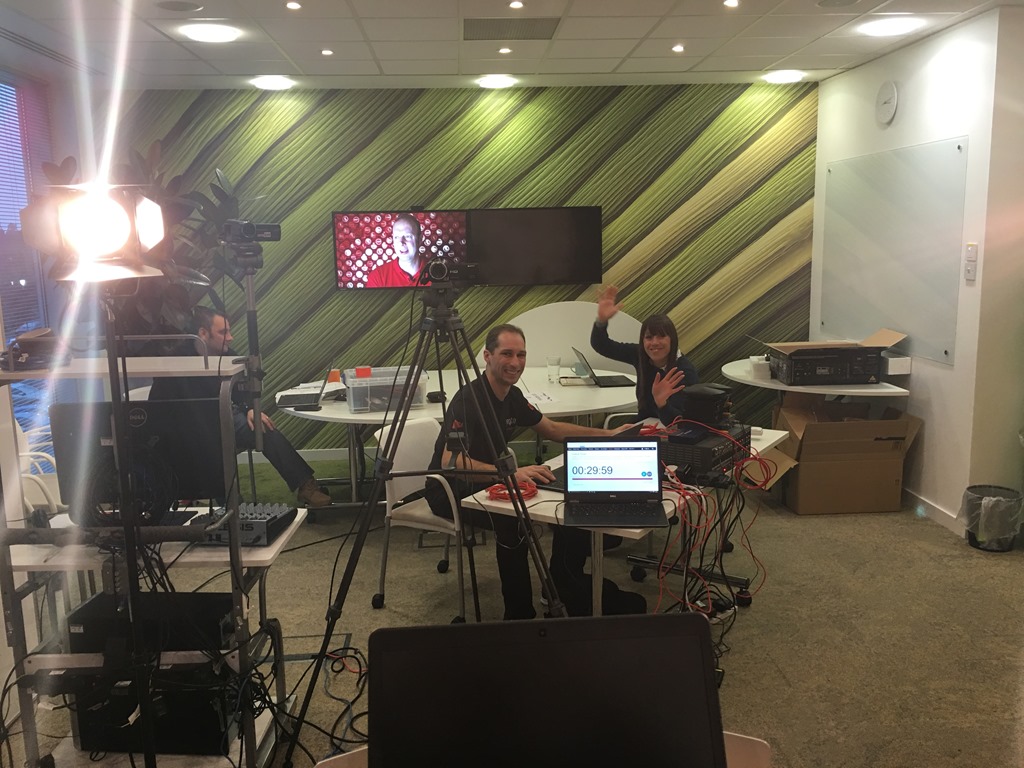
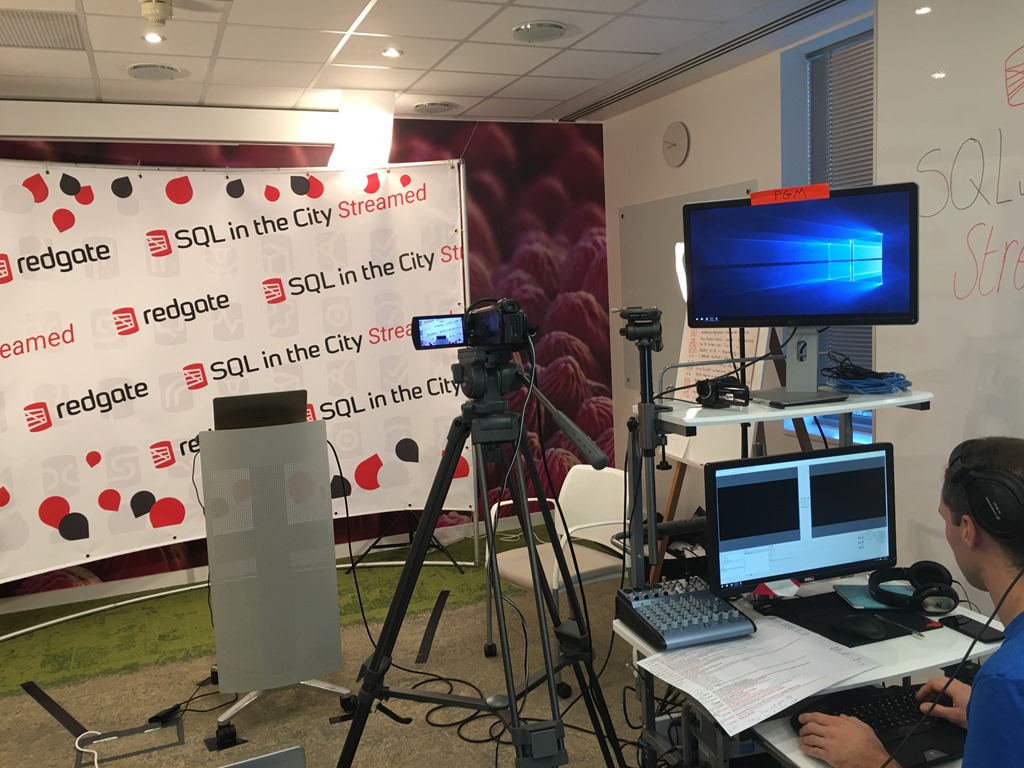
    When we decided to stream SQL in the City this year, I wondered how things would go. We’ve debated about a studio at the Redgate office but never built one. However, we did take over a room for this event, one on the top (2nd) floor, in a corner of the building away from most desks.

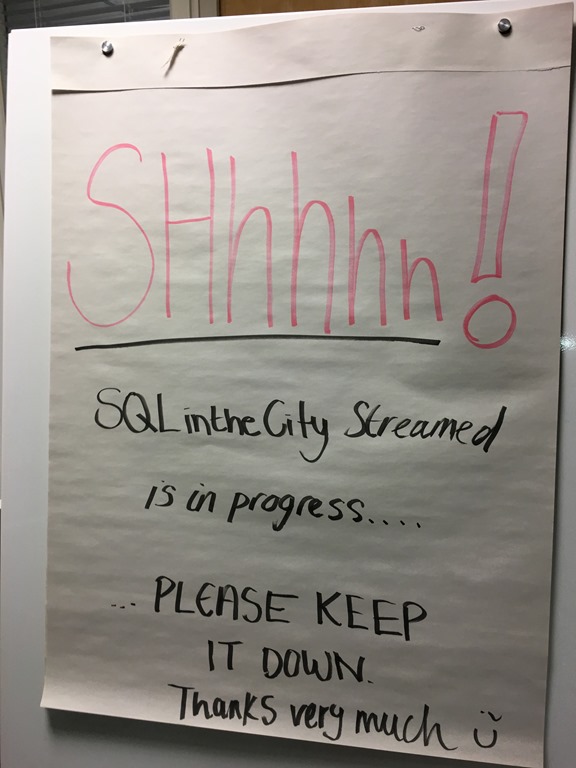
    We didn’t have a red “on the air” light, but our engineers did put a whiteboard in the hall outside.

    IMG_0212

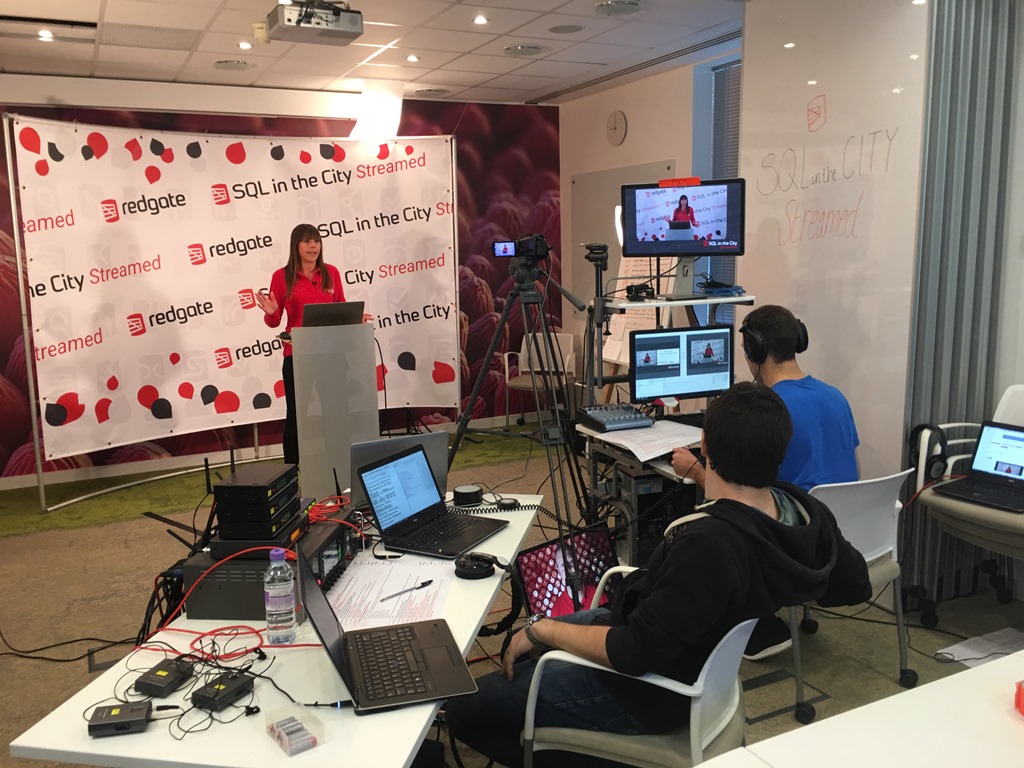
    Inside, we had a backdrop and podium for presenters, tape on the floor for our marks, and multiple cameras. Our setup allowed for a few microphones, multiple video feeds, and a few monitors on the wall.

    IMG_0192

    My view from the podium shows a few desks and the monitors on the back wall. One had the live stream, and the other was hooked up to a laptop where Annabel would type questions that we could see (or other notes).

    IMG_0174]

    The event kicked off with Annabel providing an opening each day. Here is the opening segment from Wednesday morning. I watched most of the first day in the room, and then did what most presenters did the second day; I’d work at my desk and then pop in 10 minutes or so before my talk.

    IMG_0198

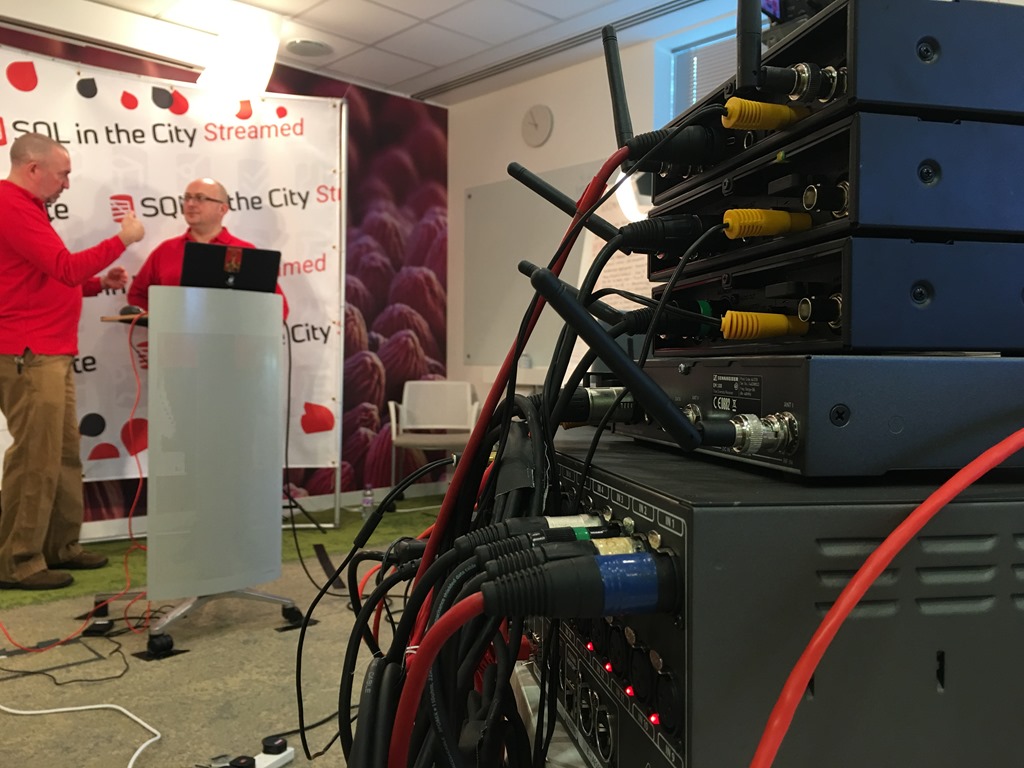
    There were lots of wires, and while most were taped down to the floor, we had to be careful about where we walked. I suspect next year we’ll have a better setup. At least, I hope we do, and hope that we actually do more streamed content throughout the year.

    IMG_0201

    I think this was a success, and certainly an easier way for me to present content. It was strange to not have an audience, but it helped to have a few people in the room that were watching and paying attention.

    While I really do enjoy live events and audiences, and I am pushing for a live SQL in the City 2017 in the UK, I also know that streaming and video broadcast is changing for all sorts of media. I’d like to experiment and do more here, and might do some more from home in 2017, but I do hope we’ll have more streaming from Redgate, perhaps even a Redgate TV show running on a regular basis.

  • Not Excited by Linux

    You’re not excited by Linux. At least most of you in this community aren’t excited. A recent poll we ran showed that nearly two thirds of the people answering aren’t interested in even evaluating SQL Server on Linux. That’s an interesting result because in some groups I’ve spoken with, quite a few people are excited by the prospect of using a different host platform for their database.

    When Microsoft first announced they were going to run SQL Server on Linux, I was excited, mostly because I think this means more applications and organizations would consider using SQL Server, which I think is a fantastic platform. It’s been the platform of choice for my entire career. However, from a business perspective, I wasn’t sure if this was a great idea. After all, Microsoft may reduce their revenue from Windows licenses if a large number of people moved to Linux for their underlying OS.

    Does the OS matter? I don’t know if it does. I’m not sure how much revenue comes in from Windows Server licenses for hosting SQL Server. I’m sure it’s a significant number, but will the number decline substantially if some people move to Linux from Windows for their SQL Servers? Perhaps, but I wouldn’t think many people make that move.

    Instead, I think the people excited by Linux hosting SQL Server are those that already are deeply committed to the Linux platform and avoid SQL Server because they don’t want to run Windows servers. There will be DB2 and Oracle databases that might move to a much less expensive SQL Server license. Certainly I expect lots of (free) Express editions installed by developers, which will allow them to gain experience, and perhaps be more comfortable in the future with SQL Server as a data platform.

    It’s hard to know if the move to Linux will result in a big change to Microsoft’s bottom line, but I do think it opens up many new opportunities for us, as data professionals, to find work. With the way that SQL Server works and the seamless way the Linux version seems to behave, I don’t even think most of us need to know much about Linux to develop or manage an instance on that platform.

    Steve Jones

    The Voice of the DBA Podcast

    Listen to the MP3 Audio ( 3.5MB) podcast or subscribe to the feed at iTunes and Libsyn.
  • Please Fix This–T-SQL Tuesday #86

    tsqltuesdayIt’s T-SQL Tuesday time, and this month is an interesting topic. The invite comes from Brent Ozar, and it’s designed to get you to look at SQL Server. I spent some time thinking about this one and getting a post together.

    You can participate as well. Just write a post on your blog, the second Tuesday of the month, link to the invite or leave a comment on their post. If you want to host, contact Adam Machanic.

    Better Checks

    This Connect item was submitted by Erland Sommarskog, and I think it’s one that is worth spending development time on. The title is Add optional checks for more robust development, and I think it’s a great idea. I’m a big fan of testing and ensuring that you meet standards, that silly mistakes aren’t being made in code, and in general, finding ways to improve developer productivity.

    I know that getting errors or failing tests are a pain, but these should drive you to change behavior. If you constantly code “select *”, then you want to get out of the habit. Tests, standards, or other checks are one way to do this.

    This suggestion from Erland, which has quite a few votes, is a good one. Getting some sort of warning from deferred name resolution, is a good thing. Having the ability to prevent, or ignore some of the issues, is important. I’d really like to see all of these checks implemented, with the ability to turn them on/off as needed.

    These don’t take the place of unit tests with something like tSQLt or automated testing, but they are a good start to helping us produce better software.

    If you agree, go vote , and perhaps we can get this implemented.