Author: way0utwest

  • Democratic Data Science

    I know quite a few people that are jumping on the data science bandwagon, brushing up on statistics, learning R, and hoping to land one of those lucrative data scientist positions. I wish you good luck, and some of you will succeed, but I wouldn’t count on there being lots and lots of data science positions in the future. The work is hard, and it will take a lot of learning and practice to become good. Plus, perhaps we won’t need as many data scientists as some are predicting.

    There seems to be a lot of work being done with intelligent agents and “bots” that can perform some lower level analysis of data and interact with humans. However, there is also work being done with more capable software that might analyze data and find patterns by applying different algorithms and analysis to make it easier for business analysts to comb through the mountains of data. After all, the growth of IoT, of more metrics and measurements being made in all kinds of applications mean that we can’t just throw bodies at problems. We need better ways to work with large amounts of data.

    This work isn’t really aimed at eliminating data scientists or data analysts. Rather, this is aimed at trying to free up their time to do the creative, thoughtful work of examining data. The grunt work of playing with algorithms and testing them according to some measure of success is handled by software. I think that this is a mantra that will be repeated over and over in the next couple decades in computing. Grunt work is automated, thoughtful work is done by (well-paid) humans. If you’re not doing the latter, you might not have a job with the former.

    I do think there is still plenty of opportunity for data professionals, after all, we need to manage all that data, find ways to ensure it’s available and can be queried, data is somewhat clean, and certainly that we have some idea of what the data means to our business. I’m not sure software agents will easily be able to set those things up, though certainly they’ll do the work of applying our rules to large sets of data.

    There will still be plenty of data science roles, and certainly humans need to be watching the software to be sure it’s working well. There will always be tuning efforts, and perhaps always reports that users need help in building. However, as software becomes more sophisticated, there will certainly be less grunt work in our industry, just like many other industries have seen lower, or at least lower mid-level positions reduced in number. We should be prepared to prove our value and ensure our skills are useful to our organizations.

    Steve Jones

    The Voice of the DBA Podcast

    Listen to the MP3 Audio ( 3.0MB) podcast or subscribe to the feed at iTunes and LibSyn.

  • The Desktop Rebuild–Part 2

    You can read part 1, but that’s more about the (initial) hardware changes. This one looks at getting moving on the new desktop. Note, that since I changed the MB/CPU/Boot disk, I decided to reinstall Windows as well on a new disk to ensure I wouldn’t have more issues.

    Having a new Windows desktop is a bit disconcerting. After all, many of us techies are used to loading more and more programs and documents onto our systems. We have lots of history with our machines, and Windows hasn’t always made it easy to move things. OSX is better, but I can’t build a Mac, or at least, I don’t want to.

    In this case, I still had me 2nd, 3rd, and 4th drives connected. The contained most of my documents, pictures, and application code. However, certainly some things needed to be installed.

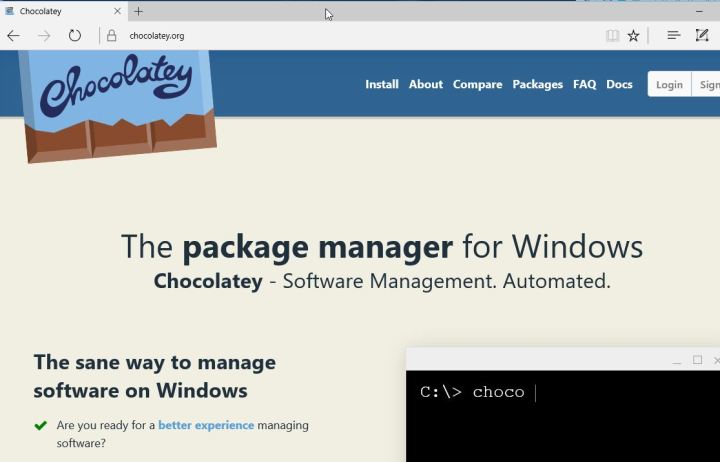
    The first thing I did with the new Windows 10 is run Edge and then go here:

    2016-06-23 23_37_58-Chocolatey ‎- Microsoft Edge

    I used to go get Chrome or Firefox right away, but I have a better way now. I use chocolatey. Once I get here, I first open a Command Prompt as Administrator and run this:

    @powershell -NoProfile -ExecutionPolicy Bypass -Command "iex ((new-object net.webclient).DownloadString('https://chocolatey.org/install.ps1'))" && SET PATH=%PATH%;%ALLUSERSPROFILE%\chocolatey\bin

    Once that finishes, I can begin installing things. In my case, I have a list of packages I want to install in a folder on my Dropbox. However, I need to get Dropbox first.

    choco install dropbox
    
    
    choco install passwordsafe

    Once that’s done, I log in (getting my password from my phone, and then I can run the rest of my installs, using Password Safe to get my passwords.

    choco install googlechrome
    choco install greenshot
    choco install conemu
    choco install firefox
    choco install sublimetext3
    choco install evernote

    I have Chrome and Firefox linked to an account, so my bookmarks come right over when I log in. SQL has to be installed separately, as does Office from my O365 account. I prefer to do Visual Studio myself, but these command line installs get me up and running.

    Fortunately I keep a copy of the .iso’s for those programs and can just run them.

    I also needed to flash my BIOS, which was easy, but I needed to download the newest file from ASRock and put it on a flash drive for a reboot. That went without a hitch, and I now have two monitor support again.

    Photo Jun 24, 10 33 59 AM

    I still need to adjust my monitor and also get a new video card to support the third monitor, but that’s for another day.

  • DevOps and Security

    DevOps is a buzzword these days, and like many of the hyped concepts written about, it has a lot of meanings. There is this idea releasing software more often, using automation, having various groups talk to each other, and more, all of  which we might see as common sense. However other DevOps ideas, such as releasing more often (with potentially less review), being willing to break applications and fix them quickly, having developers able to release code to live, production environments, these don’t seem to be ideas that would enhance security for most organizations.

    However, that’s not necessarily the case. Security and DevOps practices aren’t necessarily mutually exclusive. I ran across a piece from the security perspective, looking at some of the ideas in DevOps that can actually enhance security.

    Writing more code, especially around the configuration and infrastructure, allows versioning, auditing, and more that can ensure we have fewer mis-configured systems. Adding some Desired State Configuration (DSR), with some automated testing of this code, could ensure that the changes made don’t open up security holes. Or, at least, allow us to determine who made the change and when the issue appeared. These are important for understand security risk.

    There are also the ideas of measurement, metrics, and feedback, which are important for ensuring security. After all, anomalous behavior should be investigated, as this could be a sign of intrusion. For databases, it’s especially important with the large number of clients that connect to our systems. Adding DevOps style monitoring can allow us to determine if a workload is normal, or perhaps a sign of intentional, accidental, or malicious data query activity.

    I enjoyed the piece, and I’d recommend you read it. Plus, whenever I see “snowflake” in an article, I think of Grant and want to read further to see how someone else has used the same analogy he does.

    Steve Jones

    The Voice of the DBA Podcast

    Listen to the MP3 Audio ( 2.2MB) podcast or subscribe to the feed at iTunes and LibSyn.

  • Debuting Talks at the Summit

    This is a series of posts on the PASS Summit and SQL Saturdays. I’m outlining some thoughts here, sometimes for the first time, but on topics that I think make better events. These are opinions and thoughts, not mandates or demands. I’ve written previously on choosing speakers.

    One of the interesting items at the recent Speaker Selection Town Hall from PASS was a question about wanting sessions submitted to the Summit. The question was about whether the sessions could be given at a SQL Saturday (or other event), or if the Summit should be the first place the talk is given.

    I’m torn on this.

    One one hand, the Summit needs to attract people. This is a business and original content goes a long way to exciting people. I submit and speak at conferences that want this, and I’ve also given sessions at the Summit, which was the first time that I’d ever presented the content in front of an audience.

    On the other hand, we want good sessions. If I had one complaint from many Microsoft sessions, it’s that there are many speakers that struggle to give a good talk because they’ve never practiced it. I appreciate they’re busy, but I would love if they had to present a couple times internally and practice.

    The same thing occurs for us. The two times I’ve presented new content at the Summit (or other events), it’s very stressful. I’ve also struggled with timing and flow. Even having one talk at a local user group to 3 people will help make a better session.

    This isn’t perfect. I’ve seen speakers give the same talk 5 times and not improve or adjust their pace. My preference is to give the benefit of the doubt that speakers will work to improve over time. Note, if they don’t, give them the feedback.

    I also see value in having great sessions repeated. I’ll pick on a couple people here. Aaron Bertrand has given T-SQL: Bad Habits & Best Practices at many events. I think I’ve seen it twice. It’s great, and worth seeing. DBA Mythbusters from Paul Randal is great. I know Paul adjusts and grows content over time, and this is one I could see being on the schedule every year. I’ll also say that almost anything Itzik Ben-Gan presents is worth having at every conference.

    I don’t know what percentage of repeat sessions should be allowed, but I wouldn’t rule this out. I also think it’s fine to pick sessions presented at other events, if they make a good event. One thing to keep in mind is that if you take advantage of every slot at the Summit, you’ll see 13 or 14 talks.

    14/112 (or so)

    You won’t see everything. I doubt you’ll watch everything, even if you a super motivated and buy the content on USB.

    The same thing occurs at SQL Saturdays. At one of the smaller events, Sioux Falls, there were 3 tracks, but only 4 time slots, so you could see 4 of 11 talks at best.

    No one sees all content.

    While you might want Grant to have something new at the Summit that you haven’t seen at SQL Saturday Boston, there are lots and lots of other people that would like to see Grant present, even if it’s the same talk from SQL Saturday Boston.

    If I could wave the magic wand, what I’d want PASS to do is this:

    • Have 80% new content (content not given at a previous Summit), but content that has been practiced somewhere. In fact, I’d ask that many speakers schedule a user group talk (or a SQL Saturday) prior to the Summit to work out any bugs. This might mean some crunches for user groups in the Aug-Oct range, but that’s fine.
    • That means there would be 20% content that’s being repeated. I think that’s OK, if there are great sessions worth repeating. Certainly I think some of the talks that speakers have given could be updated a bit, but many are worth giving again.
    • Of course, that’s just an idea, and one that doesn’t mean we have hard numbers. Maybe the 20% is a hard ceiling, but the percentages can vary, just discuss why. As the committee makes decisions, keep notes and comments and then drop them in a post.
    • More I’d like to have PASS continue to disclose data, discuss this more, and adjust over time.