Author: way0utwest

  • Why Use R Services?

    I ran across a blog post from the very talented Joe Sack recenty, who I hope makes a few more minutes for me the next time we’re in the same town together ;).

    The post is a look at some of the customers that are using R Services in SQL Server 2016. As you might expect, there are highlights from customers that show dramatic improvement in performance. Going from 200 valuations/hour to 12,000/minute and taking a process from 2 days to 1 hour. I’m sure not all operations improved that much, but I bet most had some improvement. R Services is a big improvement in the way data is analyzed with the R language.

    What I really like, however, is that the piece includes some of the gotchas customers experienced, with links on how one might go about fixing the issues. There are also hints on visualizations and performance tuning options. I like looks at technology that include some details on those items that work well or don’t work well. This is a good overview that I hope gets more customers interested in using R services.

    But, I hope that we see deeper pieces that can give technical guidance on specific scenarios. Which models scale well and which don’t? Which options in some analysis improved (or hurt) performance? There are plenty of items which are best answered with specific examples, rather than general advice. With all the customers and data Microsoft gathers, especially for companies that might use R Services in azure, I’d expect that we could get some useful, detailed examples on how this (and other) technologies actually work in the real world. I’d like to see this guidance, not just with R Services, but with other technologies as well. Certainly providing some sample data sets and code that performs well really (or tuning options), is what most of us want to see.

    Of course, I’d like to see more of these stories and details at SQLServerCentral as well, so if you are solving problems and want to publish something, drop us a note. We’d love articles from the real world, whether on SQL Server 2016, or any prior version. The more reference problems and solutions we have, the more people learn to code better.

    Steve Jones

    The Voice of the DBA Podcast

    Listen to the MP3 Audio ( 3.1MB) podcast or subscribe to the feed at iTunes and LibSyn.

  • Not a Great Search

    Tldr: A bit of a rant. I’m not spending a bunch of time crafting this.

    I have mixed feelings about searching for information on Microsoft sites. It kind of works, kind of doesn’t. I know that there are resource constraints to upgrading their sites, but I’m more and more annoyed.

    Perhaps this is one reason I don’t use Bing. Maybe, not sure. I need to think about this.

    Anyway, I go to the main BOL page online often. It’s supposed to be more updated than the local help, and I don’t have to use some procedure to get to it. I went today and entered in a search, getting these results.

    2016-06-22 13_47_36-t-sql wildcard characters - MSDN Search

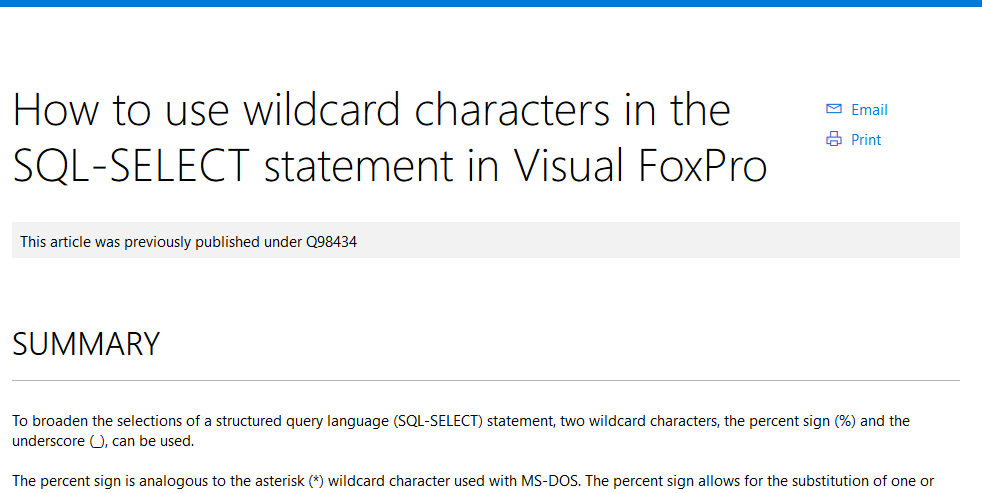
    Check out the second one. That might be interesting, and it’s in the Support KB. I click on it and see this:

    2016-06-22 13_53_40-How to use wildcard characters in the SQL-SELECT statement in Visual FoxPro

    That. Is. Not. What. I. Want. (at least not these days)

    Even surfacing the entire title, or maybe tagging this as a VFP article in addition to a kb one.

    As I delve into more technologies, I find acronyms crossing over, so I want to look for a term in SQL Server, or in C#, and right now I have to search and then try to limit things with a click on the left. Except that I don’t always get a good way to limit searches.

    2016-06-22 13_55_37-Settings

    That’s not a great example, but that’s the term of I thought of today that crosses over.

    Can we please get some way to default a search to the areas we’re working in? I can click something if I’m working with SQL and need to search wider, but I seem to get (more and more) results from Sharepoint, C#, etc that aren’t relevant.

    Ugh, I know I’m ranting a bit, but search becomes more and more important in the see of data, especially with things like Azure rev’ing every quarter. Give me a way to search current docs, in my area, easily, by default.

  • Starting ReadyRoll with an Existing DB

    I’ve been working with ReadyRoll quite a bit the last few months, and wanted to start putting out some information. I’m looking to do a longer series, but here’s a quick post on getting started.

    When you install ReadyRoll, you get a new project type under SQL Server.

    2016-06-14 12_27_14-Photos

    This is a database project that will track all changes to your database as a series of migration scripts. Let’s get started. I’ll choose this and give it a name.

    Once I do this, I get the ReadyRoll window with some information. What I really want to do here is point this to my existing database. Right now it’s looking at a LocalDB instance.

    2016-06-14 12_28_07-Photos

    I’ll click the configure link and get the Connection String dialog. This is the database that mirrors one of the SSC databases, with lots of objects in it.

    2016-06-14 12_29_38-Photos

    Once I’ve done this, the project will use this database. The Shadow database will also be on this instance.

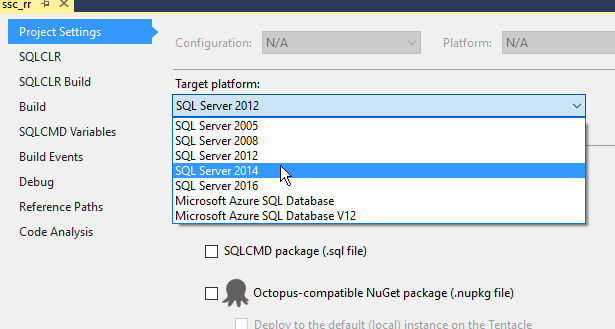
    I need to make one other change and set the correct version in the Project Settings.

    2016-06-14 12_48_29-Photos

    Now, back to the ReadyRoll window. I’ve configured the DB connection, so I can ignore that. What I want to do is import my database, getting a baseline script.

    2016-06-14 12_49_32-Movies & TV

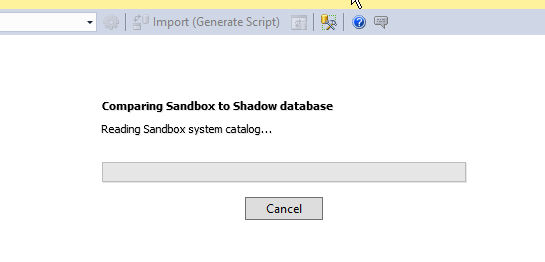
    I click that and ReadyRoll creates a Shadow database (since one doesn’t exist) and begins to import objects.

    2016-06-14 12_49_39-Photos

    Once that’s done, I get a list.

    2016-06-14 12_49_48-Photos

    And a migration script.

    2016-06-14 12_49_58-Movies & TV

    This is my baseline, starting script. This contains all the objects that exist in the database at this point. These are also added to the Schema-Model, but I can ignore those. I’m going to work on the database itself.

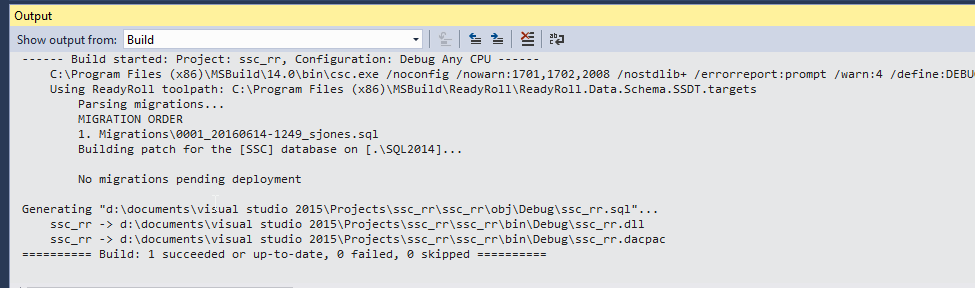
    The ReadyRoll widget notes this was an import, and there’s no need to deploy anything since these aren’t changes, but just the state of the db.

    2016-06-14 12_52_09-Movies & TV

    I can see this if I do a Visual Studio build. Note the message in the middle: No migrations pending deployment. The changes in script 1 (001_20160614-1249_sjones.sql) are already in the db.

    2016-06-14 12_52_50-Photos

    Now I can make changes to my database and get new scripts. Add a table in the designer?

    2016-06-14 12_54_55-Photos

    When I click Update (and Generate Script), I get a new migration script.

    2016-06-14 12_55_09-Movies & TV

    Note that I just generated this script. I’ll write more about this process later, but for now, I’ll click Deploy Project to execute this against my database. When I do that, VS does a build, and one migration is executed.

    2016-06-14 12_56_06-Photos

    Add a procedure?

    2016-06-14 12_57_13-Photos

    Generate a new migration script.

    2016-06-14 12_57_35-Movies & TV

    And so it goes. I can work with my database in VS and get new scripts. I can also do an import if someone else makes changes to the database from their own machine with VS, SSMS, SQLCMD, isql, etc. The import will generate another migration script that gets added.

    This is a really basic look at ReadyRoll, but it will get you started. I’ll tackle more topics and different ways of working with database development in another series of posts.

  • A Beautiful Google Mind

    I read a quote a few years ago that really resonated with me. The quote is attributed to Jeffrey Hammerbacher, an early Facebook employee that left to found Cloudera, a data analytics company. The quote went like this:

    “The best minds of my generation are thinking about how to make people click ads. That sucks.”

    That actually dovetailed with something I’d heard in the mid 2000s, when someone lamented that the best technical minds in computer science weren’t working to further our industry or even just produce amazing software. Many of them had left industries to work inside financial institutions, manipulating our stock markets and money systems to make millions.

    I can’t blame anyone for choosing to engage in a business that will reward them. That’s the beauty of capitalism. I think you can go too far, but I’d hope that most people, while pursuing their success, would look beyond just money. At least at some point. I would like to believe that most of us find there to be things at least as, if not more so, important than money.

    Larry Page founded Google, and is one of the richest people in the world. I ran across an article on his beautiful mind, which looks at the ways in which Mr. Page is trying to change the world. Perhaps he has an eye on profit, but my impression is that he also wants to make life better for more and more people around the globe. His focus happens to be ways technology might help us, and I’m hoping he succeeds. Much like I admire Bill and Melinda Gates are trying to improve health around the world. Those aren’t my passions, but I’m glad someone is driven by them.

    Many of us aren’t financially secure for life or able to fund whatever endeavor comes to mind. However, we can make a difference in the world. We can be examples that show there is something beyond making money at work. We can also volunteer or donate some of our time to help others. We can all be a Larry Page in some way, impacting the world in a small way to make it better for everyone.

    Steve Jones

    The Voice of the DBA Podcast

    Listen to the MP3 Audio ( 2.6MB) podcast or subscribe to the feed at iTunes and LibSyn.