Author: way0utwest

  • LAST_VALUE–The Basics of Framing

    I did some work a 3-4 years ago, learning about the Windowing functions and enjoying them so much I built a few presentations on them. In learning about them, and trying to understand them, I found some challenges, and it took some experimentation to actually understand how the functions work in small data sets.

    I noticed last week that SQLServerCentral had re-run a great piece from Kathi Kellenberger on LAST_VALUE, which is worth the read. There’s a lot in there to understand, so I thought I’d break things down a bit.

    Framing

    The important thing to understand with window functions is that there is a frame at any point in time when the data is being scanned or processed. I’m not sure what the best term to use is.

    Let’s look at the same data set Kathi used. For simplicity, I’ll use a few images of her dataset, but I’ll examine the SalesOrderID. I think that can be easier than looking at the amounts.

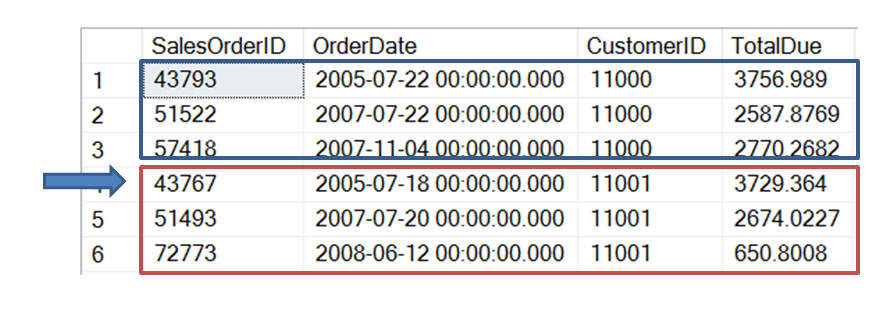
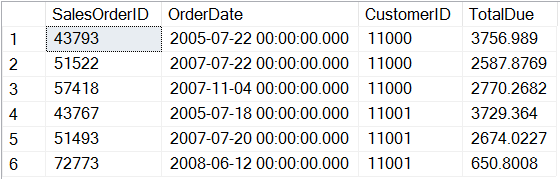
    Here’s the base dataset for two customers, separated by CustomerID and ordered by the OrderDate. I’ve included amount, but it’s really not important.
    2016-06-06 13_38_55-Phone

    Now, if I do something like query for LAST_VALUE with a partition of CustomerID and ordered by OrderDate, I get this set. The partition divides the set up into the two customer sets. Without an ORDER BY, these sets would exist as the red set and blue set, but in no particular order. The ORDER BY functions as it does in any query, guaranteeing the same order every time.

    2016-06-06 13_46_36-Movies & TV

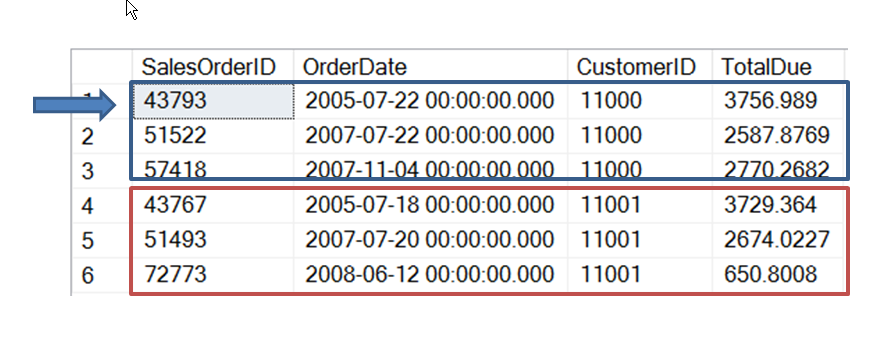
    Now, let’s look at the framing of the partition. I have a few choices, but at any point, I have the current row. So my processing looks like this, with the arrow representing the current row.
    2016-06-06 13_49_22-Movies & TV

    The next row is this one:

    2016-06-06 13_49_33-Movies & TV

    Then this one (the last one for this customer)
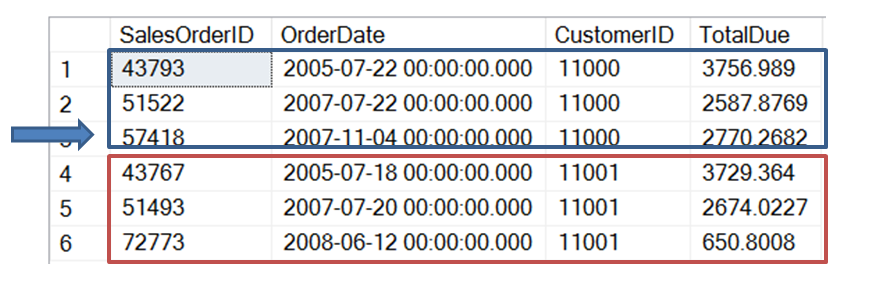
    2016-06-06 13_49_44-Movies & TV

    Then we move to the next customer.

    2016-06-06 13_49_54-Movies & TV

    When I look at any row, if I use “current row” in my framing, then I’m looking at, and including, the current row. The rest of my frame depends on what else I have. I could have UNBOUNDED PRECEEDING and UNBOUNDED FOLLOWING in there.

    If I used UNBOUNDED PRECEEDING and CURRENT ROW, I’d have this frame, in green, for the first row. It’s slightly offset to show the difference.

    2016-06-06 13_53_22-Movies & TV

    However, if I had CURRENT ROW and UNBOUNDED FOLLOWING, I’d have this frame (in green).

    2016-06-06 13_54_21-Movies & TV

    In this last case, the frame is the entire partition.

    What’s the last value? In the first case, the last part of that frame is the current SalesOrderID (43793). That’s the only row in the frame. In the second frame, the last one is 57418, the last row in the frame, and partition.

    What if we move to the next row? Let’s look at both frames. First, UNBOUNDED PRECEEDING and CURRENT ROW.

    2016-06-06 13_56_16-Movies & TV

    Now the frame is the first two rows. In this case, the last value is again the current row (51522). Below, we switch to CURRENT ROW and UNBOUNDED FOLLOWING.

    2016-06-06 13_56_29-Movies & TV

    Now the frame is just the last two rows of the partition and the last value is the same (57418).

    There’s a lot more to the window functions, and I certainly would recommend either Kathi’s book (Expert T-SQL Window Functions in SQL Server) or Itzik’s book (Microsoft SQL Server 2012 High-Performance T-SQL Using Window Functions). Either one will help. We’ve also got some good articles at SQLServerCentral on windowing functions.

  • Updates During Outages

    Slack went down on June 10, 2016. I noticed, which is funny, since I don’t necessarily use the tool every day. I tend to still communicate with email, but more and more people like using Slack at Redgate, so I do pop over there. It’s also a good way to drop a quick note and perhaps get a quick reply. In this case I’d asked a group to do something and hadn’t heard back. Since my request didn’t generate a ticket, I didn’t want to send another email, which could result in more delays if someone isn’t processing email. However, that’s not important.

    What was interesting is my Slack web page didn’t connect, and when I pinged @slackhq on Twitter, they directed me to status.slack.com. That’s where they post updates. That site was also down, which somewhat defeats the purpose of having a separate location for updates.

    I’ve experienced this a few times, where someone (sometimes me) has built an update or notification mechanism that is dependent in some way on the actual service we’re updating. Often this has been because the same http server is being used, but sometimes it’s the same database instance is used to allow non-technical people to post updates. In all those cases, at some point the update mechanism has broken.

    I’ve learned to actually separate my update broadcast mechanism from the production server. We’ve done this in a few ways. I’ve had includes of a simple text file in Web applications in addition to a static page that can be served from a web server. I’ve learned to use a separate physical host that can be moved to the proper IP address in the event that our firewall or load balancers don’t work. They key, I’ve learned, is separation. Have a separate resource that can manage a simple message back to users. Perhaps even a small database that can respond to queries with a “we’re down” reply.

    Downtime is never good for users, and rarely are people pleased with being unable to access their system, but good communication goes a long way to soothing the hurt feelings. Most of us accept that systems go down and problems occur. What we’d like is a short note (and updates) that let us know something is being done.

    Steve Jones

    The Voice of the DBA Podcast

    Listen to the MP3 Audio ( 3.2MB) podcast or subscribe to the feed at iTunes and LibSyn. feed

  • Triple Check Your Restores

    I used to work at a nuclear power plant. Not really in the plant, but as a network administrator in the building next door to the plant. Probably a good thing since I struggled to get to work on time and everyone going into the plant had to go through a metal detector like that at most airports. My tenure might have been shorter if I had been late every day to my desk.

    However, there was one thing that got drilled into me by each person I knew who did work closely with the power generation side of the business. Everything was (at least) triple redundant. Not only did they want a backup for a component, or a system, but they wanted a backup for the backup. There was a limit to the paranoia, but in critical places, where radiation was concerned, we had multiple backups. One notable, and impressive, area was the power for the control rooms and pumps. In addition to batteries for short term power loss, there was a large diesel generator for each of our two reactors, plus a third that could take the load if either of the first two failed. Those were impressive engines, each about the size of a very large moving truck and jump started with a few dozen large canisters of compressed air that could spin the crankshaft in a split second.

    This week there was a report that the database for the US Air Force Automated Case Tracking System had crashed. Apparently the database became corrupted, which happens. However, the surprising part of this story is that the company managing this system reported they didn’t have backups and had lost some data going back to 2004. They are looking to see if there are copies in other places, which I assume might mean exports, old backups or something else, but the reports make this seem like a completely unacceptable situation. I assume this is an RGE event for a few people, perhaps all of the staff working the system.

    I was reminded of my time at the nuclear plant because we had a similar situation. We didn’t lose any data, but we found a backup system hadn’t been working for months. Those days we had a tape drive system that automatically rotated 7 tapes. I think this would last us about 4 or 5 days, so it was a once a week job for one administrator to pull the used tapes and replace them with new ones. We had a system where tapes were used 4 or 5 times before being discarded, and our rotation had a tape being used every 3-4 months. However, the person managing the system rarely restored anything.

    One day we decided to run a test. I think this was just my boss giving us some busy work to keep us occupied but in a useful way. When we went to read a tape, it was blank. Assuming this was just a mix-up, we grabbed one of the tapes from the previous day and tried it.

    Blank.

    At this point, my coworker turned a bit red and started to stress. He was in his 40s, with a family and mortgage. I was in my early 20s and had no responsibility here, but I could appreciate his concern. We frantically loaded tape after tape, even looking at the oldest tapes we’d just received from our off-site provider. None were readable, and most were blank. We nervously reported this to our boss, who had us request a sample of tapes from off-site storage going back over 6 months.

    Eventually we realized that we hadn’t had any backups for about 4-5 months. The tape drive had stopped working properly, hadn’t reported errors, but dutifully kept retrieving files and rotating tapes each week, unable to properly write any data. No databases, no email, no system was being backed up.

    A rush order to our computer supplier had been placed the first day to get us two working tape drives that we manually loaded tapes in each day, and checked them the next morning. Eventually we replaced the drive in our tape leader and instituted random weekly restores to be sure we had working backups. I’m not sure if the plant manager or upper IT management was ever told, but I’m glad we never had to deal with a hard drive crash during that period.

    Backups are something we all need to perform. I note this as the #1 thing a new DBA or sysadmin should perform on systems. However, backups are only good if you can read them and actually restore data. I’ve made it a point to regularly practice restores as a DBA, randomly restoring backups with diffs, logs, or to a point in time. Not only do I test the backup, but I test my skills. I’ve also tried to keep an automated process around that restores all production systems to another server to test both the restore as well as run a DBCC CHECKDB. Corruption can live in databases for a long time. It flows through backups, at least in SQL Server, and this is something to keep in mind.

    I’d suggest that you make sure you ensure that your backup plan is actually working by performing a few restores. Build an automated process, but also run some manual restores periodically. You want to be sure that you can really recover data in the event of an emergency.

    Steve Jones

  • The RGE

    I first heard this little acronym from Grant Fritchey (b | t). He used it when talking about backups and restores, and I like it. However I realize that I’ve never actually noted what it is, so a short blog to do so today.

    An RGE is a Resume Generating Event. This is usually when you make a mistake so egregious that you’ll be packing up your personal effects and exiting the building. If it’s really bad, such as releasing financial or other confidential information, you might be escorted out and someone else packs up your things. I’ve seen it happen, and it will shake you. Don’t do this.

    We talk about forgetting about backups, or writing bad code or some important task we often perform as causing an RGE. In my experience, that doesn’t happen too often. Companies usually have a fairly high tolerance for mistakes.

    However, that tolerance is usually extended only once. Don’t make the same mistake again. I’d also note that some managers can be very short tempered, and a single, large issue might be an RGE in their eyes.

    I don’t usually worry about causing an RGE, but I keep the acronym in mind. Especially when I do something that could affect the core parts of my organization’s business.