Author: way0utwest

  • Quick Folder Size with PowerShell

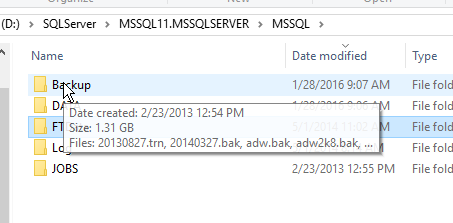
    This is a fairly simple idea, and one I’m sure many people have done in the past. Personally, I have tended to just hover a mouse over a folder when I want a size. That seems to work fairly well, but not only is it slow, it’s not programmatic.
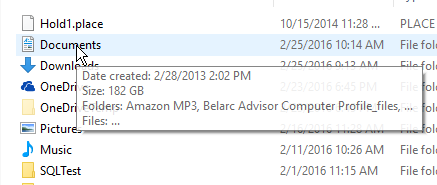
    2016-02-25 10_24_01-Settings

    I saw Jose Barreto write a quick OneDrive size script in PowerShell (PoSh), and thought it was interesting. It didn’t work for me as I’ve moved the OneDrive folder to my D: drive, so I had to alter this to get information. However in doing so, I decided to play with a function.

    Here’s the code I used, altering Jose’s slightly.

    UPDATE: Thanks to Mike Fal, one of my go-to PoSh experts, I’ve removed the aliases for Dir and %.

    function Get-FolderInfo($folder) {
    $OneDrives = $folder
    Get-ChildItem $OneDrives | ForEach-Object {
    $Files=0
    $Bytes=0
    $OneDrive = $_
    Get-ChildItem $OneDrive -Recurse -File -Force | ForEach-Object {
    $Files++
    $Bytes += $_.Length
    }
    $Folders = (Get-ChildItem $OneDrive -Recurse -Directory -Force).Count
    $GB = [System.Math]::Round($Bytes/1GB,2)
    Write-Host “Folder ‘$OneDrive’ has $Folders folders, $Files files, $Bytes bytes ($GB GB)”
    }
    }

    Note that I’ve passed in the folder name and then kept Jose’s code. This worked fine for me, as you can see below.

    2016-02-25 10_24_11-Windows PowerShell ISE

    The next step for me was to make this programmatic and useful. All that text isn’t helpful. What I really want is just a size. I guess I need a folder name as well, so I built a function to return that information. I merely changed the last line to:

      Write-Host “$GB”

    I also moved this to the end of the function, rather than for each subfolder. With this change, I can now call this for a folder and get the size in GB returned.

    2016-02-25 10_31_22-Windows PowerShell ISE

    And this checks out from Windows

    2016-02-25 10_31_16-Settings

    I know there are better ways to write this function, but this was more of a programming exercise. This was really a 10 minute chance to practice and experiment a bit with PoSh and work on skills.

    BTW, I used dot sourcing to load this as a function I could callIn love

    2016-02-25 10_33_42-Jump List for VMware Workstation Pro

  • Learning from Microsoft

    I know that many data professionals out there are skeptical of the cloud. Certainly there are problems with reliability, security, and more that prevent many of you from migrating to some online database. However that doesn’t mean that everything being done in platforms like the Azure SQL Database is a bad idea.

    One of the interesting things that has occurred at Microsoft is a completely new engineering effort for SQL Server. It seems there is one SQL Server development team that works on the Azure SQL Database. This is (I guess) the main branch in version control, and what we see with SQL Server 2016 is a subset of the code being built for the on-premises, boxed product.

    Certainly there are some features that exist in the box that aren’t in Azure, but relatively few of them. Those features, and many new ones, have to be included in the version control system, but they can’t be activated. Microsoft must be making extensive use of feature flags, allowing their developers to build and test features in the Azure cloud, but not make them available to customers, or potentially even other parts of Microsoft.

    If you really think about the effort to build a platform like Azure SQL Database and allow it to be a development environment as well as a production environment, that’s an amazing engineering effort. From the outside, I’m amazed at how far the SQL Server team has come in the last few years. I’ve seen a number of features released in the cloud first, and then appearing in the SQL Server 2016 CTPs.

    I think there are some amazing lessons here for software development. Certainly I think many of us could learn from how feature flags and multiple versions of software can co-exist in systems. That would certainly help many of us deploy new software in a way that minimizes interruptions to customers and clients. Or manage those multiple clients with different requirements from the same codebase.

    I hope that Microsoft will continue to evolve, as well as share their knowledge with the world. There are other companies that seem to be accomplishing amazing things at scale, Netflix, Amazon, Google, and more. Some of them share their techniques, but I truly hope that the methods they all use for building software become spread throughout the industry and help all of us build better, more secure applications.

    Steve Jones

    The Voice of the DBA Podcast

    Listen to the MP3 Audio ( 3.3MB) podcast or subscribe to the feed at iTunes and LibSyn.

  • Create a Database Master Key–#SQLNewBlogger

    Another post for me that is simple and hopefully serves as an example for people trying to get blogging as #SQLNewBloggers.

    One of the first things you need in a SQL Server database in order to implement encryption is a database master key, DMK. This is simple to create, though you need one in each database that will support encryption.

    The syntax is easy, with only really an option to specify a password. There is no name, as there’s a single DMK per database. Set your context to the correct database and end enter:

    CREATE MASTER KEY ENCRYPTION BY PASSWORD = ‘Som3thingR3ally$|tr0ng’;

    When you execute this, you’ll just get a result message. At least, if it works you will. The password must conform to the password requirements of your Windows OS, which is good.

    Note: This is a securable code, like the password for a user account. Make sure you store this in a password manager for your organization.

    By default, this is protected by your password as well as the Service Master Key (SMK) on your instance. In practice this doesn’t usually mean much for you, but be aware of this.

    You do need CONTROL permission on the database, though usually I’d expect a db_owner or more permissions to actually create these keys.

    And, of course, back up the key as soon as you can.

    SQLNewBlogger

    This was about 5 minutes work for me. I would guess most new bloggers could read, understand, and produce an explanation of this in 30 minutes.

    References

    CREATE MASTER KEY – https://msdn.microsoft.com/en-us/library/ms174382.aspx

    Create a Database Master Key – https://msdn.microsoft.com/en-us/library/aa337551.aspx

  • The Dangers of Algorithms

    I ran across an interesting piece in Wired recently that talks about algorithms and the power they hold in the modern world. I don’t think it’s a great piece, and it starts to mix code, data, algorithms and other aspects of modern software in a way that seems disjointed to someone that works on software. I think there is come confusion about how data and software differ.

    I don’t deny that there are potential negative impacts of the ways in which we process data. Certainly we have bugs in software that cause issues, but we also end up with implementations of specifications that may not quite match up with the expectations of our clients. Even in simple applications, if I’m not constantly interacting with a client in a detailed way, I find that the software can operate in a subtlety different manner than others expect. Of course, there are certainly people that deliberately program systems to intentionally help, or hurt, others, but I think we have just as many issues from small communication mistakes. That’s one reason why DevOps, CI/CD, and frequent releases are valuable. We get feedback quicker on the implementaiton of the design.

    Does it make sense to disclose algorithms? Make source code available for examination? I definitely think there are intellectual property issues to consider, but when there are legal challenges or arbitration, I would expect that the actual code of a system can be examined. We definitely need to ensure that code examined in these cases is not part of the public record. However there needs to be open examination in such a way that the groups involved, and perhaps even other interested parties, have confidence that the algorithm performs as expected.

    This becomes easier in databases, since our code is often easily accessible, but more complex in applications. Many of us realize that subtle changes in application code can cause issues for data, which is part of the reason we like declared referential integrity in our databases. That way we’re not affected if an application makes a mistake in enforcing our data integrity rules.

    Steve Jones

    The Voice of the DBA Podcast

    Listen to the MP3 Audio ( 2.7MB) podcast or subscribe to the feed at iTunes and LibSyn.