Author: way0utwest

  • The Years of Experience

    I heard Tim Ford say recently that the years of experience don’t matter as much as what you do with them.

    That’s a great quote. It’s also one that goes along with the idea that there is no shortage of people that mistake 5 years at a job for 5 years of experience. It’s highly likely that many people really get 6 months of experience and repeat those same skills for years, because that’s what the job requires. Unless you have a dynamic, changing environment, one that experiments and regularly looks to upgrade systems, it’s hard to get those years of experience without changing jobs.

    That’s a conundrum. Do you want to change jobs to get new experiences and grow? Some people become consultants for this reason. Others regularly look to move on to a new company, sometimes sacrificing benefits, short commutes, or something else to grow their careers. However plenty of people prefer to stick with an organization, whether that’s because loyalty, a great set of coworkers, security, or nature of the work being accomplished. Many people will stick with a job as long as they can.

    In those cases, I do believe that you can still do something with your years and grow experience. Continue to learn, experiment, and suggest changes where they fit. Learn to write the complex T-SQL that’s needed in older SQL Server 2005/2008 systems, but spend a bit of time also learning how Window functions in SQL Server 2012+ run more efficiently. Rebuild reports in PowerBI, and see if your organization can see the benefits of investing in one new thing this year. Even if your company won’t make changes, imagine what you’d do if they ever change their minds.

    Above all, practice your skills. Rewrite old processes and squeeze out more performance. Automate things in your job, whether you use PoSh or VBScript, when you can make gains in productivity, you can create time. Time that’s valuable in helping you learn. Even if you can’t get your code deployed, will will have the satisfaction of improving your skills, and knowing you can make a difference if you ever get the chance.

    I realize many of you are busy. I realize that learning about R or Kimball data warehousing might be seem to be pointless because your organization will never use the technology. I get it, and I don’t disagree. However I hope to inspire you to try to enjoy technology. Jump on Twitter with the #sqlfamily and gain some motivation with what others are doing, or have them cheer you on as you learn. You might be surprised what you can do with your years when you find something you enjoy and get support from others that share your excitement about computing.

    Steve Jones

    The Voice of the DBA Podcast

    Listen to the MP3 Audio ( 3.0MB) podcast or subscribe to the feed at iTunes and LibSyn.
  • The Writeable Warm Standby

    I saw a question recently that went like this: I get one full backup from FTP. I’ll get daily log backups through FTP after this, but never another full. I need to restore this daily log backup and allow the group receiving the database to read/write the copy, and then reset it with the new log backup overnight.

    First, this is untenable. At some point you’ll have some issue with transfer, lose a log, or the database will go corrupt. I can guanantee you that at some point you will need another full backup. Not every week, or even every month, but you will need one.

    Second, this is a tough situation. I saw some answers, which I agreed with, but I started thinking about ways to get that data moved. My first thought it use STANDBY and move the data every day to a clean database. I’ve done this before, and in the GB range, even 100s of GB, this can work. It helps if you can whack indexes and constraints on the destination, but a copy of data table-by-table goes fast.

    However then I thought about other ways. You can’t take a backup of a standby database, nor can you take a snapshot. However while searching, I saw an answer to this post on SO.

    TL;DR: copy the mdf/ldf to a new database.

    That was interesting, so I decided to test it. Turns out, it works pretty well. HOWEVER, it’s dangerous, and I think you should be very careful about this. I wouldn’t count on this being production stable, and certainly not data stable. You better have other copies of this data.

    Here’s what I did. First, create a database with some data.

    CREATE DATABASE mydb;
    GO
    USE mydb;
    GO
    CREATE TABLE mytable(id INT);
    GO
    INSERT mytable SELECT 1;
    GO
    

    Next, let’s back this up, take if offline, and then copy files.

    USE master;
    GO
    BACKUP DATABASE mydb
     TO DISK = 'mydb.bak';
    GO
    

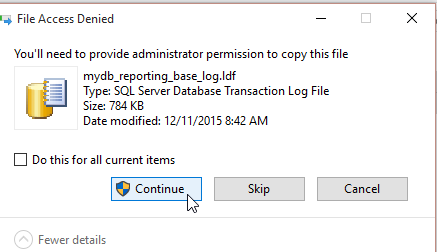
    Now we can copy the files to new files. There are UAC issues here, so you’ll need to add some rights to the files if you do this regularly. I left a comment in my script, but I actually did a CTRL+C,CTRL+V in the data folder, allowing the UAC permissions to work.

    2015-12-11 08_42_22-Photos

    Once that was done, I had new files:

    2015-12-11 08_28_15-Photos

    I tried to run at attach, but got a permissions error:

    Msg 5120, Level 16, State 101, Line 30
    Unable to open the physical file “D:\SQLServer\MSSQL11.MSSQLSERVER\MSSQL\DATA\mydb_reporting.mdf”. Operating system error 5: “5(Access is denied.)”.

    The solution I found was to run SSMS as an administrator. Annoying, but it works.

    At least for the OS error. However, then you get this:

    Msg 1824, Level 16, State 1, Line 35 Cannot attach a database that was being restored.

    You can’t do this. At least not easily.

    You can do this. First, delete the files you copied over, then run this:

    CREATE DATABASE mydb_reporting
    go
    alter database mydb_reporting set offline;

    The next step is to delete the MDF and LDF files, which will be mydb_reporting.mdf and mydb_reporting_log.ldf  by default. I could specify other names, and would if this were something I needed to script.

    Once those files were deleted, I’d next copy my files again and rename them. That would result in this:

    • mydb_reporting_base.mdf –> mydb_reporting.mdf
    • mydb_reporting_base_log.mdf –> mydb_reporting_log.ldf

    Now I can go back to SSMS. In SSMS, I do a simple ALTER.

    ALTER DATABASE MYDB_Reporting SET ONLINE

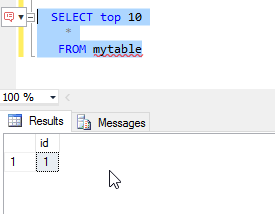
    Then I can run this:

    2015-12-11 09_03_28-Start

    I have a copy of my database. Can I apply logs and move forward? Let’s try. First, let’s add data and make a log backup

    USE mydb
    GO
    INSERT mytable SELECT 99
    GO
    
    BACKUP LOG mydb TO DISK = 'mydblog.trn'   
    GO
    

    Next we restore again. We also set the databases offline again.

    RESTORE LOG mydb_reporting_base
     FROM DISK = 'D:\SQLServer\MSSQL11.MSSQLSERVER\MSSQL\Backup\mydblog.trn'
     WITH  MOVE N'mydb' TO N'D:\SQLServer\MSSQL11.MSSQLSERVER\MSSQL\DATA\mydb_reporting_base.mdf'
        ,  MOVE N'mydb_log' TO N'D:\SQLServer\MSSQL11.MSSQLSERVER\MSSQL\DATA\mydb_reporting_base_log.ldf'
        , STANDBY = 'D:\SQLServer\MSSQL11.MSSQLSERVER\MSSQL\Backup\undo.log';
    GO
    USE master
    GO
    ALTER DATABASE mydb_reporting_base
     SET OFFLINE;
    GO
    ALTER DATABASE mydb_reporting SET OFFLINE
    GO
    

    Once again it’s file copy time. The UAC comes into play again as I copy and rename the _base files. However once that’s done, things work.

    2015-12-11 10_17_02-Photos

    This works, but I am not recommending this as something you should do, especially for critical systems. This can work, but it’s dangerous, and really not supported by MS.

  • The $90,000 Laptop

    A hospital got the opportunity to pay $90k for a lost laptop.

    There’s no excuse for this. If you have a Windows laptop, enable bitlocker today. If you have OSX, setup FileVault. If you’re on Linux, choose dm_crypt or something else. Go ahead, get that setup, save off your keys as a backup, and come back. I’ll wait.

    Now, don’t you feel better? I’m sure you do, and you are somewhat more protected from the random theft, misplacement, or loss of your laptop. All of those things happen regularly. Not to each of us, or many of us, but as the collective set of developers and DBAs around the world, we lose laptops regularly.

    Certainly some of us have precautions like never carrying data around. That’s good, and I’d recommend that. For those that need to develop on the go, they might have a curated set of test data we can use for development. That’s fine. We should make an investment in building test data and have that data used for unit, integration, and system testing.

    We should have investments in ensuring that our systems can not only be encrypted, including encryption of backups and networks, but that we can restore those systems in disasters. Make the investment in ensuring recovery, and everyone is more likely to accept encryption. We need to invest in a process for managing keys, revoking them, and re-issuing them. We need to be sure we can upgrade encryption algorithms over time. What is secure today might be easily broken tomorrow.

    I’d urge you to make all those investments, but until you do, at the very least, encrypt your laptops and desktops. While any random theft could result in a lost laptop, it’s not unheard of for anyone walking through your office to pilfer a drive lying around, or even one inside a desktop.

    Steve Jones

    The Voice of the DBA Podcast

    Listen to the MP3 Audio ( 2.1MB) podcast or subscribe to the feed at iTunes and LibSyn.

  • Graduation – An Exciting Day

    It’s quite an exciting day for me today. My oldest son graduated college this morning, finishing his Bachelor’s degree and beginning the next phase of his life.

    I’m quite proud of him and just wanted to put a few memories of him down related to data. He was the first kid in our household to seriously use a computer for school, and while his younger siblings are much more comfortable with computing than he is, we had some good times.

    • Setting up a networked computer and trying to limit access to various topics and sites on the Internet (a complete fail, BTW)
    • Reinstalling OSes for him after various viruses or other sites rendered computers unusable.
    • Discovering all my bandwidth was gone as my son found the wonders if BitTorrent.
    • Buying him a computer for Christmas, the first time I’d done that for someone.
    • Helping him learn some SQL as he studied GIS in college.

    It’s been an amazing time watching him grow, learn, and mature into an adult.