Author: way0utwest

  • Open Live Writer

    I’m writing this post from the Open Live Writer project software. I’ve used Live Writer for years, but it’s shown its age. Not the least of which is doens’t support OAuth2, so I haven’t been able to use it with my Blogger blogs.

    That should change, but we’ll see. Scott Hanselman noted there’s an open source fork of the software. I downloaded it today, and it’s slightly different, but not much. Mostly fonts from what I see.

    I may clone the project and see if I can fix things myself. There are some nagging items for me. However you should get the latest version and keep an eye on the project if you want a better blogging software tool.

  • Running Powershell with Task Scheduler

    Another post for me that is simple and hopefully serves as an example for people trying to get blogging as#SQLNewBloggers.

    One of the things I needed to do with my SQL Saturday download process was run this automatically. I don’t want to remember to do this, so I decided to set this up on a schedule.

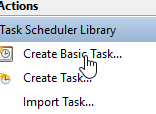
    I ran a quick search and it seemed to be a simple process. Essentially I run the Task Scheduler application and then call my script as a parameter to the PowerShell exe. The first step is to run Task Scheduler.
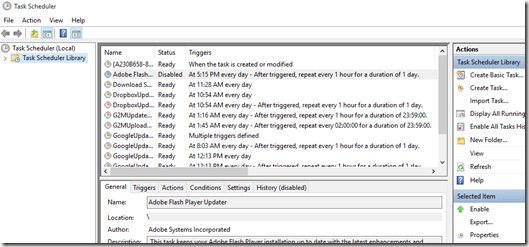
    2015-11-05 11_43_36-Task Scheduler

    This has a list of jobs, which I found some to be interesting. I disabled Adobe and a few others. Those are really annoying. I clicked "Create a basic task".
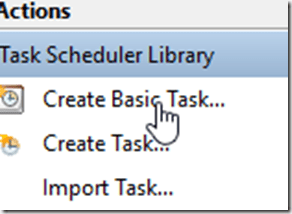
    2015-11-05 11_43_47-Task Scheduler

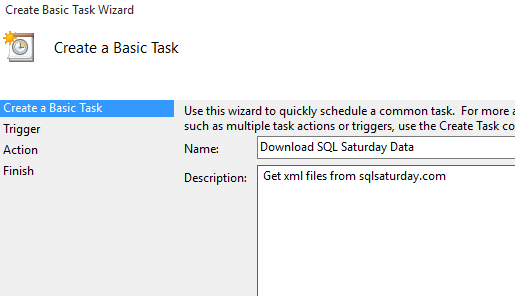
    The basic task is a wizard to walkthrough. First enter a name and description. Use something that will help you in 5 months when this breaks.
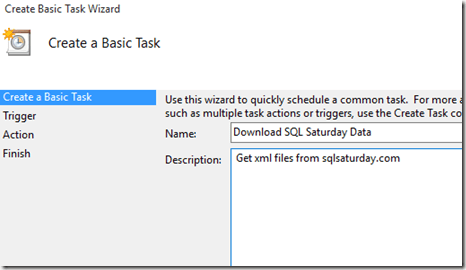
    2015-11-05 11_44_07-Create Basic Task Wizard

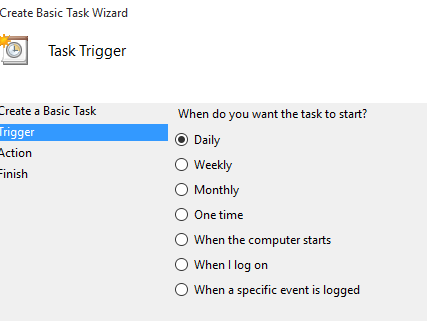
    I decided to run this daily. It’s not a big deal to me, so I’ll let it just go.

    2015-11-05 11_44_16-Create Basic Task Wizard

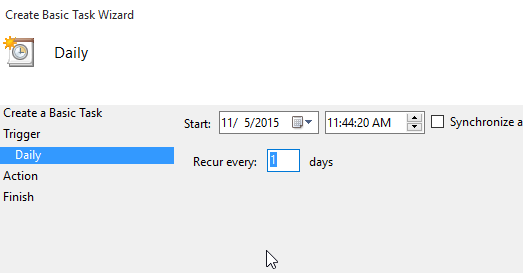
    The time doesn’t matter, and I let it run in the middle of the day. This way I might notice it running sometimes and that will motivate me to keep working on this process.
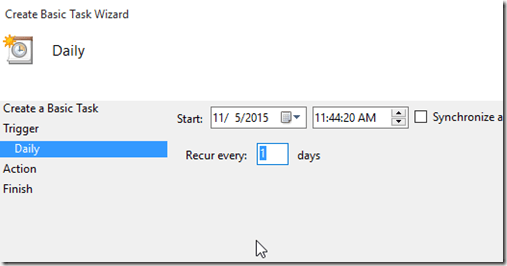
    2015-11-05 11_44_22-Create Basic Task Wizard

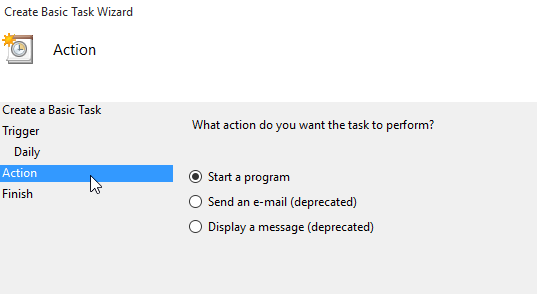
    I want to run a program, so I choose that in the next step.

    2015-11-05 11_44_29-Create Basic Task Wizard

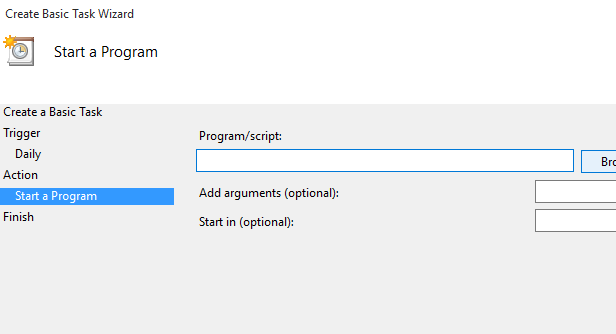
    The dialog wants to know which program. In my case, I’ll have to browse to my PoSh code.
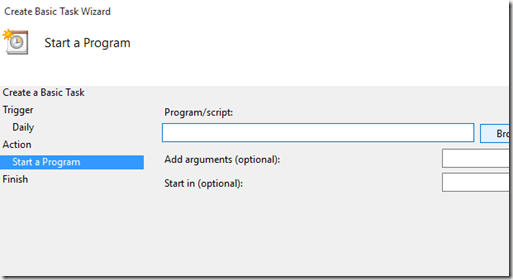
    2015-11-05 11_44_36-Create Basic Task Wizard

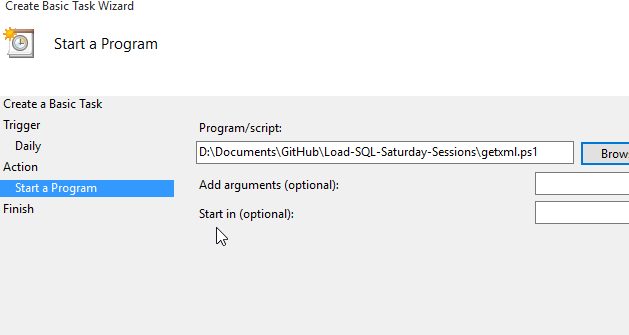
    I pick my code and it puts the path in here. However that won’t run as is. If you’ve used PoSh, you know this doesn’t work.
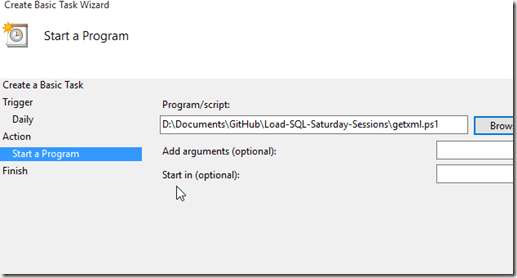
    2015-11-05 11_44_44-Create Basic Task Wizard

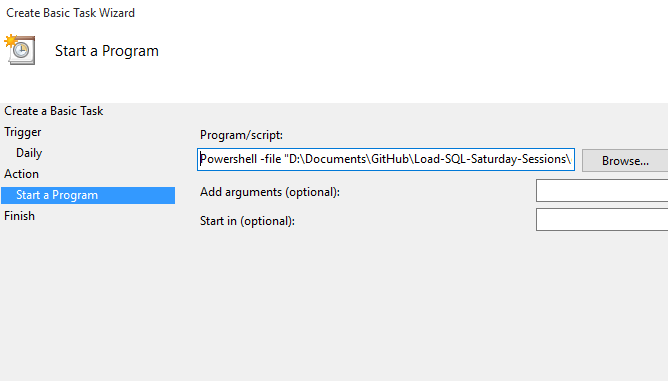
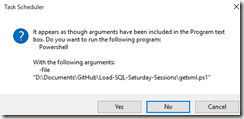
    What I need to do is call powershell.exe. I found this in the reference item below and what I do is add "powershell" to the front of my file, and then use the "-file" parameter. I also enclose my PoSh script in quotes.
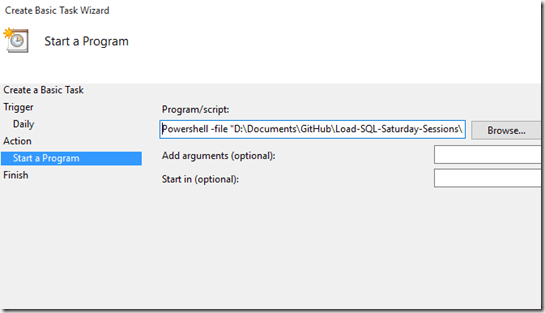
    2015-11-05 11_44_58-Create Basic Task Wizard

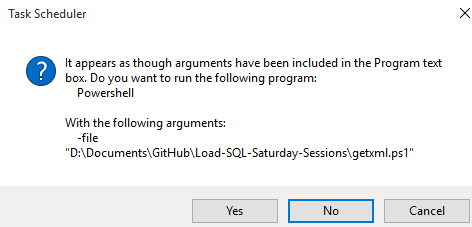
    When I click next, I get the warning, which I accept.
    2015-11-05 11_45_05-Task Scheduler

    There’s a summary after this, but I say OK to that, and then run the script from the Task Scheduler. It works perfectly, so I stop there.

    Now we’ll see how it works over time. And if I get the next step working.

    SQLNewBlogger

    This was a quick process for me. A google search, a 2 minute read, and then 2 minutes to build the task.

    It took maybe 10 minutes to write this post, most of which was taking the screen shots and resizing them.

    You can do this.

    References

    I just used one link, which was from the Scripting Guy blog.

  • An Inconceivable Scale

    One of the talks I give on SQL Server deals with unstructured data. I start out this talk looking at the scales of data we deal with and was been amazed by the research I did about how much data we humans have created. What’s even more interesting is that the growth is outracing predictions made just a few years ago.

    When I started working with computers, we talked about kb of data, thousands of characters. That’s an amount of data we humans can easily comprehend. In fact, we used to talk about floppy disks and the number of average sized books that could be stored in kb, or single digits of MBs. As humans, we can comprehend that scale. Most of us have seen hundreds or thousands of books in a library.

    When we move to GB, things get harder, though at 4GB for a DVD, many of us can conceive what multiple GBs can mean. However terabytes? Can we conceive the scale of data? Sure. A TB is about 40 Blu-ray disks. While we might not appreciate how much data that is, we can picture it.

    A PB? That’s 41,000 Blu-ray disks. I can’t even conceive of what that looks like, much less imagine the billion MB sized pictures.  That’s a scale that has no reference. However as humans, we will create multiple exabytes of data this year. As individuals working with data, few of us will work with EB in our organizations, but some of us will. I read recently that Paypal processes 1.1PB of data regularly. Regularly processes, not just has in cold storage.

    We have zettabytes and yottabytes, but who could possibly conceive of what those mean? There’s not frame of reference I can imagine, though that may change. I expect that we will become used to PB at some point, just like a TB is no big deal right now. In fact, I really think I’ll see a TB on my phone sometime before the end of this decade.

    Steve Jones

    The Voice of the DBA Podcast

    Listen to the MP3 Audio ( 2.8MB) podcast or subscribe to the feed at iTunes and LibSyn. feed

  • Building Better Communication Skills

    This editorial was originally published on Jan 11, 2011. It is being re-run as Steve is on vacation.

    I think that one of the most valuable skills that someone in technology can have is the ability to communicate with others. It doesn’t matter whether you write code, rack servers, or sit in meetings with business people, it is important that you find a way to express clearly what you want, need, or would expect from someone else. If you can’t, you will find that you often struggle to get anything accomplished in an efficient manner.

    It’s possible that you can get by with verbal communications in many instances, but it seems that so much gets done by written communications of some sort. Especially these days where it seems that so much of the interaction between people takes place through email, IM, or even Twitter. We are constantly using some form of written text to convey information between each other.

    However it seems that many people don’t place a premium on building better writing skills. When I talk to many people at SQL Saturdays, most of them are hesitant to try something like blogging. The most common complaint: I hate writing.

    But we have to do it constantly at work and working on your writing skills will not only help you to communicate better, but it will also help you learn to better organize your own thoughts. You will have a better understanding of the logical thought process, which might even help you build better code.

    Steve Jones