Author: way0utwest

  • #SQLFamily Feud

    I’ve started a new project. Actually, I started this well over a year ago, but I lost track of it and last week, despite the craziness, I was reminded of the effort and decided to get it going.

    What is the Game?

    A few of us were chatting about fun things at events and someone came up with the idea of Family Feud.  I thought it was great and started collecting questions. I then began organizing them, thinking I’d send out the list to 1000 people and get lots of responses.

    We would have the data available, and distribute it to someone at an event, such as SQL Saturday, and allow them to run a game. A game typically is two teams competing against each other, trying to give the top answers to a particular questions. Sometimes there are 4 answers, sometimes 6 or 7, but the idea is to get three of the answers for a team to win points. The first team to buzz in, or in this case, maybe signal the moderator gets to answer, each person in turn.

    Three wrong answers and the other team gets one chance to answer and win the round.

    I envision that we’d allow each group to collect points in maybe two rounds, and then we’d have a final round. The final round is one person from each team answering a set of questions. I’d say we do 5 to keep it quick. The second person doesn’t hear the first person’s answers, and together they need 200 points, with the count of survey answers matching their answers being added to each sum. Duplicates are not allowed.

    It’s a little cumbersome to explain, but watch the show on YouTube to get an idea how it works.

    Delays and Distractions

    However, I wanted to narrow the field, and didn’t want to send this in the SSC newsletter to everyone. Perhaps that was a mistake, but in compiling my list of people, I got distracted. Building a large group to email to is tedious, and despite some OCD on my part, I also have a little Short-Attention-Span-Syndrome.

    I had a soft launch last week, posting the first survey on Twitter and getting 100 responses in a few hours. That was kind of cool.

    I’ve got 6 surveys, which is a good start. I’m thinking if this works, that I’ll look to run additional surveys and collect more data that can be used in the future.

    What’s Coming?

    I am planning to randomly announce surveys on the @SQLServerCentrl and @way0utwest Twitter accounts this week to try and get more responses, but distribute them around the entire #sqlfamily.

    If you want to participate, watch out for the #sqlfamilyfeud hashtag later this week and send your answers in quick.

    If you’re an event organizer and want a copy of the datasets, feel free to ping me.
  • The Office

    This editorial was originally published on Dec 29, 2010. It is being re-run as Steve is on vacation.

    An article caught my eye. The majority of workers think they can be productive outside of an office in a survey conducted of 2,600 IT professionals. Most of the these people also said that they tended to work extra hours each day outside of the office. The majority also said they would take a lower paying job if they could access the information they needed outside the office.

    That’s actually a smaller percentage that I expected would want to work away from an office,  though more than I expected would actually take less pay to do so. As least in America, it seems that people are very concerned with their salary, and reluctant to ever take a pay cut. I’m glad it seems that some people are starting to understand that value of their time to themselves and their families.

    It’s hard to work at the office, as Jason Fried said recently in a TED Talk. I haven’t worked in an office in some time, but I do remember a constant stream of interruptions. An hour of time without someone talking to you was rare, and I assume that the situation is similar with many knowledge workers today. We have people that we pay to think, and solve problems, but we don’t give them the time to actually work on those problems.

    Steve Jones

  • Puzzled by T-SQL

    Live blogging this a bit as I try things. This will update a bit, so you’ll have to read through.

    Adam Machanic posted this: T-SQL Puzzle-How many rows will this return? SELECT*FROM(VALUES(1),(2))AS x(i)WHERE EXISTS(SELECT MAX(i)FROM(VALUES(1))AS y(i)WHERE y.i=x.i)

    I was in a doctor’s office waiting at the time, but I responded that I didn’t think one row was right. I didn’t have the chance to see what happened, so I couldn’t reason through what was happening. Maybe I should have been able to? Not sure.

    I got home and ran this (thanks, SQL Prompt):

    SELECT
         *
       FROM     ( VALUES ( 1), ( 2) ) AS x ( i )
       WHERE     EXISTS ( SELECT  MAX(y.i)
                        FROM
                        ( VALUES ( 1) ) AS y ( i )
                   WHERE
                     y.i = x.i );
    

    I get two rows back, a 1 and a 2. Very strange.

    I tried experimenting a bit. I created tables and put data in there. Maybe there’s something I don’t get in the VALUES() clause.

    CREATE TABLE mytable99 (id INT);
    CREATE TABLE mytable999 (id INT);
    GO
    INSERT dbo.mytable99
    ( id )
    VALUES
    ( 1 ), (2);
    INSERT dbo.mytable999
    ( id )
    VALUES
    ( 1 )
    ;
    GO
    SELECT
    *
    FROM
    dbo.mytable99 AS x
    WHERE
    EXISTS ( SELECT MAX(y.id)
            FROM dbo.mytable999 AS y
            WHERE y.id = x.id );


    Same result.

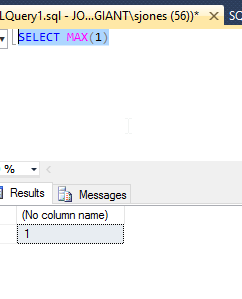
    Hmmm, Adam added a clue. Why does select max(1) work?

    2015-12-03 13_43_15-Photos

    I was guessing that max() operates on the scalar set of [1]. However I’m not sure.

    I then did this:

    UPDATE dbo.mytable999 SET id = 9;
    

    When I re-ran the query, still two rows. Without a match.

    Next I added another row to the first table.

    INSERT dbo.mytable99
    ( id)
    VALUES
    ( 3 );
    

    Now I get three rows.

    What I’m guessing (at this point) is that the correlated subquery returns a 1 for every row of the first table, so this means I get the size and shape of that table. The EXISTS() is always satisfied.

    I’ll be interested to learn what is happening, or if I’m right.

    Update: I’m not.

    Or semi-right.

    The exists is satisfied, but why?

    Adam posted a second hint asking me to remove the max(). I did that and got 1 row. Well that’s interesting. How does the aggregate affect the correlated subquery, and how does this affect the Exists().

    I decided to break down the query inside the EXISTS(). I did this with scalar values. Since I’ve been dealing with two rows, I used those two scalar values.

    	 SELECT
                    y.i --MAX(y.i)
                  FROM
                    ( VALUES ( 1) ) AS y ( i ) 
    			  WHERE
                    y.i = 1 ;
    
    	 SELECT
                    y.i --MAX(y.i)
                  FROM
                    ( VALUES ( 1) ) AS y ( i ) 
    			  WHERE
                    y.i = 2;
    

    With these queries, I get one row and zero rows, just an empty set. That makes sense in terms of why removing the MAX() gives me one row in the whole thing.

    Next I added the MAX back.

    	 SELECT
                    MAX(y.i)
                  FROM
                    ( VALUES ( 1) ) AS y ( i ) 
    			  WHERE
                    y.i = 1 ;
    
    	 SELECT
                    MAX(y.i)
                  FROM
                    ( VALUES ( 1) ) AS y ( i ) 
    			  WHERE
                    y.i = 2;
    

    Now I get one row for the first, and one row for the second? Huh? However the second set is a row with NULL in it. I checked the EXISTS() documentation, and sure enough, if there are rows, this returns true, even if the row has a null value. This isn’t the value of a row, but rather just its presence.

    I then did this to check:

    SELECT 'test' = 1
     WHERE EXISTS( SELECT * FROM mytable WHERE 1 = 0);
    
    SELECT 'test' = 1
     WHERE EXISTS( SELECT null);
    

    Sure enough, the first gives me an empty result set, while the second doesn’t.

    But why does MAX() return a row? I tried this with a simple query:

     SELECT MAX(i)
      FROM ( VALUES (1)) AS x(i)
      WHERE x.i = 2

    Which does return NULL. I did search and saw this explanation on SO, saying that the result of the MAX() for the group (where x.i=2) is undefined, hence the NULL. This is born out as you see here:

    CREATE TABLE mytable88(i INT);
    GO
    SELECT MAX(i) FROM dbo.mytable88 AS m;
    

    Strange. Certainly I wouldn’t have expected that from MAX(). I would have thought it was an empty set, but apparently that’s not the case.

  • What is DevOps?

    There is a lot of confusion in the world about DevOps. Some of that might be because the concept hasn’t been well defined, or implemented, in many organizations. It might also be because other companies have been running as DevOps organizations for years without having a name for what they did and no good way to talk about their practices as a whole. Plenty of those efficient organizations resent having DevOps presented as a “new” idea when it’s been their modus operandi for years.

    I an across a primer on DevOps that I thought was a good explanation for management. It’s not perfect, and the piece minimizes the problems of changing culture and attitude. There is an emphasis on breaking down barriers and silos, but no discussion as to how managers should do this. I think most people expect managers to know how to get teams to work together, but in practice, I have found few managers that could do this.

    There is no magic to DevOps. There isn’t a tool you can buy, or a consultant that you can hire to implement it. All you can do is get help and guidance in helping your staff to learn to work more closely together. Developers have to learn to consider the operational impacts of their work, while formalizing some of their processes. They need to automate their testing, but also the packaging and installation of their software, while working in standardized environments. Operations is the flip side of this, in that Operations staff must be responsive and quick to build the standard environments developers need. They must work with developers to feedback issues and requirements from Operations to the developers, including bugs that can be caught with changes to the automated testing processes.

    DevOps is about working together. With respect and professionalism, but also the attitude that we can help each other do our jobs better. This impacts our compensation and reward systems, as well as organizational structures. I wouldn’t underestimate the impact this has on the way an IT department works, but I also wouldn’t be afraid of the changes. However I would move slowly, evaluating the impacts as processes change, and working to assuage the fears and concerns of your staff.

    Ultimately DevOps, in my mind, isn’t about saving money or getting software build faster. It’s about working together to become more responsive to our clients as our software becomes ever more important to them.

    Steve Jones

    The Voice of the DBA Podcast

    Listen to the MP3 Audio ( 3.1MB) podcast or subscribe to the feed at iTunes and LibSyn.