Author: way0utwest

  • SQL Source Control and Git–Getting Started

    It seems as though Git is taking the world by storm as the Version Control System (VCS) of choice. TFS is widely used in the MS world, but Git is growing, Subversion is shrinking, as are most of the other platforms.

    As a result, I wanted to do a quick setup using SQL Source Control (SOC) and Git, showing you how this works. SOC supports Git in a few ways, so this is the primary way I’d see most people getting started.

    Update: Since this was published, the SQL Source Control team released an updated version (v4.1) with support for Git that allows push/pull within the client. I’ve got an updated post here.

    Scenario

    Here’s the scenario that I’ll use. I’ve got a database, WindowDemo, that has a few tables, some data, and a few procs. As you can see below this isn’t linked to a VCS.

    2015-09-24 16_34_56-Cortana

    I want to store my DDL code in c:\git\WindowDemo\trunk. I’ve got that folder created, but it’s empty. I’ll keep related database stuff (docs, scripts, etc) in c:\git\WindowDemo if I need it.

    2015-09-24 16_37_36-Photos

    Git Setup

    The first thing you need to do is get your Git repository setup. There are many ways to do this, but I’ll use the command line because I like doing that. The commands in the various client GUIs will be very similar.

    I’m going to set the git repository here at c:\windowdemo to keep all my database stuff in one place. To setup the repository, I run a git init in the command prompt. This initializes my repository.

    2015-09-24 16_41_02-Photos

    Now I have a git VCS, I need to get code in there.

    SQL Source Control Setup

    Now I move to SSMS to link my database to the repository. In SSMS, I right click my database and select “link database to source control”.

    2015-09-24 16_42_27-Start

    This will open the SOC plugin on the setup tab. I’ve filled in the path to the place in the repository I want the code to go. This is the trunk folder. I’ve also selected Git, using the “Custom” selection on the left and Git in the dropdown.

    2015-09-24 16_43_54-Link to source control

    Once I click the link button, I’ll get a dialog showing progress and then return to the setup tab.

    2015-09-24 16_44_15-Start

    Notice the balloon near the top. This lets me know the link is active and I have changes in my database that aren’t in the VCS. There’s a pointer to the “Commit changes” tab, so I’ll click that.

    2015-09-24 16_48_00-New notification

    In the image above, I see I have a number of “new” objects from the perspective of the VCS. I can see the name, and the type of object in the middle. At the bottom, I see the version in my database (highlighted code) on the left and the version in my VCS (blank) on the right.

    This is where I commit my changes. I enter a comment at the top and click the “commit” button on the right (not shown). When I do that, I’ll get a clean “commit tab” that shows that my VCS is in sync with my database DDL.

    2015-09-24 16_50_18-SQL Source Control - Microsoft SQL Server Management Studio

    Inside Git

    What’s happened in my VCS? Let’s look in the file system. Here I see my trunk folder.

    2015-09-24 16_51_49-Photos

    SOC has created a structure for my DDL code and included some meta data. If I look in one of these folders, such as Stored Procedures, I see
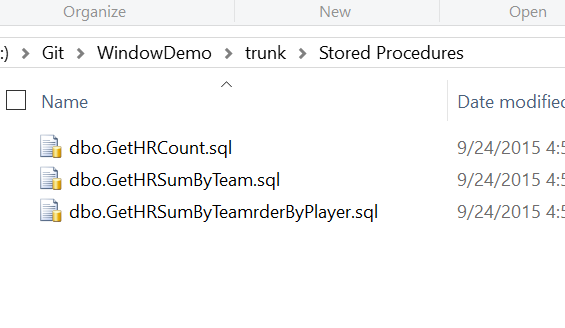
    2015-09-24 16_58_56-Photos

    This is the .SQL code that matches what’s compiled in my database. SOC stores the current CREATE statement for all my objects so that they can easily be examined.

    Inside Git, I see a clean status with all my files as committed objects.

    2015-09-24 17_02_57-Start

    This is what I want. Now I can continue on with database development, tracking all my changes. I’ll look at the flow and tracking changes in another post.
  • The Work of the Ancients

    I was reading a post from someone recently where they noted that they didn’t worry to much about the architecture of the system since it wouldn’t likely last very long. The poster had a comment that many systems are replaced inside of a few years.

    In my experience, that’s not usually the case. In fact, while I don’t expect many applications I’ve worked on to last for 25 years, I suspect many of them will exist for ten years or more, especially if they are receiving regular development resources. With that in mind, I wanted to see how your databases are faring these days. I suspect a database might last longer than a particular application, as it seems most organizations are loathe to ever let data go.

    What’s the age of your oldest, regularly used database?

    I’m looking for an age in years. If the answer is less than one, I’m not sure I’d call that old at all. I am sure many of your  systems are older, and might have changed, but let us know the year when the system went into production.

    I can tell you the SQLServerCentral systems are old in some ways, not so old in others. We’ve grown from one database to three over the years. The oldest database is circa 2003. Some of the data from that one was migrated to other databases around 2007. We’ve got data in the system since 2001, but we’ve certainly changed structures and storage over the years.

    I’d guess that most of you that are working in companies that are older than ten years will have a database that’s at least that old. However let us know this week, and if you have any interesting notes, feel free to share them.

    Steve Jones

    The Voice of the DBA Podcast

    Listen to the MP3 Audio ( 2.4MB) podcast or subscribe to the feed at iTunes and LibSyn.

  • Standing Desk Update

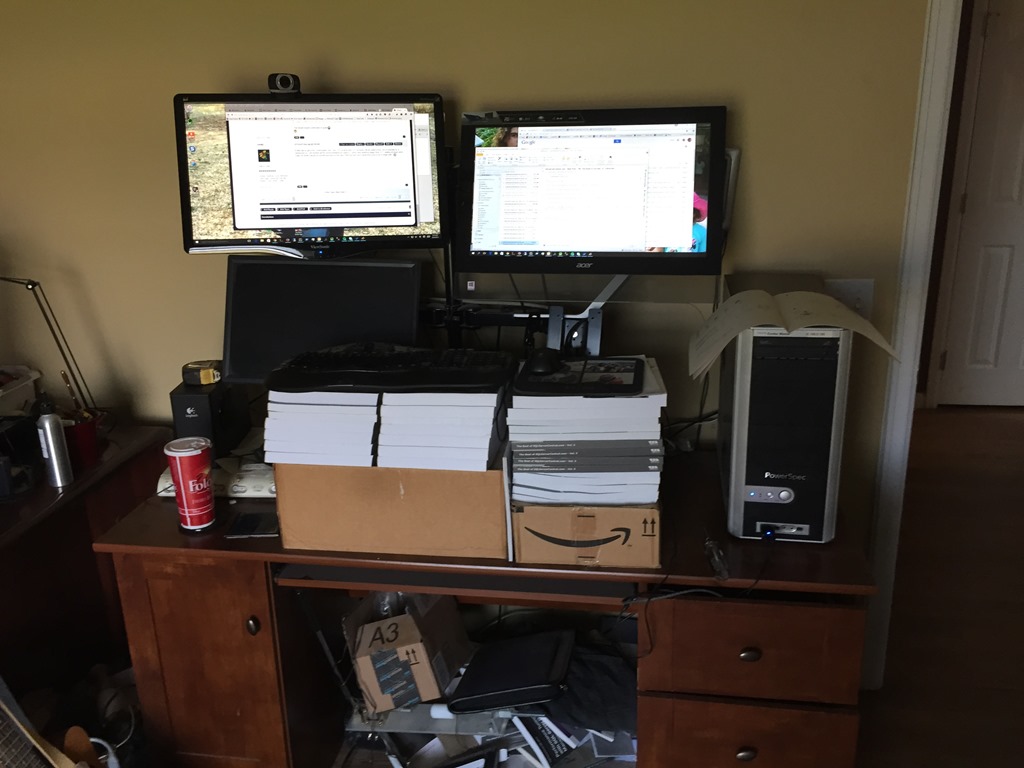
    It’s been a long time since I wrote about my workspace, however I made a change recently. This was the "short term test" situation I set up a couple years ago:

    Photo Aug 24, 9 14 19 AM

    After just using boxes for a few days, I decided I liked things and got monitor stands. However I left my boxes in place for the keyboard and mouse. Mostly because I wanted a few months of playing with heights.

    I actually did experiment, adding and removing books a few times, but mostly I let things languish. I wanted to build my own keyboard stand, but kept finding excuses. I lived with the setup, getting annoyed with no good place to place a mug of coffee or a piece of paper. Precariously balancing my laptop on the books at times.

    A few weeks ago I saw some friends on Facebook mention they were getting standing desks. I’d seen Brent Ozar’s desk, but had no desire to spent that kind of $$. I wasn’t even sure I wanted an adjustable one as when I sit, I usually go to a table or couch with my laptop.

    Someone recommended a simple desk, which I liked, but wasn’t sure I wanted to ask my boss for $700 for a hand crank desk. However I did spend a few minutes shopping when my daughter asked for a desk for her room. She got a normal desk from Ikea as she’s starting high school and wanted a workspace.

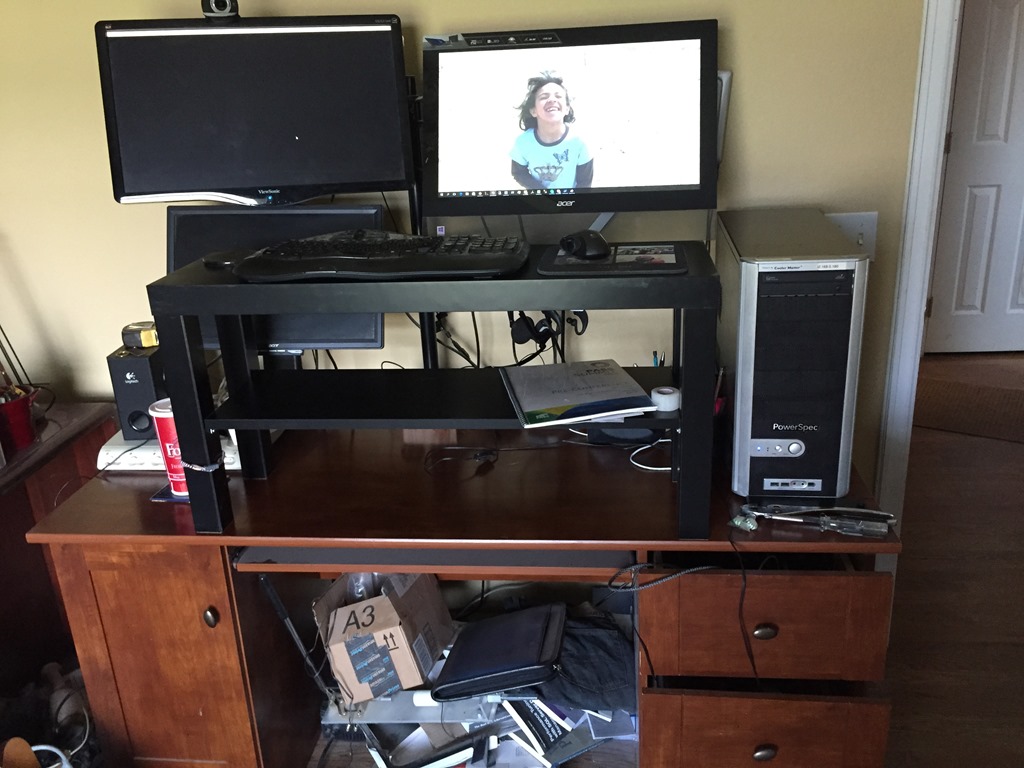
    I saw a $400 electric adjustable one, and was tempted, but decided to go for a $40 upgrade for mine. I got a small table, and added it.

    Photo Aug 24, 10 43 42 AM

    This one isn’t perfect as it’s a touch high. I did add a couple more foam mats and raised myself to a good level, but I’m not sure I love this.

    I do, however, like the extra shelf and space for putting a couple mugs down. I usually have two (coffee and water), so this is handy. I also have space for a few pieces of paper if I need to set them down.

    I’m not sure if this is a good move. For now I want to leave things alone as I’m not in a hurry and want to be sure I would use an up/down desk. I certainly have some tasks that work better sitting down, like webinars, so I am tempted to get a chair and work here at times.

    The one good thing I have going for me is Redgate is good about ergonomics and ensuring a good workspace. I am tempted by the treadmill desks, but I think I’d just as soon just walk away from the desk if I need a break.

  • Have a Think

    I’m used to working at a chaotic pace. I have lots of diverse projects and deliverables that constantly force me to change my focus. I have short term and long term projects. I work with diverse technologies. My workload is a mix of development and administrative tasks. It’s a hectic schedule that gets worse when I travel since SQLServerCentral must continue to run.

    Years ago I was struggling with daily deliverables, the bimonthly SQL Server Standard magazine, and a couple book projects a year. It was maddening, especially when my business partners also wanted me to experiment with ways to grow our business. I wondered, how would I ever find time to dream up new ideas or implement a proof of concept.

    Andy Warren helped me slow down by scheduling “thinking time.” He told me it was important, and he had to make some at his job. Carve out an hour once a week or so and just spend time thinking about a project. Don’t do; just think.

    I have kept that advice in mind over the years, and I try to take some time to just think about the tasks I need to accomplish. I don’t worry about actually getting anything done, but instead try to just think about the best way to move forward. I don’t always succeed, but I continue to try to make time and just think.

    Whether you run a business or just write code for one, I think the art of stopping and thinking is a bit lost. So few of us actually stop to spend some time planning. Instead we’re very quick to start writing code or trying out a configuration change. While I am a proponent of experimenting, I still think it’s worth taking a few minutes and just consider different ways to experiment. Often we can choose better experiments if we have a plan.

    Try it this week. Take ten or fifteen minutes and think about the next task rather than diving right in. You might find it to be a more valuable tool than just experimenting.

    Steve Jones

    The Voice of the DBA Podcast

    Listen to the MP3 Audio ( 2.7MB) podcast or subscribe to the feed at iTunes and LibSyn.