Author: way0utwest

  • SQL Data Generator–Masking Production Data

    This is a series on SQL Data Generator, covering some interesting scenarios I’ve run into. If you’ve never tried it, SQL Data Generator is a part of the SQL Toolbelt. Give it a try today with an evaluation today.

    I learned a new trick with SQL Data Generator that I wasn’t aware of previously. I think this is a good idea for masking some of that production data that you might not want developers to have.

    Let’s start with a production table. In my case, I’ve created a Sandbox_Prod database with a table in it for employees. I’ve added a few records that contain some sensitive information.

    CREATE TABLE Employees
    (
    empid INT IDENTITY(1,1)
    , EmployeeName VARCHAR(250)
    , EmpployeeEmail VARCHAR(250)
    , active TINYINT
    , salary money
    , pwd VARBINARY(max)    
    )
    ;
    GO
    INSERT INTO Employees
    VALUES  ( 'sjones', 'sjones@sqlservercentral.com', 1, 10000, ENCRYPTBYPASSPHRASE('The User Sample', 'MyS%83ongPa44#word')) 
         ,  ( 'awarren', 'awarren@sqlservercentral.com', 1, 20000, ENCRYPTBYPASSPHRASE('The User Sample', 'Ano$2therS%83ongPa44#word') )
         ,  ( 'rsmith', 'rsmith@sqlservercentral.com', 1, 5000, ENCRYPTBYPASSPHRASE('The User Sample', 'Kedj93m@@83ongPa44#word'));
    
    GO


    I’ve got a second database, called Sandbox, that simulates my development environment. I’ve got the same table, but without any data in it.

    What I want to do is move some of the production data to my development area, but not all of it. Some of the production data needs to be masked.

    SQL Data Generator Sources

    I can use SQL Data Generator from Redgate to do this, by using a data source that actually exists. In this case, I’ll create a new project and point it at my Sandbox database. I’ve deselected all of the tables except my Employees table.

    2015-09-22 16_31_57-Cortana

    When I pick my Employees table, I see the familiar generation screen on the right. Most of you are like me and notice the number of rows and the option to delete data.
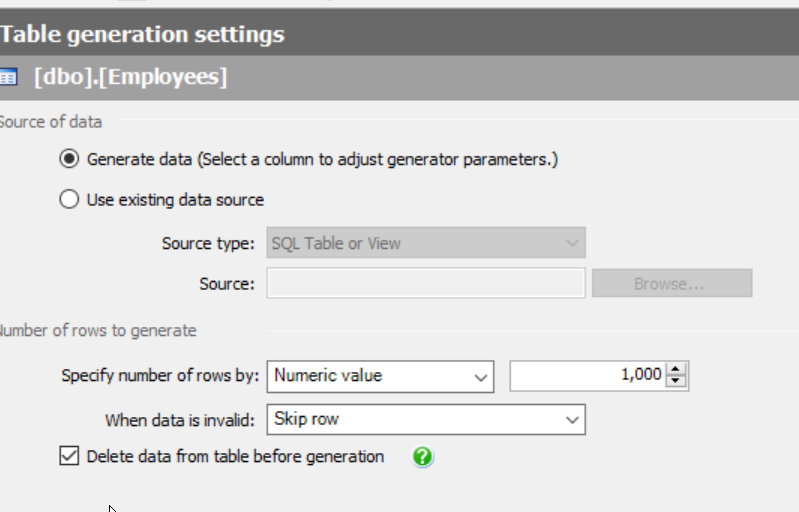
    2015-09-22 16_32_54-SQL Data Generator - New Project _

    However there’s another option. I can select the “Use existing data source” radio button instead. When I do this, I have a few choices for data. I can use an existing table or a CSV file. Both of those can be good choices, especially if I have sets of data I want to load into the table. Either one can help me to build known, specific data sets for development (or testing).
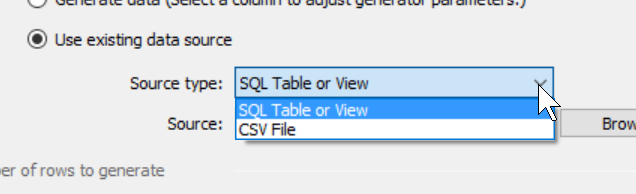
    2015-09-22 16_35_19-SQL Data Generator - New Project _

    In my case I will choose an existing table. When I do this, I click the “Browse” button and I get a connection dialog for SQL Server. I pick my instance and the production database.

    2015-09-22 16_35_26-SQL Data Generator - New Project _

    I click “Next” and then get the chance to select the table to use. In this case, I’ll pick the Employees table.

    2015-09-22 16_39_03-Select SQL Table or View

    When I return to the main SDG screen, I see the table listed as the source, but my preview shows the actual production data. This is because I’ve mapped the production table as a source, and it will be used as it currently exists.

    2015-09-22 16_40_12-New notification

    That’s not what I want. I want to mask the email address and the salary. However, now I can change things like I might do for any random data generation.

    Let’s first click in the EmployeeEmail column. When I do that, I see the following, the column with its source set as the existing column in the production table.

    2015-09-22 16_59_52-SQL Data Generator - New Project _

    However the drop down gives me lots of choices, including an Internet email generator.

    2015-09-22 17_00_07-

    If I select, then my preview changes. Now the image below shows production data for all columns other than the email.

    2015-09-22 17_01_23-New notification

    I can repeat this for the salary (and password to be safe). When I do that, I’ll see random data for those columns and production data for others.
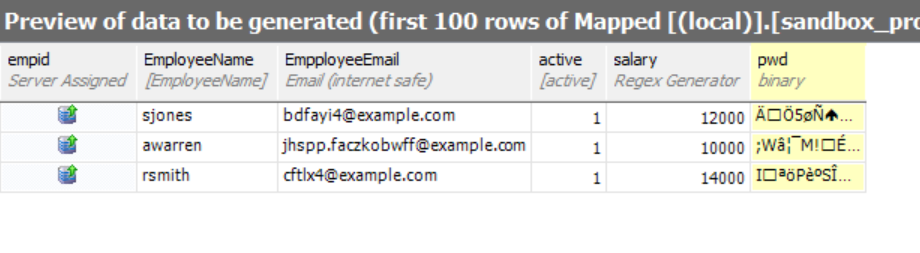
    2015-09-22 17_03_26-New notification

    I can repeat this for all tables in my project, mapping through data that isn’t sensitive, and masking data that is. It’s a tedious process, but it’s a one time process for specific data. Once this is done, every restore can have the project run and the data masked. If production DBAs do this refresh, then developers never see sensitive information

  • Are you a Data Scientist?

    It seems that there’s no shortage of re-branding attempts being made in all industries and by all types of people. I still remember when most of us were called computer programmers instead of developers. Not many people writing C# or Java code would want to be called “programmers” today.

    One of the latest fads is the call for more data scientists to work on big data, another equally, poorly defined term. However it seems that he definition of what a data scientist is has been so ill defined that almost anyone that can write a query using aggregates might define themselves as a data scientist.

    A good thing if you are looking for a job. Many of you might find opportunities (and raises) if you convince a hiring manager that you are a data scientist. However I’d be wary of living on just the new brand without growing your skills. If your company comes to expect more, especially with regards to advanced statistical analysis, you might find yourself in a bind.

    I ran across a piece that looks at the skills that a data scientist might actually need. I don’t know how many managers might understand the difference between simple discrete rules engines and more subtle, complex, multi variable, adaptive algorithms, but there can be a big difference in how well the system actually performs for your company.

    No matter what you choose for your carer, I’d certainly encourage you to continue to learn more about how to work with data. Whether you want to learn more about statistics, pick up R, or improve your visualization skills. Keep Learning. Keep your brain active and work to improve before you find yourself without a job and in need of training. Every little bit you learn helps and the practice of continuous improvement builds a habit that will serve you well over time.

    Steve Jones

    The Voice of the DBA Podcast

    Listen to the MP3 Audio ( 2.7MB) podcast or subscribe to the feed at iTunes and LibSyn.

  • Congrats to Jen, Tim, Ryan, and Argenis

    Last week we received the results of the PASS Board of Directors elections for 2015. Jen Stirrup and Tim Ford were re-elected to new terms. They’ve served for the past few years as members of the BOD. Ryan Adams was elected for the first time, and I supported his candidacy, so I’m glad he won.

    Argenis Fernandez didn’t get elected, but I still applaud his decision to run. He was one of only four out of the thousands of PASS members that did so. However in reading Andy Warren’s notes, perhaps Argenis will end up being on the board anyway.

    If that’s the case, I’m glad. I think Argenis brings a fresh, new, different view, which is needed.

    In any case, I’ll publicly thank them here, and in person when I see them, as their volunteerism should be appreciated and acknowledged.

  • No Time for Testing

    There is a bit of a rant from John Welch on testing your data manipulation that I like. I think some of the impact is lost because the end shows an advertisement for a product that helps here, but the points made are good. We all want to test, we think it’s hard, we don’t have time, and our businesses live with the issues from limited testing.

    I’m not a fan of Test Driven Development, as John is. Usually this is because I’m not always 100% sure of the results I want or have been given. I’ve often been given a request to do x and as I get involved, I find that the requirements might be incomplete, or even wrong, and they’ll change. As a result, I like to write a little code, get some idea of what I want to return or change, and then write a test that verifies what I’ve done is correct.

    It’s a subtle difference, and maybe I’m doing TDD in the wrong order, but I like to get code, test it, then think about potential issues (which I might find as I write code) and write a few tests for the things that I’ve missed.

    However I do believe we need to test our code. We all do test our code, even if it’s with a few before/after queries. What I don’t get is why we don’t just mock up a quick test that we can run in an automated fashion. It’s not much more work, and then we can more easily re-run the test later to ensure any refactoring or optimizations we make continue to work as expected.

    Steve Jones

    The Voice of the DBA Podcast

    Listen to the MP3 Audio ( 2.1MB) podcast or subscribe to the feed at iTunes and LibSyn. feed