Author: way0utwest

  • PostgreSQL v SQL Server

    A site that’s a comparison of the platforms.

    http://www.pg-versus-ms.com/

    Certainly some good arguments being made, but (admittedly) biased towards specific workload items that the author uses.

    However, I agree with lots of the items listed. There are quite a few items, such as 1.1 and 1.2. Not having 1.5 is stupid silly. I know I can write a CLR assembly and stick this in here, but why hasn’t it just been included? 1.6 is interesting for sure and as someone that lives in BOL, it is very frustrating.

    Without a doubt there are some cumbersome things in SQL Server that I think could be made much, much easier. However, as pointed out numerous times, MS is concerned about money, and not necessarily making the product better.

    I don’t agree with the Linux v Windows debate. Lots and lots of people run Windows and the latest surveys I’ve seen of servers from automated places show Windows as close in terms of numbers.

    I’m also not sure some of the BI stuff matters a lot in a general comparison, but if that’s what you do, then this is interesting. I’d also point out that since MS is trying to move into these areas, some of these things are being addressed. SQL Server 2016 will support JSON and R.

    Enjoy the read. Don’t get too wrapped up in the details, but certainly if you think some of these items are important, let MS know.

  • Why Test Table MetaData Tests with tSQLt

    I wrote at SQLServerCentral about using tSQLt to check table metadata. In essence we are testing the API of our table. However, since the table could change, and may need to, what’s the value of having a test fail if the table changes?

    In my mind, I don’t necessarily want to have table structure tests for all my tables. After all, developers need to have flexibility to work with and change tables in our applications. If it’s a pain for a developer to change every table, because a test fails and they have to go change the test, that’s an issue.

    There’s also the problems of a developer changing a table, changing the test, and then having everything pass, without passing along information that a schema change was made.

    I would limit the API tests for a metadata to those tables that are important, with the caveat that anytime someone fails a metadata test, they need to inform the team.

    But Steve, isn’t every table important?

    Yes and no. Certainly all tables should be important to the application in some way, but really many of them are contained in the application. If changes are made, it’s not necessarily a problem to change other objects to catch up to the table change. However, some tables may cross teams or applications and they are an issue.

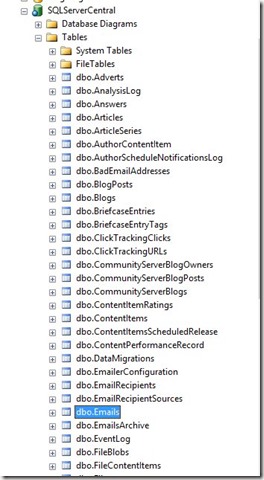
    As an example, I have lots of tables in the SQLServerCentral database.
    tablemetadata_1

    If the Blogs table, or the Articles table changes, then we need to alter stored procedures and possible ASP.NET code for our application. In fact, in this list, pretty much all of these tables could be changed by a developer without a large impact, assuming they’re going to look at the other objects or code affected.

    However the table highlighted, the emails table, along with a few others, are important. These tables not only support SQLServerCentral, the web app, they are also called by our emailer process, which is a completely separate application. In essence, these tables are the opposite of a microservice. They’re shared.

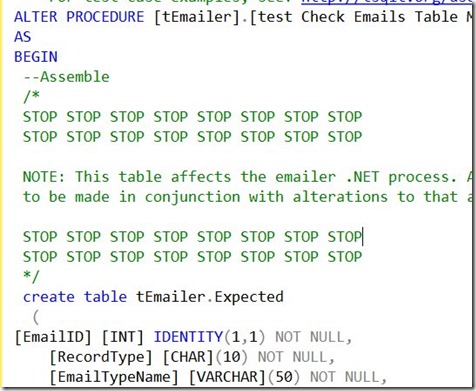
    If someone wants to change the Emails table, I want to be sure that others are informed. In fact, I might choose to include a note in the test header that various groups need to be informed or that the table affects another application. In that case, before a developer went to change the test, they might at least have a chance or noting this has far reaching implications.
    tablemetadata_2

    It’s not a perfect solution, but it does help. The other thing I could do is limit access to metadata tests for various tables/views and merely call these tests in a CI, or other automated, process. That way failures would be public, and a variety of people could be informed, preventing a developer from making changes without a discussion.

    As I mentioned, I wouldn’t do this for all tables. In fact, I’d limit this to particularly sensitive tables that might require lots of rework if they were changed. We want to speed development, and ensure code works, not slow developers down.
  • Boring or Scripting

    Do you want to continue to perform boring, repetitive, mundane tasks as a part of your job? Many of you might not be challenged at work, or you might be burdened with a series of requests that repeat themselves over and over. They’re easy tasks, many of them probably take minutes. I’m sure there’s also a level of mindlessness that you find comforting at times with just working through a familiar task.

    However many of you also get busy. You have no shortage of new tasks that get assigned to you on a regular basis. You probably also get stressed from your heavy workload at times. What do you do when you’re too busy to work through the mundane tasks, but they still need to be done? It can be a challenge to manage that burst in a workload if you haven’t prepared for it.

    There is a way to remove some of the mundane administrative work from your job. It’s not simple, and it’s not going to solve all your issues right away, but over time, you can certainly reduce the burden of working on dull tasks over and over again, across multiple machines.

    Learning PowerShell (PoSh) or some other scripting language. VBScript works fine, as does Perl, and there are others, but if you’re a Microsoft person, especially a SQL Server person, learn PoSh. It’s used in all the products, it’s becoming a standard for all Microsoft products, it works in the cloud, and it works with SQL Server. It takes some getting used to, and it certainly can help with repetitive tasks. It can also run all your SQL scripts for you, just in a more automated fashion.

    You can grow your career, add a new skill, reduce your workload, and become more efficient at your job.

    Or continue to be boring.

    Steve Jones

    The Voice of the DBA Podcast

    Listen to the MP3 Audio ( 2.3MB) podcast or subscribe to the feed at iTunes and LibSyn.


  • Awareness

    How often have you been caught off guard by some issue with one of your databases? I would guess most people have received a phone call, email, or trouble ticket that alerts them to the fact that something has gone wrong. A few of you might have even had an irate customer or manager wander over to your desk and loudly inform you of an issue. Those are not great times, and most of us would prefer to find out about problems before others bring them to our attention.

    This past week was the 66th T-SQL Tuesday blog party. If you haven’t heard of it, I would encourage you to look each month for the announcement on Twitter and participate. It’s a great chance to share some knowledge, and showcase your own experiences or viewpoint on a particular topic. I’d actually encourage all of you to go back and write posts about the past topics at some point. It’s a great way to challenge yourself to document your own experiences in a concrete way.

    The theme this month was monitoring (thanks to Catherine Wilhelmsen b | t), and this is exactly the way that you build awareness in your environment. Monitoring allows you to ensure that you, as the DBA, learn about issues, or potential issues, first. Monitoring doesn’t solve your problems; that’s up to you to do, but it can help you proactively detect issues early and perhaps mitigage them before users notice them.

    The blog entries this month cover all sorts of issues that you might think about watching for. The 825 errors in your log, metadata about your backups, jobs, and more. There’s a variety of posts that cover all sorts of home grown systems, as well as noting that third party products work well. You have a huge variety of choices, from building your own tools and processes or purchasing something like SQL Monitor from Red Gate. However no matter what your budget, resources, time, desire, and more, I’d highly recommend that you really think about ensuring that you are monitoring your systems in a way that lets you know how things are working.

    What to do when they’re working poorly, that’s up to you. Hopefully the information we publish at SQLServerCentral, and the links we send out every week from Database Weekly, can help you learn to be better at your job.