Author: way0utwest

  • Quick Installs with Chocolatey–Screen Capture

    I have been looking for a new screen capture tool. I used to use Snagit, but it felt too heavyweight and buggy for me. I just need to snag part of a screen for my job and blog. I used Quick Screen Capture, but in Win 8 it didn’t want to accept my license key. I’d tried a few more, but none really worked well.

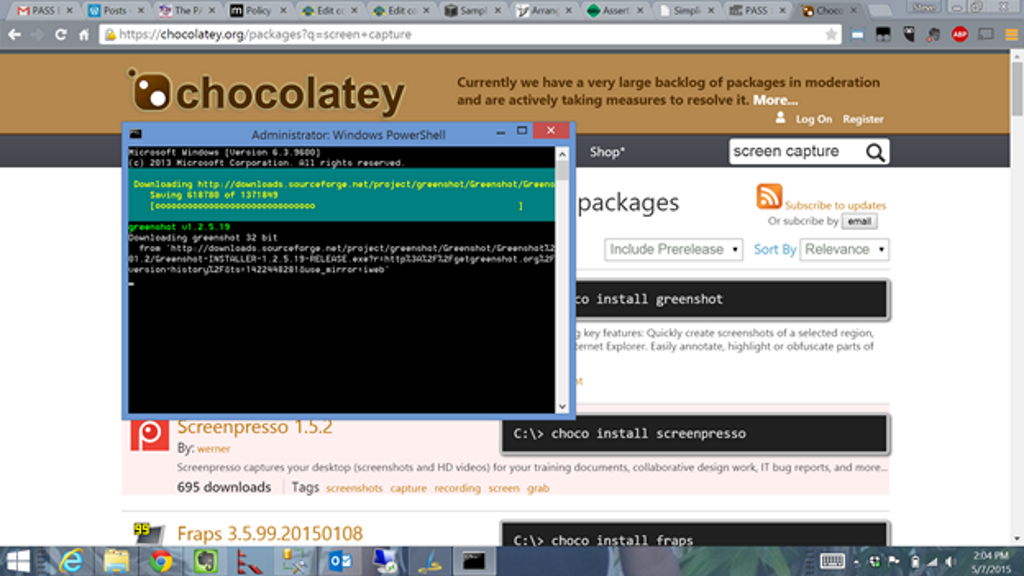
    I mentioned this to Andy Warren on the phone the other day and he told me to try Green something. I decided to do that today, and couldn’t remember the name, so I surfed over to chocolatey.org and searched for screen captures. Sure enough, Greenshot popped up first.

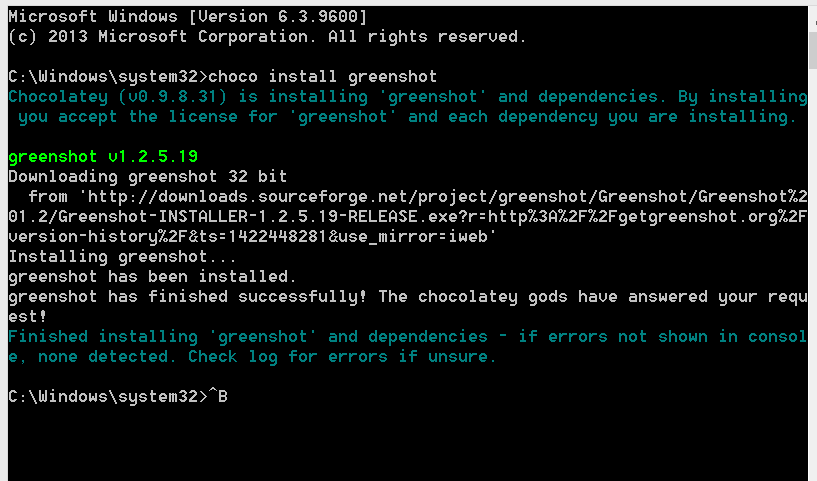
    I quickly opened an administrative level command prompt and typed “choco install greenshot” and went along with my work.

    Chocolatey is an amazing package manager and it started the install for me in the background.

    chocolatey_install

    A few minutes later I noticed the browser pop the greenshot website as the final part of the install. The program was set up with its install defaults and running on my system.

    2015-05-07 14_06_26-Administrator_ Command Prompt

    Chocolatey is amazing and I urge you to look at it for installing software on your system, especially if you’re a developer or consultant that regularly moves hardware or systems.

    If you’re a software developer, get your stuff packaged into here.

  • Getting Database Properties – DatabasePropertyEx()

    Another post for me that is simple and hopefully serves as an example for people trying to get blogging as #SQLNewBloggers.

    I had someone ask me a question about security recently, and while working through the answer, I ran across something I didn’t know well: databasepropertyex(). Here’s a few notes.

    Each database in SQL Server has all sorts of options and settings. Most people (including me) get in the habit of checking here for the information. First we right click the database (after starting SSMS if it isn’t running)

    dbproperty

    Then you get this dialog, with lots of stuff.

    dbproperty2

    And more on the other tabs.

    dbproperty4

    Time consuming, and error prone. As I get older, I find that trying to decide which selection is set for which option becomes harder. I find my finger tracing across the screen. It’s entirely possible I’d make a mistake when glancing at this to check the ArithAbort setting.

    Use T-SQL

    Scripting and querying is usually better. Not the sp_configure scripting where you get a whole list of options, but looking for a particular item. That’s where DatabasePropertyEx() comes in. This lets you query for a database property.

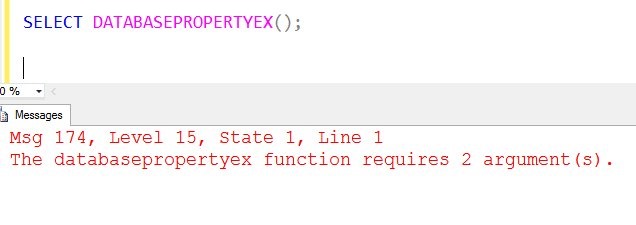
    The problem comes in when you run it. If you run the function, you get little information.
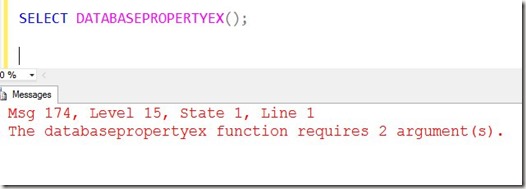
    dbprop_a

    Certainly you can go look at BOL to get more data, but that’s annoying. If I run sp_configure, I get data. However here, nothing. Even if I do what I think would be helpful, with a NULL parameter, I don’t get a list of stuff. SQL Prompt alerted me to the fact that the first parameter is the database, and the second is the property, but that doesn’t work.

    dbprop_b

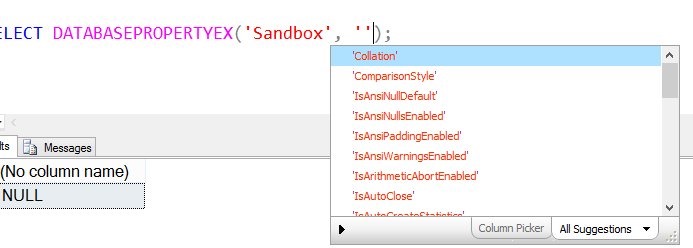
    Fortunately, I have SQL Prompt, so I get this when I put in quotes for the second parameter.
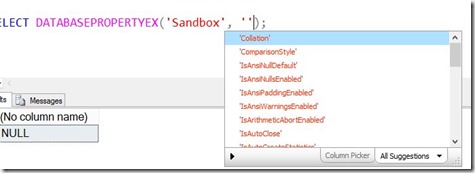
    dbprop_c

    As you can see, the parameters don’t map to the properties, though you can figure out what they mean if you see them. They tend to follow the conventions that most application programmers use (IsAutoClose).

    That’s fine, and it just means you need to have a reference handy for properties to query. I wish MS would give all properties with a NULL parameter, or a link to BOL.

    Writing

    This one took a bit longer to write. Once I realized I didn’t know databasepropertyex() very well, I had to read about it (5 minutes) and experiment a bit. I took some screen shots, which is always cumbersome. As I wrote this, I had to change the wording and ordering a few times to try and convey a simple message. I was originally going to look at more details, but decided to keep this simple and talk about just querying properties.

    This was about 30-40 minutes for me.

    You can do this. Join the #SQLNewBlogger group and start documenting your career. You can see all my posts that fall into this area by looking through the SQLNewBlogger tag here.

    References
  • Documenting with Tests

    Documenting code isn’t a task that many people enjoy. Those of you that have been through a computer science curriculum probably added lots of verbose, and obvious, comments to code. It’s probably unlikely that you ever found much value in the comments in a paying job.

    There are all sorts of ideas on how to document your softwarewriting good comments, and even refactoring code to remove unnecessary comments. I’m sure that if we put five developers in a room, we’d end up with eight different ways to comment code that would be debated, with no agreement on how to proceed.

    I ran across an interesting approach from Ed Elliot on documenting your code with unit tests. I hadn’t thought about the tests providing some documentation, but it’s an interesting idea. I’d have to work with the concept a bit, but I’m skeptical I’d get enough information from unit tests to ensure I understood what a stored procedure was doing, especially if I had 10 tests for a long procedure.

    I do think unit tests are important, and perhaps in conjunction with some type of code header that gives the requirements the procedure fulfills, I’ll get enough information to understand the code.

    I don’t have a universal solution that I think will work in most situations, but I do think that having a tool like intellisense or SQL Prompt helps you self document code with expressive names for columns, variables, and aliases. If nothing else, those phrases for variables can clue the next programmer in to what is happening better than single letter names.

    Steve Jones

    The Voice of the DBA Podcast

    Listen to the MP3 Audio ( 2.2MB) podcast or subscribe to the feed at iTunes and LibSyn.

  • Database Lifecycle Workshops

    Trying to implement version control, and Continuous Integration (CI), and automated releases of code is hard. The concept is simple, but all of the various processes, tools, and links that need to be connected can be hard. I’ve seen too many organizations that struggle to get started, often because they see the entire process as just too complex and overwhelming.

    It’s not.

    Whether you’re trying to release application code or database code, you need to treat them in a similar manner. While there are lots of books, tools, blogs, and companies that can help you work with application code, the database has been more challenging.

    At Redgate, we’ve put together a few workshops to help break down the stages of engineering your database delivery and get you moving to help smooth the process of making database changes. These workshops are coming to locations all around the US and UK in the next few months. Check out our schedule, which has dates in :

    • Bellevue, WA (May 15)
    • London, UK (May 20)
    • Philadelphia (June 4)
    • Belfast, Northern Ireland (June 26)
    • London (July 8)
    • San Diego, CA (July 16)
    • Manchester, UK (July 24)
    • Baton Rouge, LA (July 31)

    There are more dates, and we’re certainly open to scheduling more locations and even private classes if you’d like. Contact us if you have a request.

    Most of these classes are delivered by experienced partners of Redgate, often consultancy organizations that have been working with clients for years to build smoother application delivery processes, and are moving into the database space. The classes use our tools, and Grant, myself, or one of our other Redgate experts will be on hand to help you learn the skills you need to start implementing DLM concepts. We can even recommend consultants to work with you for a two day DLM Health Check or on longer term projects that help you build better software. Contact DLMPartners@red-gate.com for more information.

    We find that many of our customers are struggling with different parts of building a smooth software pipeline. They want to get better, and they find the Redgate tools help, but they need a little push or confidence to implement an engineered process.

    Our three workshops are designed to teach you about different parts of a DLM environment. They map to the Database Lifecycle, helping you move to a different stage and a better engineered process at each step. The three workshops are:

    • Database Source Control – getting your database code into a Version Control System and dealing with the issues of branching, merging, team coordination and more.
    • Database Continuous Integration – learning to automate the building and testing of your code each time a change is checked into a VCS. This lets you find issues quickly.
    • Automated Database Deployment – Gain the skills to automatically generate upgrade scripts and ensure they are tested and deployed smoothly, without any of the release day stress many of you experience.

    These classes won’t solve your DLM challenges in a day, but they’ll give you the skills and confidence to move forward. Ask you boss to send you and get a bit of training to help you start building better software.

    Come join us and learn to ship often and ship safe.