Author: way0utwest

  • Managerial Moneyball

    I really enjoyed reading Moneyball. Its a book about baseball and data and how information should be used to choose baseball players for the Oakland As. It’s an interesting approach, one that has rarely been used in the sport in the past, though it is gaining traction. It does seem that this approach has helped the As to high level of success given the constraint of their limited payroll. There’s even a great movie if you don’t want to read the book, but the book is really much better and goes into more detail on data points and how they are used.

    The idea of using data to make decisions has been applied to other areas, with “The Moneyball Effect” being talked about in other industries. Recently I also ran across an opinion piece on bad managers that also referenced Moneyball. The piece notes that most people make poor managers. They lack the skills, and more importantly, they really lack those innate qualities that motivate, inspire, and engage employees. Whether you agree with that last part, I think most of you agree that most managers are poorly chosen, trained, and certainly not qualified.

    The idea of using data to identify people that would make good managers, and perhaps even move people out of managerial roles. The premise of the piece is really the bad managers make their teams perform worse, so if you’ve got one of the seven-out-of-ten people ill suited to the work, you should move them out of that position. Then identify, promote, train, and support the others to manage your employees and help them to perform at their best.

    Steve Jones

    The Voice of the DBA Podcast

    Listen to the MP3 Audio ( 2.3MB) podcast or subscribe to the feed at iTunes and LibSyn. feed

  • T-SQL Tuesday #61 – Giving Back

    tsqltuesdayIt’s that time of month again, the time when we have a day where everyone writes on the same topic.

    This month Wayne Sheffield is the host and has chosen Giving Back as his theme. It’s a good one with the holidays and it’s one that really inspired SQLServerCentral. We built a business, but one that was founded on helping others and giving back to the community. The same could be said for SQL Saturday as well.

    Volunteering

    First the soap box. Everyone should give back to the world at some point in their lives. Perhaps it’s when you’re younger, perhaps when you retire, maybe it’s this weekend, but you should volunteer to make the world a better place.

    Now for my plans for giving back.

    They won’t change a lot from the past few years. I look to speak at various SQL Saturdays and User Groups in 2015. While Red Gate funds my travel and sometimes asks me attend events, I choose many on my own. I also donate my time as I don’t get a shorter week when I’m delivering a talk or two on Saturday. I still have the same responsibilities and deadlines to manage during the week.

    In 2015, I’m going to try and get to 8 SQL Saturdays. I did 11 in 2014, but I’m not sure I’ll end up with the same number. We’re still planning out 2015, and I don’t have any SQL Saturdays in the first quarter, but I’m hoping to make up a few later in the year.

    I also plan to get to each of the Denver area user groups in 2015. I managed to speak in Boulder, Denver, and Colorado Springs in 2014 and I hope to do the same in 2015.

  • SQL Server Disk Space Emergencies

    One of the things I’ll see happen often with SQL Server instances is that the system will run out of space on a drive. This could be for a variety of reasons, some of which can be prevented, and some cannot. You might have:

    • Don’t delete old backup files
    • Data growth fills the disk over time, usually years
    • tempdb rapid growth that uses all space
    • old import files not deleted over time

    There are other reasons, but I’ve often found that some process will cause an emergency and the SQL Server stops working, or stops backing up database, and administrators are in a panic to free space so the server can continue to function.

    Here’s what I suggest to smooth the way with a series of placeholders and a job.

    Create Placeholders

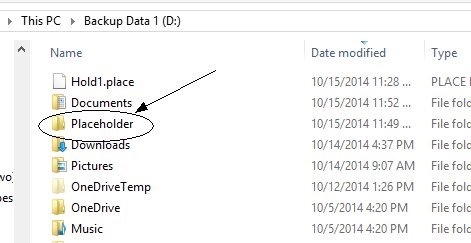
    First, create a folder on your SQL Server (or really every server) called Placeholder. I’d put it in the root to make it easy to find and standardize on it.

    placeholders3

    In the folder, place a series of files to save space. If you don’t know how to do this, I can show you an easy way. I have 4GB reserved here.

    placeholders4

    Now create a SQL Server Agent job. I might standardize this on every server I have with the same name and path.

    placeholders5

    The job has one step, which is designed to delete one file, each time it’s run.

    Note that I had a slight bug in what I shot above. I had the contig.exe utility in the folder and the first execution of the job deleted that file. Not a big deal in an emergency, because I can run the job again, but I’d make sure that only the place holder files are in this folder on machines.

    Here’s the job. It’s a PoSh type of step.

    placeholders6

    The actual PoSh code is here:

    $fileEntries = [IO.Directory]::GetFiles(“d:\placeholder”);
    $delete = 1;
    foreach($fileName in $fileEntries)
    {
    if ($delete -eq 1)
    {
    Remove-Item $fileName
    $delete = 0;
    }
    }

    When I run this, each time I run it, it’s just a single click or sp_start_job call.

    placeholders7

    After it runs, I have 1GB more free space. If I need more, run it again.

    placeholders8

    However, once you clear your low space condition, I’d be sure I put the placeholders back.

    For the next emergency.

  • Holiday Struggles

    It’s the slow time of year. As I saw tweeted recently, “And now for the month when nothing gets done.” I haven’t usually felt this way at a few jobs as the budget and planning process has typically been a part of a busy month. As I’ve run SQLServerCentral, I’ve also been looking back and forward this month, trying to think about our industry and data in a long term way. I have found December to be frenetic as times as I try to get in some ski days while still getting work done.

    However this year I’ve been in a situation that I think many people get into. I had a number of vacation days I needed to take, so I scheduled them a day here and there across the weeks. Between being off for Thanksgiving week, and missing almost the complete last two weeks of the year, I’m finding it a bit difficult to get into the swing of things as I have a few days back at work. It seems that work naturally slows down in teams as various people take holiday time off, but this is the first time that I’ve struggled to actually get my own work done as I’m in and out of the office on an irregular schedule.

    Perhaps this is the time when those of us who don’t work in Christmas related industries can catch up on work that we are often too busy to do otherwise. Are there maintenance items you can schedule? Maybe tackle some in-depth query tuning that is needed for end of year processes? Is it the time to “scratch an itch” at work? Red Gate has their Down Tools Week scheduled this week, and it’s a time when people can tackle fun projects that improve the business, but are rarely worked on. Our SQLServerCentral Scripts plug in for SSMS came out of one of these weeks.

    Pitch an idea to your boss to take a week or two and dig into something that is needed, but never prioritized. Maybe you’ll get your wish as a Christmas present.

    Steve Jones

    The Voice of the DBA Podcast

    Listen to the MP3 Audio ( 2.5MB) podcast or subscribe to the feed at iTunes and LibSyn.