Author: way0utwest

  • Continuous Learning

    It was a simultaneously busy, and also relaxing Tuesday for me recently. I attended Allan Hirt’s A to Z of Availability Groups at the PASS Summit. I’ve set up an Availability Groups before, but I was never sure that I completely understood everything happening in my lab, so this was a good chance to add some depth and color to my skills in this area. I met a few people surprised that I was spending time in a pre-con learning. They seemed to expect that I’d know most of what Allan was talking about.

    I know quite a bit about AlwaysOn and the related technologies, but I wouldn’t consider myself anywhere near an expert like Allan. I’ve fumbled through settings, but it’s a complex topic, and more importantly, it’s easy to misunderstand or confuse the subtleties of the technology. I went because a good, solid grounding in the technology, being led about in an organized fashion by an expert, is a good way to expand and solidify your knowledge. I saw other “experts”, MCMs and talented speakers in different pre-cons, each trying to continue to learn more about SQL Server.

    SQL Server is a big platform, one that’s wide in the number of features, and deep in complexity. No one knows everything about SQL Server, and most of the people I know that are extremely talented in areas of the platform, continue to grow their knowledge on a regular basis in a variety of areas.

    It’s the mission of SQLServerCentral to help you do the same thing, with our daily newsletter that brings you educational information about SQL Server. Hopefully you look forward to regularly growing your knowledge, just as I do.

    Steve Jones

    The Voice of the DBA Podcast

    Listen to the MP3 Audio ( 2.1MB) podcast or subscribe to the feed at iTunes and LibSyn. 

  • Bucket List Data

    I made a bucket list over a decade ago after hearing an interview with Ted Leonsis, former President of AOL. He had an interesting list, and while mine was more pedestrian, I have managed to knock off quite a few items, though there are more I’d like to get to. Actually, I need to redo my list and re-think my life as it’s changed since I first wrote things down.

    Over the years, I’ve also tracked other sorts of data about my life, things that just intrigued me. I had my running streak (1500+ days), 14ers climbed (4), states visited (38), books read each year (75-100), and more. I’m not quite sure why numbers have a fascination for me, but they do and perhaps that’s why I like working with technology and data.

    I’m sure that many of you share a similar passion for numbers, so I wanted to ask you this week:

    What interesting data points do you track, or have you tracked, about your life?

    It could be something with your family, hobbies, sports, weather, or something else. If there’s something you track and would like to share, let us know. If you have some interesting way of tracking data, or even an application you’ve worked on, I’m sure there are others that would find the data interesting.

    Steve Jones

    The Voice of the DBA Podcast

    Listen to the MP3 Audio ( 1.9MB) podcast or subscribe to the feed at iTunes and LibSyn.

  • It’s Not Just Poor Coding

    We hear regularly about SQL injection continuing to be a problem (it is) and malware causing data loss for many companies. We’ve got misconfigured firewalls and backup tapes being lost. However even if we could solve all those issues, we’d still have security issues.

    A new study shows that many workers share a tremendous number of files with coworkers, and potentially friends on a regular basis through the various cloud services. I don’t worry so much about cloud service providers being hacked themselves, or their employees selling information. It could happen, and probably does, but it’s also likely just isolated incidents that have limited impact. However I’m more worried about the poor security practices of the employees.

    Many people tend to use the same passwords on different sites (a bad practice). They also often open attachments from “friends”, unaware of how dangerous it can be to pass along and share documents that can embed malware. Malicious coders are becoming smarter, learning to make their actions more subtle, often only infecting a device to use it to send emails or files to other users who are the real target of the malware. With all of these issues, it’s much more likely that a user will end up creating their own hack for malicious servers than targeted attacks will work. It’s also highly possible that many users will share documents with friends, unaware that they might be exposing corporate data to the general public with confusing settings in some of these services.

    Ultimately I’m becoming more cautious about sharing information with others. I won’t open many files sent to me by people I don’t know well, and never look at any “humorous” attachments. I won’t accept a USB key from you and plug it into my laptop. It’s sad because we’ve built some amazing services to allow us to communicate easier and faster than ever before, however we’ve also not built these applications with an eye towards security first, and convenience second.

    Steve Jones

    The Voice of the DBA Podcast

    Listen to the MP3 Audio ( 2.6MB) podcast or subscribe to the feed at iTunes and LibSyn. 

  • T-SQL Tricks – Templates in SSMS

    There are lots of little tricks that you can use to become more proficient, and efficient, at writing T-SQL. Here’s a short one that might be more for administrators, but I think for developers it’s very handy as well.

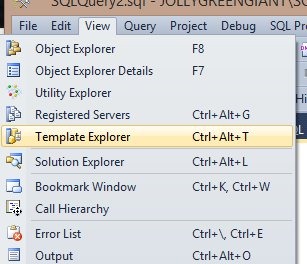
    SQL Server tools have included templates for years. I first started using them in Query Analyzer with SQL Server 2000. The tools have changed, but we still have templates in Management Studio (SSMS). We can access the templates by exposing the Template Browser from the View menu (as shown below).

    templates1

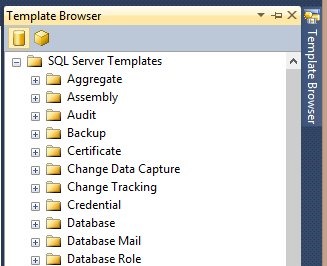
    We can also use the CTRL+ALT+T shortcut. Either of these will give us a tab on the right side of our SSMS main window, opposite the Object Explorer, as shown below.

    templates2

    Like all the windows in SSMS, I can detach this, move it, auto hide, etc.

    Each of these folders contains a series of default scripts that are installed with the tools. For example, I can look at the Backup folder and see three scripts in there. I can grab one of them with a left click and "drag" it to the query window and the script will appear in the query window as I’ve shown here.

    templates3

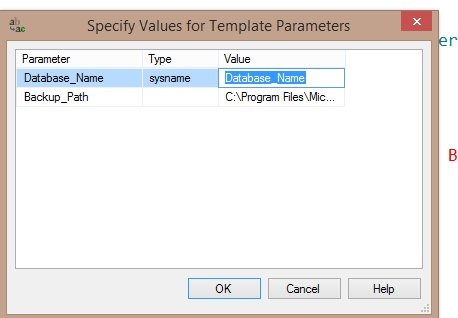
    A CTRL+Shift+M will give me the parameters in the script, which I can replace with my own values (or accept the defaults).

    templates4

    Many of these are generic, but they are useful. I’d encourage you to take a look at them and use them when you can.

    You can customize these, but that’s for another post.