Author: way0utwest

  • Making Better Presentations–Organize Things

    This is part of a series of tips for speakers on how to make your presentations better.

    Organization matters, and it makes a difference to how your presentation goes. The more organized you are, the better the experience for attendees. If you are very unorganized, then it becomes hard for the audience to follow what you are doing.

    I’m am giving a few tips and tricks here, not for the actual outline and focus of your talk, but a few items that can help you smoothly move through your presentation.

    Startup

    Most of us don’t present a talk exclusively from Powerpoint. If you do, that’s great, but often I find people need to move from Powerpoint to Management Studio, or switch to a VM, show code in Visual Studio, run a browser (for Azure), etc. I personally need to sometimes run Red Gate tools as part of my talks, so I’ve learned to get organized.

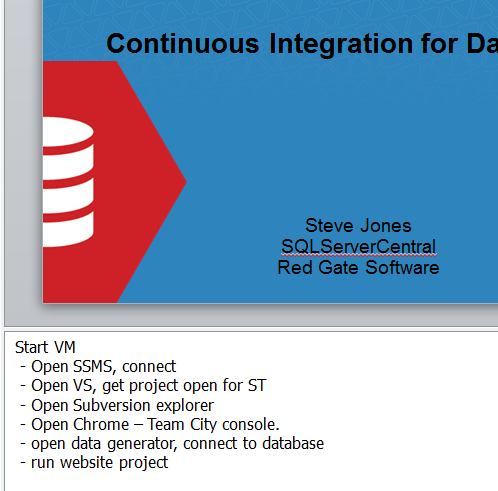
    I actually got this trick from Brad McGehee and I think it’s great. As I’ve written and organized my talks, I’ve learned to make notes in Powerpoint. Every time I need to run some tool or application, I put a note in the first slide of my deck. These are a few things I need to run, and when I get ready for a talk, I have a list of items to start right away.

    Here is the first slide from my Continuous Integration for Databases talk.
    betterpresent_a

    Even if you only have one talk, it’s easy to forget things. I’ve seen lots of presenters forget to run Zoomit, start Visual Studio, or even SSMS. As someone that watches dozens of talks a year live, I can tell you it’s less than impressive or exciting when I get to watch Visual Studio start up on a projector.

    Code

    I’ve tried different methods for organizing my presentations. I’ve put all the code in separate folders. I’ve numbered the files; I’ve named them. I’ve put everything in one long script file with comments.

    All of those have worked, and all of them have failed. The important thing is that you have some organization. When you’re speaking in front of people, you’re concentrating on your topic and flow. Anything that distracts you is PAINFULLY obvious for attendees.

    It will happen, no matter what, but minimize it. Get some sort of organization and ensure that what you’re showing on the screen smoothly transitions from one section to the next.

    Comments

    In line with having code organized in files, I would highly recommend that you include comments and notes in your code for both you and the audience. We are trying to teach and explain our code and concepts. There’s no mystery or magic that we need to keep people from knowing, so the more we can disclose, the better.

    Your attendees will appreciate some instructions in the code when they try to duplicate your efforts on their own machines. However these same instructions can be very helpful for you during a talk. The instructions will guide you alone, allowing you to continue to speak and explain things, without trying to multi-task and remember the flow of your presentation.

    Think Ahead

    All of the organizational items really come down to you thinking ahead. Just as you might do as a DBA or administrator, considering what might go wrong, or what might interrupt your “uptime” as a presenter will help you prepare for a smooth delivery in front of an audience.

  • Database Checkups

    I am most definitely a fan of continuous delivery (CD) and the idea that we have the ability to both release our software at any time, for any change, but also have the process and mindset in place to rapidly push enhancements and patches through our development process. However I’m also no naive enough to think that the processes of Agile, Lean, Scrum, Continuous Integration, or any other methodology make this happen. It requires belief and effort by your entire team, including management, to evolve your software quicker.

    There is a downside. The faster, and more often, you release changes to your production system, the more likely you are to cause an issue. This isn’t really any different from traditional waterfall processes, which also cause issues in production, but it does mean that the perception of issues is a bit changed. People expect higher quality when they implement a CD process, and while quality might be higher (there is debate on this), it certainly isn’t perfect.

    Walgreens has implemented a CD process, and they rapidly deploy changes, but they’ve also had issues. In fact, there’s a piece that talks about an issue during a database deployment, and offers some guidance on preparation to deal with problems in your deployment process. The ideas of monitoring (which is critical), planning for recovery, coordinating development, etc are all things that we need to do in any production environment, but they are especially important in a CD process where people expect changes quickly. Whether those changes are enhancing the application, or rolling back a problematic deployment, they need to happen quickly.

    Over time, which may be decades, I expect that more and more organizations and end users will expect patches and changes to their software to happen in the background, while the system is being used. This might mean we need to plan for application architectures with sections that can be upgraded separately, or maybe we will develop ways to modify executable code without ending the process. In either case, the ideas behind CD will become more and more useful, and the more you understand them, the better off you’ll be.

    Steve Jones

    The Voice of the DBA Podcast

    Listen to the MP3 Audio ( 2.5MB) podcast or subscribe to the feed at iTunes and LibSyn.

  • PASS Rocks SQL Saturday

    I had another piece that looked at some issues with PASS slated for today, but it’s been a tough morning. Both with work, and with the conflict with PASS, so I’m going to move this up and give PASS more praise. As conflicted as I am about the organization, it does amazing things for the community.

    SQL Saturday #318 – Orlando

    I remember when Andy first pitched me on this idea. I was dubious, but we talked about it over months and finally got the first event running in Orlando on Nov 10, 2007.

    This weekend, starting already with pre-cons, is the EIGHTH SQL Saturday in Orlando, SQL Saturday #318.

    8!!

    There have been have only been 14 Summits. I went to SQL Saturday #300 a couple weeks ago. That’s amazing. Free training, probably 20+ sessions at each event, held in countries all over the world, from Brazil to Nepal.

    If that doesn’t make you smile, you don’t get community.

    Now, I know some of you will say “Andy and Steve started SQL Saturday.” True, but it was hard, it was a time sink (mostly for Andy) and while we grew a number of events, we would never have gotten this far.

    It’s mostly due to the efforts of Karla Landrum and I can’t praise her enough for the enthusiasm, excitement, and support she brings to the process.

    But it’s also PASS.

    The organization supports Karla with behind the scenes help from people at headquarters. Without their decision to absorb SQL Saturday and promote it, market it, support local organizers, this would not have grown as it has.

    If you search the hashtag, you’ll find some amazing notes. Tweets, excitement, blog posts, and more. If you have been to an event, then you get it. You know how amazing this is and you should thank the people that work and volunteer for PASS.

    If you haven’t been, you’re missing out.

    Go. Give it a try. Carpool to one near you. Help organize one with your user group. You’ll be amazed.

    PASS has done something special with SQL Saturday and they deserve a lot of praise and credit.

  • Is SQL Server Mature?

    When I asked recently what compelling reasons there are, or aren’t, for upgrading SQL Server, it seems cost was the issue for most people. I can understand that, especially as licensing for VMs has made it an expensive endeavor to upgrade their systems. Many, many companies have started to revisit their policies regarding upgrades and seriously evaluate the decision to undertake a version change. While I’m not sure if many companies are starting to look at keeping all instances of SQL Server for ten years, I know many are looking to keep their noncritical systems on the existing versions as long as possible.

    As I read through the posts on my piece, I found this great quote from one of the commenter: “I’m a great believer in “If it ain’t broke, don’t fix it” and so if a system is running acceptably for it’s purpose, I’ll leave it alone.” To a large extent, that’s how I’ve viewed systems. If things are working, it becomes hard to justify an upgrade. In fact, I had a client that was running a SQL Server v6.5 instance in 2005, a full ten years after that version was released. Why? Mostly because the database backed a card key system that worked. While the database wasn’t supported, neither was the card key system, and since an upgrade would have been close to $100,000, it wasn’t worth performing. We did upgrade to a virtual server to remove hardware dependencies, but otherwise left the system alone.

    That brings me to this week’s question, which is one that I’ve asked myself for years: Is SQL Server mature?

    If a version of SQL Server can handle the load placed on it, is there any good reason to upgrade. I suspect that for many applications, the base features of SQL Server are good enough. If these features have performed well for a number of versions, then why change? While I like the changes in T-SQL, especially error handling, I’m not sure those changes are worth paying tens of thousands of dollars for. I’m not sure the improvements are really justified for many applications, and I’m not sure many developers can even find the time to implement them.

    More and more I think that key to continued adoption and growth of SQL Server is licensing by scale, not edition, and not by feature. Just like Azure, let me pay for the cores and RAM I need, and let me easily grow that as needed.

    Steve Jones

    The Voice of the DBA Podcast

    Listen to the MP3 Audio ( 2.8MB) podcast or subscribe to the feed at iTunes and LibSyn.