Author: way0utwest

  • Reverse Engineering Disasters

    If you are responsible for managing systems, you should have some sort of disaster recovery plan. Even if you are only managing the one system you carry with you on a regular basis, you should ask the question: What would it take to destroy this data?

    It’s a good question, and in the post I’ve linked above, a technologist talks about some of the failings of disaster recovery plans because they forward engineer plans to recover systems. People think of specific problems and try to prevent them. They don’t reverse engineer to find out what events would cause them to lose their system.

    That’s really the key to a lot of design and architecture in computer science. You can’t think about just what you expect to happen, or even what you want to happen. You have to consider the other ways in which events could occur or the issues that could cause an problem in your system. In development, the things you expect are considered to be the happy path. A good architect or engineer will think about everything else in addition to the happy path.

    I sometimes think that far too many decisions are made while considering the happy path, but ignoring or discounting the other paths available. These other paths may be unlikely to occur, but having worked with computer for over 25 years, I can tell you that I often find the least likely events occurring far too frequently.

    As the author says, you should never say “I never even thought of that happening.” Consider reverse engineering problematic situations and then make a judgment of how likely is it that any of the events will occur. That way you have at some idea of what could go wrong and what events you are willing to protect against.

    Steve Jones

    The Voice of the DBA Podcast

    Listen to the MP3 Audio ( 2.1MB) podcast or subscribe to the feed at iTunes and LibSyn. feed

    The Voice of the DBA podcast features music by Everyday Jones. No relation, but I stumbled on to them and really like the music. Support this great duo at www.everydayjones.com.
  • Better Presentations–Hide those Windows

    This is part of a series of tips for speakers to make your presentations better.

    I wanted to give some specific SQL Server presentation items that have bothered me recently. These aren’t big things, but they do cause problems for attendees, and that might mean the difference between someone learning what you are presenting and getting lost because they can’t easily see.

    Windows

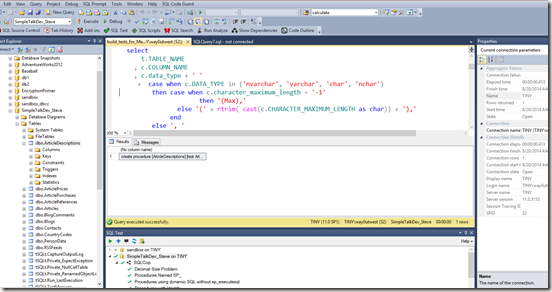
    How does this look?

    badpresent_thumb1

    It’s bad. Imagine if you were 15 feet back from the presenter, which is how this looks on a screen. I can barely see code.

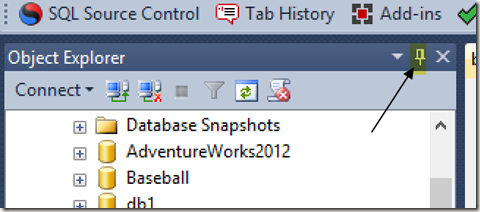
    If you look at the Object Explorer, there’s this little item in there .I’ve highlighted it below.

    objcet_explorer_a_thumb3

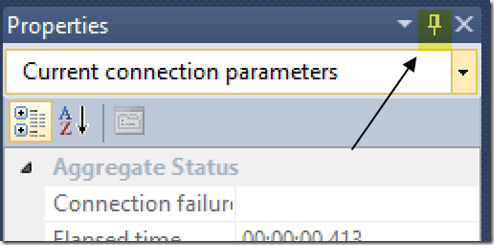
    There’s also one on the Properties window.

    properties_a_thumb1

    In fact, my SQL Test window at the bottom, most SSMS add ins and  Visual Studio windows have them.

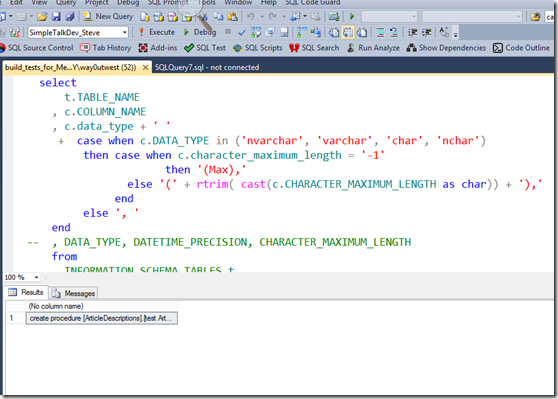
    Click them. They’ll hide the windows, like so.

    badpresent2_thumb1

    This is a much cleaner view of things.

    But, Steve, you’ll say. I need those windows. I get it, I need them, too. They’re on the side of your screen and you can pop them open. They’ll stay open when you work in them, and disappear when you don’t.

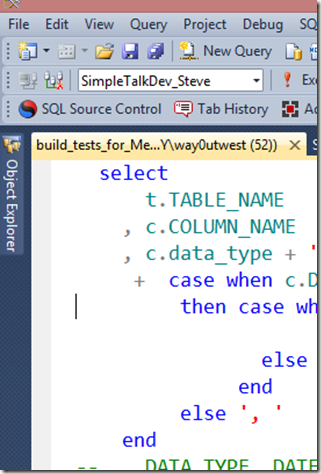
    Gone when I don’t need it.

    oe1_thumb1

    Here when I do:

    oe3_thumb1

    It’s a quick tip, and it’s easy to learn. Once you practice with hiding and using windows, I’m sure you’ll find that you work more efficiently all the time, not just when on stage.

  • Smooth Database Deployment at SQL in the City 2014

    One of the themes at Red Gate Software this year has been “ship often, ship safe”. Actually, that’s been a theme (and goal) for us the last few years as we’ve learned how to build software faster, maintain quality, and get features into the hands of our customers. We’ve been working hard on expanding our knowledge , both through tools and education, to help our customers deliver their database software in a better way.

    Grant and I have traveled around the US giving free seminars on database development, deployment, and delivery, with ideas on how you can more easily manage your software pipeline. This fall, we’ve revamped our talks and added a new one on testing, and we’ll be delivering these talks at our 2014 SQL in the City events. We’ll be in London on Oct 24, 2014 and Seattle on Mon, Nov 3, 2014 talking about software, along with a number of our Friends of Red Gate. These will be full day conferences with a variety of DBA related topics featuring a number of speakers that are experts working with SQL Server. Quite a few of our developers and managers will also be available to share our knowledge about the process of building, testing, and deploying software, particularly database driven software. We’d also love to hear about your challenges and issues you face on a regular basis. If you can come, we’d love to meet you.

    Our events are a casual, fun, educational way to learn more about SQL Server. You’ll get ideas and tips for becoming a better developer or DBA that you will want to experiment with and put into place every day to make your job more enjoyable. We hope you join us at one of these events, or at one of our seminars in the future.

    Steve Jones

    The Voice of the DBA Podcast

    Listen to the MP3 Audio ( MB) podcast or subscribe to the feed at iTunes and LibSyn. feed

    The Voice of the DBA podcast features music by Everyday Jones. No relation, but I stumbled on to them and really like the music. Support this great duo at www.everydayjones.com.
  • Making Better Presentations–Tips and Tricks

    I give a lot of presentations each year. I am constantly trying to improve my presentation skills to continue to get invitations to speak, to represent my employer well, and to ensure attendees are interested and learn a few things.

    With that in mind, I’ve compiled a number of tips that I have learned over the years, or that I’ve seen ruin some interesting presentations.

    I’ll be adding to this list over time and linking to the posts as they become visible.

    Feel free to try one of them (please), all of them (if appropriate), or none of them (not recommended).

    Feedback is welcome.