Author: way0utwest

  • T-SQL Tuesday #54–Interviews and Hiring

    TSQL2sDay150x150It’s the May T-SQL Tuesday, and this time it’s a great one. This month the host is Boris Hristov (@BorisHristov) and his topic is one that’s near and dear to me. He’s asking about interviews and hiring, and I have a lot to say on this topic. I could talk about both sides of the table here, and I’ll have to choose one for today, but I’ll give a few more stories over at The Modern Resume.

    This is the monthly blog party in the SQL Server community. The second Tuesday of the month is when you need to publish a post, on GMT time, and then link to the invitation. I’d encourage you to participate.

    I Don’t Know

    I’ve interviewed lots of times in my career. I’m not sure why, because I’ve often gotten great performance reviews, and I think I’ve been well liked at my jobs. Perhaps it’s my own restlessness, but it seems that I’ve often found myself in some situations where I needed to move on for some reason. Quite a few of the times it wasn’t my fauly, but However I’m picky, and so I’ve usually interviewed with lots of companies before deciding to take a job.

    A few years back I was unhappy with my current employer (they’d been acquired) and set up 5 or 6 interviews across a couple months. I often get responses from resumes I submit, and usually secure an interview after a phone screen. A lot of my writing at The Modern Resume is based on my success in getting interviews and job offers.

    The interview I got was at Raytheon Polar Services, the company that manages the infrastructure for the South Pole research station at McMurdo. A developer friend I’d worked with at a previous job had spent a couple years there, including a summer at the South Pole and he helped me get the interview.

    oval-conference-table-wood-southwest-airlines-2

    I walked into a room like the one above. My friend and his boss shook hands with me and we sat down. About 9 or 10 others filed in and took seats around the table. They introduced people and said they would go around the table, allowing the various developers to ask questions.

    The first person to my left looked at me and asked me, “what is ACID?”

    I started to answer. “It’s Atomic, Consistent, …”

    I couldn’t remember. I was sitting there, this great opportunity being offered to me, a friend’s recommendation, and I was stuck on the first question of the afternoon. With a room full of developers watching me.

    “I don’t know what the rest of the acronym stands for, “ I said (if you don’t, look it up), and then I proceeded to explain that the idea of ACID in databases has to do with transactions and ensuring data integrity and consistency. I also explained that I could google the exact terms, and would after the interview.

    I didn’t know, and I admitted it. I try to be honest in interviews, hoping that I can get the company to be honest with me. It’s a joint interview, and I interview the company as much as they interview me.

    However I also know that I don’t know everything. I’ve had multiple questions over the years where I didn’t know the answer, and I just admit I don’t know, explain how I might solve the issue. Someone asked me about a complex networking issue one time and I didn’t know the answer. I admitted it, but also told them I had a friend that was a CCIE and he’d be who I’d ask about networking issues I didn’t understand.

    When you don’t know, admit it. However don’t stop there. Explain what you’d do. Show how you can learn, or solve the problem. Would you ask other developers on the team? You can do this, but not too often. Would you research? How long do you work on it before you ask for help? Do you admit when you’re out of your depth?

    Often I’ve found that showing you can admit faults, can learn, and have plans to drive yourself forward help. Of course, you can’t be woefully under qualified. If I interviewed as an MDX developer, I could talk for days on how I’d learn and the people I could ask for help, but outside of an entry level position, I wouldn’t be qualified to work in that area. Hopefully, however, I’d have made that clear in a phone interview.

    Admitting you don’t know is OK. Just don’t stop there.

  • Better Training

    I was talking with some data professionals recently about training and the value of college, work, or some other method of entering the technology business. I have a few thoughts about the different ways of teaching people about this business, and I’m curious what you think.

    What do you think of traditional computer science? Colleges have students study computer science theories, languages, and more. Build small software projects, write pieces of operating systems and more as part of their curriculum. Students also still have the requirements of other core classes like science, language arts, etc., but does this train them well? I almost think that students ought to be charged with working on real projects, perhaps open source projects, and tackling some small part of the system. Perhaps an older student needs to do project management work, or architectural specifications for less experienced students that are actually programming. Is that good preparation for the real world?

    What about a vocational school that teaches students with real projects? If the students are required to work in the same ways that companies do, given requirements, asking for milestones and deadlines, providing some training, but not all, would you consider that better preparation than anything else?

    Ultimately the best preparation I’ve seen for IT is to immerse people in actual work situations, having them solve real world problems. The best way to do that is actually set up environments where students are forced to build domains, set up clusters, write code that actually would be used to manage a server or produce an application. In essence, run students through an apprenticeship.

    Or maybe the best solution is to actually offer more students apprenticeships where they can learn in the real world.

    I know there’s no one way that works for everyone, but I think that we certainly can find ways to better equip the majority of potential employees than we do now.

    Steve Jones

    The Voice of the DBA Podcast

    Listen to the MP3 Audio (2.2MB) podcast or subscribe to the feed at iTunes and LibSyn. feed

    The Voice of the DBA podcast features music by Everyday Jones. No relation, but I stumbled on to them and really like the music. Support this great duo at www.everydayjones.com.

  • Beware the Windows 8.1 Update Upgrade

    I had Windows 8.0 on my laptop, and went to Win 8.1 earlier this year. Everything went well. Even this spring, when I installed the 8.1 update, things went well on my laptop. This was my test environment, as most days I work on my desktop. I decided to then update my desktop, and things went well overall, until I went to use SQL Server.

    At first, I couldn’t connect to SQL Server from SSMS. No big deal, I thought the update had stopped a service. I checked Services, and was surprised to not see a SQL Server database service. I had a browser and VSS service, but nothing else.

    I rebooted my machine, which didn’t help. I manually ran sqlservr.exe, and it failed with permissions issued. I tried repairing the SQL install, but that didn’t work either. More than a few people reported similar things, but nothing I found on the Internet worked. I kept getting security SPID errors, so I just uninstalled, and then reinstalled SQL Server.

    I’m not sure under which accounts I had my service running, and it’s possible I used my own account, but usually I set up a SQLService account on my machines. In any case, it was a hassle and pain.

    I’m not telling you to avoid the 8.1 Update, but I am warning you and noting that you might want to be sure you have good backups of your systems.

  • Filetable–Nesting folders and files

    In previous posts I showed how to create a folder in a Filetable and also how to the create (and move) files into the subfolder. However I didn’t repeat that and wanted to test the ability to actually nest things further. With that in mind, I’m going to take this to the next step.

    The Scenario

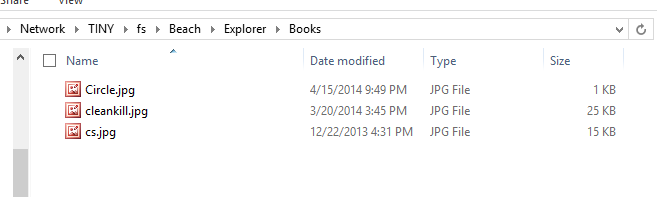
    What I’ve got is a subfolder in my Filetable called Books. This is the first level below the root of my Filetable share. This folder has three files in it.

    filetable_j

    One of these is the image of a circle, and the other two are images of book covers. I’d like to create a folder called “Covers” and then move the two jpgs into that folder together. Let’s see how this goes.

    The Solution

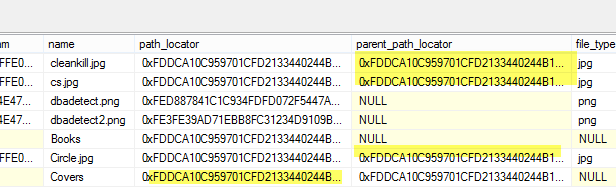
    The first set of code I want to run will create a folder, but it will have to be nested under the Books folder. As we can see from the table, the Books folder already exists and needs to be the parent_path_locator for my new folder.

    filetable_k

    The highlight shows that “Books” is in the root of my Filetable.

    Here’s the code, which calculates the new path_locator using the path_locator of “Books” as a base and then inserts a new folder.

    DECLARE @path HIERARCHYID
    DECLARE @new_path VARCHAR(675)
     
    SELECT  @path = path_locator
    FROM    dbo.Explorer
    WHERE   name = 'Books'
    
    SELECT  @new_path = @path.ToString()
            + CONVERT(VARCHAR(20), CONVERT(BIGINT, SUBSTRING(CONVERT(BINARY(16), NEWID()),
                                                             1, 6))) + '.'
            + CONVERT(VARCHAR(20), CONVERT(BIGINT, SUBSTRING(CONVERT(BINARY(16), NEWID()),
                                                             7, 6))) + '.'
            + CONVERT(VARCHAR(20), CONVERT(BIGINT, SUBSTRING(CONVERT(BINARY(16), NEWID()),
                                                             13, 4))) + '/'
    ;
    
    
    INSERT  INTO dbo.Explorer
            ( name, path_locator ,is_directory )
    VALUES  ( 'Covers', @new_path, 1 );

    .csharpcode, .csharpcode pre
    {
    font-size: small;
    color: black;
    font-family: consolas, “Courier New”, courier, monospace;
    background-color: #ffffff;
    /*white-space: pre;*/
    }
    .csharpcode pre { margin: 0em; }
    .csharpcode .rem { color: #008000; }
    .csharpcode .kwrd { color: #0000ff; }
    .csharpcode .str { color: #006080; }
    .csharpcode .op { color: #0000c0; }
    .csharpcode .preproc { color: #cc6633; }
    .csharpcode .asp { background-color: #ffff00; }
    .csharpcode .html { color: #800000; }
    .csharpcode .attr { color: #ff0000; }
    .csharpcode .alt
    {
    background-color: #f4f4f4;
    width: 100%;
    margin: 0em;
    }
    .csharpcode .lnum { color: #606060; }Once that’s run, I see this in the table:

    filetable_l

    The two highlights are the same values, with the parent of the Covers folder matching the path of the Books folder. In the Books folder we see:

    filetable_m

    Things look good so far. I can programmatically nest folders. Now I need to move the two jpgs into the proper folder. Let’s do that in one (hopefully) statement.

    We use the same code as we did to move a file, but this time instead of a variable for the new path, we embed this in the update statement. In this case I actually moved all three files.

    DECLARE @path HIERARCHYID
     
    SELECT  @path = path_locator
    FROM    dbo.Explorer
    WHERE   name = 'Covers'
    
    Update dbo.Explorer
          SET path_locator = @path.ToString()
            + CONVERT(VARCHAR(20), CONVERT(BIGINT, SUBSTRING(CONVERT(BINARY(16), NEWID()),
                                                             1, 6))) + '.'
            + CONVERT(VARCHAR(20), CONVERT(BIGINT, SUBSTRING(CONVERT(BINARY(16), NEWID()),
                                                             7, 6))) + '.'
            + CONVERT(VARCHAR(20), CONVERT(BIGINT, SUBSTRING(CONVERT(BINARY(16), NEWID()),
                                                             13, 4))) + '/'
    
          WHERE RIGHT(name, 3) = 'jpg'

    .csharpcode, .csharpcode pre
    {
    font-size: small;
    color: black;
    font-family: consolas, “Courier New”, courier, monospace;
    background-color: #ffffff;
    /*white-space: pre;*/
    }
    .csharpcode pre { margin: 0em; }
    .csharpcode .rem { color: #008000; }
    .csharpcode .kwrd { color: #0000ff; }
    .csharpcode .str { color: #006080; }
    .csharpcode .op { color: #0000c0; }
    .csharpcode .preproc { color: #cc6633; }
    .csharpcode .asp { background-color: #ffff00; }
    .csharpcode .html { color: #800000; }
    .csharpcode .attr { color: #ff0000; }
    .csharpcode .alt
    {
    background-color: #f4f4f4;
    width: 100%;
    margin: 0em;
    }
    .csharpcode .lnum { color: #606060; }The table now shows:

    filetable_n

    The shaded values, while very long now and truncated in the image, are in fact the same.

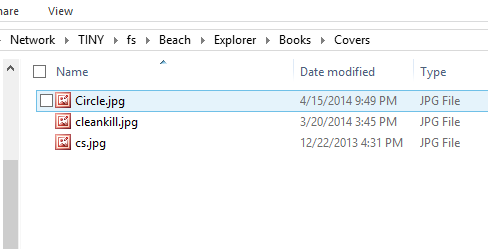
    The share shows:

    filetable_o

    and

    filetable_p

    I could certainly have accomplished this in other ways, but being able to do this in T-SQL is a nice way of managing your files in a simple way that might be easier than changing an application. It’s certainly a good way to fix incorrect data if the application can’t do it and this can be much faster than having a user move lots of files manually.