Author: way0utwest

  • Virtual Lab – Creating Differencing Disks

    This is part of my series on building a virtual lab for use with SQL Server and Windows. You can see the entire series here: Building a Virtual Lab with Hyper-V.

    The whole point of virtualization is better use of resources. Whether it’s CPU, storage, networking, power, etc., we are trying to save having to purchase 5 or 6 machines and connect them all, pay for them, etc. It’s much, much easier to use virtualization.

    This is especially true of storage. When we build a lab, we don’t want to have to allocate a ton of space for our systems. In my case, for my design, this is what I want to end up with.
    virtlab_o

    From my last post, I had the bottom two files already set up. These are my installations of Windows Server 2012 R2 Standard and Core, sysprep’d and ready to use.

    Differencing – Saving Space

    The idea in differencing disks is similar to the snapshot feature I used in VMWare to do this same process. I take a base disk, and create a “copy” of it. Except the copy doesn’t have everything from the base disk. Like a database snapshot in SQL Server, if I need to read something that’s in the base disk, I reference that. If I change something, or add something, I read from the copy.

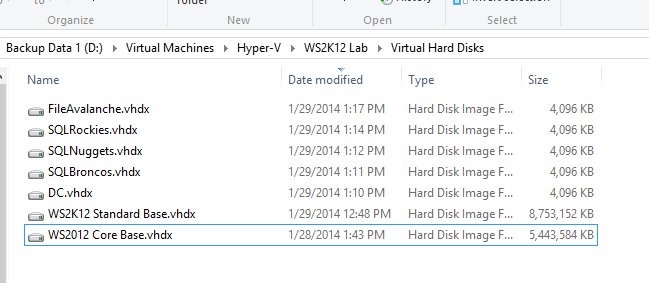
    As you can see above, I have 5 small disks at 4MB and my 2 large base disks. Each of the small disks is a differencing disk off either the Standard or Core base installations.

    I created these by selecting New Hard Disk in Hyper-V Manager

    virtlab_i

    After the intro screen, I make sure I’ve picked VHDX.

    virtlab_j

    At the next screen, I choose the differencing option.

    virtlab_k

    Now I need to pick a location for the copy. On my setup, I’m trying to keep this lab contained, so I have a WS2K12 Lab folder. I choose that as my location for the differencing disk. I give it a name, in my case, I’m using “Function” concatenated with the name of the Windows host. As seen below, my file server will be named “FileAvalanche.vhdx”.

    virtlab_l

    Next I choose the parent disk. this is the base image. Depending on what I had in my design, I choose the Standard or Core images for various machines.

    virtlab_m

    I get a summary where I can see all my options, and then click finish.

    virtlab_n

    I do this five times and all of a sudden I have a lab.

    A few things. Use some naming convention so you can tell which disk is which. Also, make sure you stick things in a location. I set a specific folder location for my VMs and disks, and then altered the Hyper-V Manager settings to default to this folder. On my machine that’s D:\Virtual Machines.

    That helps me keep things contained, and it also means that when I want to copy a VM for a backup or to another machine, it’s easy.

  • The Remote Balance

    I still have hope that we will see more and more remote workers in the future. As large companies downsize and choose smaller facilities, and as many new companies start from scratch, we’ll see many of them considering telecommuting to find the best technologists for their openings as well as reduce their infrastructure costs. As noted in the book, Remote: “Today, the new paradigm is move work to the workers, rather than workers to the workplace.”

    I don’t know if we’ll ever get the majority of people working remotely from offices or at home, but I do know that I see more and more people able to get work done outside of a traditional office. I see people checking email and responding to trouble tickets in all sorts of situations, and with all sorts of jobs. I suspect that businesspeople continue to do this more and more as devices and software expand to allow it.

    I saw that quote from Remote in a blog from Scott Hanselman where he also commented on that idea, but noted that we need to strive for some balance. It is great that you can fix a problem at your kid’s soccer game or dance recital, but it’s also important that you attend and enjoy those events.

    Like most tools, our remote access can be good or bad. If you check too often, become tethered to devices, and ignore the real world, that’s bad. However if you leave the office early, get to the game, and get some work done before the action starts, that’s good. Just don’t forget to prioritize the important stuff, which is usually not work. It’s the event you’re attending.

    Steve Jones

    The Voice of the DBA Podcast

    Listen to the MP3 Audio ( 2.0MB) podcast or subscribe to the feed at iTunes and Mevio . feed

    The Voice of the DBA podcast features music by Everyday Jones. No relation, but I stumbled on to them and really like the music. Support this great duo at www.everydayjones.com.

  • The Security of Interconnected Systems

    It’s a scary world in the wild, wild west of the Internet. Many days I think that’s a closer metaphor to the World Wide Web than the relatively ordered Kensington High Street in London. There are lots of bad people out there that are scraping identities, hacking systems, copying data, and more on a daily basis. Indeed the power of computers means that these malicious behaviors can be done at a speed and on a scale never before seen in the world.

    I ran across this account of a blackmailer stealing a Twitter name using a variety of hacks across interconnected systems. What’s worse than the attack against someone’s digital assets is that fact that so many of the companies on the Internet have no good way of recognizing ownership. It’s almost as it could be back in the gold rush days when you had to be vigilant and constantly inhabiting your property to protect the assets. At least in that time you could file a claim that would be honored. I’m not sure a Facebook name, a Twitter handle, a SQLServerCentral login, or any name on the Internet can actually be “registered” by most of us.

    The problem isn’t so much the ownership of some digital asset as it is the potential cascade of problems when we can’t own an asset and possession of a username and password seem to be what matters. I’d like to think that corporate assets are better protected, and corporations are usually more able to take legal action against attackers, but it’s entirely possible they aren’t. Especially when many of the companies that provide services to both individuals and companies aren’t providing support. The “Google” method of building automated systems that provide support looks like “hope for the best and too bad if it’s the worst” from my perspective.

    As we connect more and more systems together, whether through sign-on systems, automated feeds, or other methods, the ability to protect the entire system is dependent on the weakest link. The ability to resolve ownership and security issues, however, seems to have no protection at all.

    Steve Jones

    The Voice of the DBA Podcast

    Listen to the MP3 Audio ( 2.5MB) podcast or subscribe to the feed at iTunes and Mevio . feed

    The Voice of the DBA podcast features music by Everyday Jones. No relation, but I stumbled on to them and really like the music. Support this great duo at www.everydayjones.com.

  • Why Should You Network?

    This editorial was originally published on August 17, 2009. It is being re-run for the President’s Day holiday.

    Why should you network? I’m speaking about interpersonal networking, not the bits and bytes in the ether kind 🙂

    It’s an interesting question and one I’ve been thinking about a lot since reading Andy Warren’s posts on the subject. He thought it was interesting enough to engage Don Gabor for his business and spend a little money to learn how to do it better. After having a few sessions, Andy thought it was helpful enough to get a pre-conference session at PASS on this topic. It’s a short pre-con, 2 hours, and won’t interfere with anything else you’ve booked. It’s an additional $60, but I’ve paid my fee (it’s a business expense) and will be there.

    Whether or not you attend the session (it’s limited in size), I think there is value in learning to network better. Andy has reviewed a few books, and I’m sure I’ll have some quick techniques to give you after PASS, or even during it. If you see me during the conference, please don’t hesitate to come up and say hello to me. It’s always great to meet new people.

    Back to me question: why network? I’ll give you a few examples in my life. I involuntarily networked myself into this field. When I was in graduate school searching for a job, I saw an internship at the power company. There were a few positions, but one of them was in the EE department, slightly out of my field. The guy in charge, however, was an alum of the University of Virginia, and I applied, and he gave me the job because we were fellow graduates. I had asked him a few months later and he said I got preference for that reason.

    In 4 other cases later in my career, I’ve heard about consulting jobs in various places in the US. I haven’t been interested in any of them, but I have passed them along to friends that I’ve gotten to know over the years from SQLServerCentral. These were people that had taken the time to say hi to me at some event and then correspond with me a little. Many of them were authors, and as I got to know their skills, I became comfortable with recommending them for work. It didn’t benefit me other than a little goodwill and the feeling of helping others.

    I have heard about similar situations all the time, where people have built a friendship, or some other bond, and then referred work or helped someone get a job. As much as it may upset technical people, it’s still often who you know that matters much more than your technical skills. Networking is a great way to grow your career by knowing more people.

    Steve Jones

    PS, I don’t get anything from recommending Don’s session at PASS,  but I’ve already paid my fee to go, and since Andy Warren recommended it, I’ll do the same. I trust his advice. And if you don’t go, feel free to ask me anytime during the week about it.


    The Voice of the DBA Podcasts

    Everyday Jones

    The podcast feeds are available at sqlservercentral.mevio.com. Comments are definitely appreciated and wanted, and you can get feeds from there.

    You can also follow Steve Jones on Twitter:

    Overall RSS Feed:  or now on iTunes! 

    Today’s podcast features music by Everyday Jones. No relation, but I stumbled on to them and really like the music. Support this great duo at www.everydayjones.com.

    I really appreciate and value feedback on the podcasts. Let us know what you like, don’t like, or even send in ideas for the show. If you’d like to comment, post something here. The boss will be sure to read it.