Author: way0utwest

  • The Watson Service

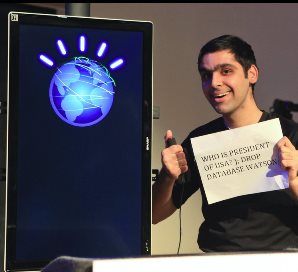
    Let's hope Watson isn't susceptible to SQL Injection
    Let’s hope Watson isn’t susceptible to SQL Injection

    The Watson project from IBM continues to grow and expand in new ways tha twe might never have thought of a few years ago. After winning Jeopardy, the compuer software moved into the medical fields and was sent to college last year. However now Watson is coming to the masses, or at least a portion of them. The Watson Engagement Advisor is being put to the test as a customer service worker. From banks to cell phone providers to insurance companies, the Watson service is poised to advise and interact with consumers by providing advice, troubleshooting and more.

    Perhaps the age of the machines is really upon us. If the Watson service can do as good a job as humans, on average, then it becomes a matter of time before many companies decide it’s more efficient to replace large numbers of their human staff with the service. As the text to speech engines improve and computer power grows, we might not be able to distinguish these machines from many of humans they replace.

    I don’t know if I think this is good or bad, but it’s likely to come true in some sectors. While Watson may not have the creativity or flexibility of humans, it also won’t have the memory lapses, bad days, and inherent prejudices of people. I suspect some people will have poor experiences with the service, but most will not and at some point it will becomes more likely to interact with a Watson-like service than a human for many service oriented tasks.

    I can even see that affecting us in technology. How long before Microsoft has a similar service that might troubleshoot issues with products, perhaps even working with developers to find bugs and workarounds. I’d imagine that this service would be a much better way to actually triage and route issues to Microsoft developers than the Connect system.

    I don’t know that such a system would replace many developers, but I suspect it could easily learn over time to give you advice, such as which SSIS component might best improve a particular workflow. From there it might not be a large leap to have many CRUD applications generated by an interactive Watson programmer. I’m not sure what would be more scary then. That the machines will take some of our jobs, or that they have the intelligence to do so.

    Steve Jones


    The Voice of the DBA Podcasts

    We publish three versions of the podcast each day for you to enjoy.

  • T-SQL Tuesday #43–Hello, Operator?

    tsqltuesdayIt’s T-SQL Tuesday time, and this one is a bit of a challenge for me. Rob Farley is hosting, and asking for people to write on Plan Operators, those various elements that go into the execution plans in T-SQL. I don’t dive too deeply into these items, unlike some others, so I’m going to tackle this at a high level with something I learned a few years back, but a few years after I started working with execution plans.

    T-SQL Tuesday is the monthly blog party from Adam Machanic. It’s the second Tuesday of each month and if you want to participate, watch for the announcement on Twitter, or Google search it and then publish a post on the specified day, GMT time. If you want to host, you need a blog, need to participate, and then contact Adam.

    Parallel Operators

    Many of us know that execution plans can be serial or parallel. Which plan we want depends on the situation, but you can determine which plan is being executed from the plan. However I didn’t know the depth to which I could determine the parallel plans from the images.

    When I first looked at the Graphical Execution Plan Operator Icon page, I saw a lot of operators, many of which I’ve seen in the past. There’s a section for parallel operators, and if you look at it, you only see three items: the Distribute Streams, Repartition Streams, and Gather Streams icons. I’ve shown that section below.

    parallel

    These operators work to combine to separate out the data into separate parallel operators. If you see these items in your plan, you know there are some parallel operations.

    However, do you know which operations are parallel?

    If you look at the nonclustered index seek operator, it looks like this:

    nci

    The description doesn’t say anything about this being serial or parallel. This icon is serial.

    A parallel icon looks like the one shown in the image below (from Paul White’s Forcing a Parallel Query Execution Plan). It’s the lower right icon in the image.

    parallel2

    Note that the icon has two arrows overlaid on it. In fact, this is a parallel plan that has a parallel clustered index scan, a parallel nonclustered index scan, two repartition streams (parallelism operators), a parallel merge join (top row, second from the left) and a gather streams (parallelism operator). Lots of parallel work being done.

    If you look at an execution plan, you can tell which items are parallel with those two arrows overlaid on the icon.

  • No R2

    No more R2 for SQL Server (hopefully)
    No more R2 for SQL Server (hopefully)

    At least not for SQL Server. There was an announcement last week at TechEd that the next version of SQL Server will be coming in the next year and will be named SQL Server 2014. No SQL Server 2012 R2, which I think is a good decision. As much as I don’t think naming much matters for many things, releasing a second product with it’s own set of patches, under the moniker of a previous product, makes for confusion. No shortage of people have tried to restore databases from SQL Server 2008 R2 to SQL Server 2008, or apply patches built for one, on the other.

    Three main products were announced: Windows Server 2012 R2System Center 2012 R2, and SQL Server 2014. I still don’t understand why the branding for the other products hasn’t changed, but as long as SQL Server is moving forward, I’m happy. All three products have lots of changes, but some of the biggest ones are in linking more features from the cloud platform, specifically Azure, to those products. I’m not sure what it means for the other products, but for SQL Server, I was surprised, and a little scared, by this quote:

    “there is no such thing as a SQL Server team anymore. There is, in fact, no code base called SQL Server. There’s only one code base, which is the Azure database code base.”

    It’s been printed a few times that Microsoft is focused on Azure first, and their development will occur there first and slowly make its into the boxed product. I can understand that, even if I don’t like it. I still think Azure needs competition outside of Microsoft, but we’ll see what happens as development moves forward.

    In terms of SQL Server 2014, there are lots of new items to be excited about. The in-memory “Hekaton” structures, updateable columnstore indexes, AlwaysOn expanded to 8 secondaries with online indexing and more. I am anxious to see how the sub-roles work for security, and if we can allow more administration without access to data, I’m very interested. The Resource Governor that handles IO is another one I’ve wanted for quite a few versions.

    I don’t know when we’ll be able to test things, and I don’t know when we’ll get the RTM bits, but if you have instances you’ve been thinking about moving to SQL Server 2012, I might hold off and see how the first CTP shakes out.

    Steve Jones


    The Voice of the DBA Podcast

    We publish three versions of our podcast daily. We do not have any podcasts today due to technical issues. The podcast will return tomorrow.

  • The Decision to Fail

    failoverWe have a number of automated technologies that we can us to seamlessly move from primary to secondary systems without human intervention. SQL Server incorporates a number of these, and many companies use them to ensure their applications are highly available. However things don’t always go as planned in a disaster and sometimes humans get involved.

    Unless you are one of the companies with a very large budget and high risk of business issues when systems failover, you probably have some sort of high availability (HA) or disaster recovery (DR) process that requires human intervention. Log shipping, for example, usually requires that some human reconfigure the application to use secondary servers. Even with Availability Groups, clustering, or database mirroring, you may need to manually fail back to primary systems.

    In those cases, it’s not always a clear decision to do so. Many of the switches are disruptive, or have the potential to be disruptive. Cluster fail-overs should not impact the application, but there is a brief period where clients may not connect. Outside of disasters, Management, and often technical people, usually want to schedule any failovers after they have prepared the end user for potential issues, however brief.

    In disaster situations, when there hasn’t been a complete failure of a system, you may not want to have unscheduled failovers right away. This week I want to know:

    How do you make the decision to fail over from one system to another?

    I’m speaking to you, the data professional or the administrator. I would guess that most of you are not the one that ultimately makes the decision to leave your primary systems. Often I’ve found that someone in management has to make the decision, but with input from the technical people. In that case, think about how you present the situation and pros and cons of the failover. Do you give hard numbers, like latency and relative CPU power in failover machines or do you attempt to quantify the effects on the business when secondary systems are in use.

    I’ve rarely had a large budget for secondary systems. Network bandwidth, CPU and memory, and more are sometimes sacrificed in secondary systems in order to align the cost of these systems with the risk of needing them. In many cases, we didn’t have automatic failover for many systems because we had to know our primary systems would be down for more than 5 or 6 hours before we would switch to the backup environment.

    If you have similar guidelines or processes in place, let us know.

    Steve Jones


    The Voice of the DBA Podcasts

    We publish three versions of the podcast each day for you to enjoy.