Author: way0utwest

  • Data Darwinism

    A great look at the future, where data about you will decide much about your life.
    A great look at the future, where data about you will decide much about your life.

    A few years ago my son asked me to buy him The Unincorporated Man. After he finished it, he gave it to me and we read all four books in the series, which we both enjoyed. The premise of this future civilization is that each person is their own corporation, selling stock in themselves to anyone in the world. As with a company, the better your performance at life, the higher the price. However there is also accountability, with your actions, jobs, etc., potentially limited by your “board of directors”, who are the shareholders in your corporation. It sounds a little drastic, but it’s not as bad as you might think. It’s actually a neat idea.

    It’s also somewhat of the way the world works now, although without all the disclosure. In today’s world it’s actually much easier to hide your flaws and poor performance because the information isn’t always readily available to potential employers. Some of us see this in the poor performance of colleagues, who were hired with good recommendations or interviews. We may find out later that these were exaggerated, though we often can’t (or won’t) do anything about this, suffering through poor performance from the individual or company.

    That may be changing. I ran across an interesting article where vehicle drivers were let go from their jobs because clients had rated them poorly or complained about them. There is some controversy here, but it does bring up the issue of more companies that look to “go where the data goes” in operating their businesses. It’s all too easy to begin using metrics, measurements, feedback, and more to make business decisions. This is one of the driving forces being building business intelligence systems in our industry. However if the models, assumptions, or data are flawed, bad decisions are not only possible, but probable. It’s easy to trust the computer’s report more than is prudent, especially when we have no good way of measuring the quality, or even appropriate interpretation of the data.

    There are lots of BI systems that work well, and provide companies with many benefits, but there are probably also plenty of them that don’t work well and we don’t hear about them. There are systems that use flawed, incomplete, or otherwise compromised models to help business leaders make decisions. Ultimately a BI system needs lots of human intelligence added to it, including judgement and refinement, constant tweaking, and a bit of common sense. I would hope that using data to cut off some service, fire an employee (or decline to interview someone), or make any far reaching decision has a lot of experience and audit built into the system to prevent its abuse.

    Steve Jones


    The Voice of the DBA Podcasts

    We publish three versions of the podcast each day for you to enjoy.

  • Reminders and Rehearsal

    I’ve spoken at quite a few SQL Saturday events. I won’t hit 50 this year, like Kevin Boles, but by my count, I’ve been to 21, with 4 or 5 more coming this year.  I have no idea when I’ll get to 50, but I hope I do.

    Capture_028

    That’s in addition to other events, which will likely bring my 2013 total to close to 15 events, similar to what I’ve done the last few years. That doesn’t seem like a lot, maybe 1 every six weeks, but I end up doing multiple talks, on multiple subjects sometimes. There was a stretch late last year where I did 12 talks in 7 different areas in about 3 weeks. It was slightly confusing for me.

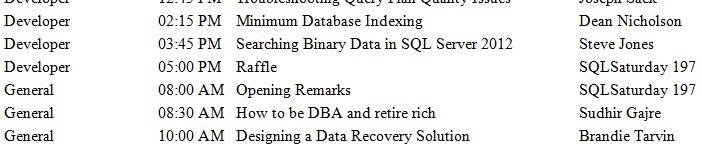
    Yesterday I received an email from SQL Saturday #197 – Omaha, which had the schedule in it. I’d glanced at it before, and had seen I was giving my Encryption Primer talk, but this time as I scrolled down, I saw my name at the end.

    sqlsat197

    Hmmm, that didn’t say “The Encryption Primer”. I’m glad I looked and double checked the schedule because I’m giving two talks. In addition to encryption, I’m talking FTS with Searching Binary Data in SQL Server.

    I’ve given the talk before, and I’m not too worried about it, but I do want to refresh my memory of the flow, and practice the demos again. I have given the Encryption talk a few times this year already, but I was planning on double checking demos again before the event. Especially as I changed the talk around and added some material for a variation I’m giving next week at SQL Intersection.

    I find it’s always good to rehearse my talks. I’m comfortable in front of people, and I know I can get through the talk, but I want things to flow and to make sense to attendees, The more practice I do, the better things go. The less “ums”, “errs” and other placeholders I use as well.

    Plus this will be good practice for SQL Bits, where I’ll deliver this talk again in May.

  • Salaries in 2013

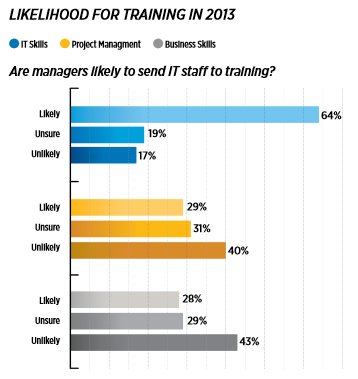
    Training is a big reason people give for making more money.
    Training is a big reason people give for making more money.

    Salaries are looking good, at least in software development in the US. Windows IT Pro released a report (PDF) that came from over a half million surveys that were completed in late 2012. You can read the report, but the highlights were that more people were satisfied with their jobs (nearly 60%) with two thirds of the respondents saying their received a raise with about half getting bonuses. The downsides were that salaries and bonuses had trended downward from the last 4 hours, which shows that economic conditions in IT are not as great as we might like.

    I found the survey on Trainsignal’s blog, which isn’t surprising given one other highlight. Eighter percent of respondents said that training in 2012 was a positive investment for themselves and their company. Ninety percent of those people said they learned new skills that could be used in their job. That’s a great point, and one that I think is worth emphasizing to your management. Budgets are tight, and companies can be reluctant to invest in training, but surveys like this can help convince them the investment is worthwhile.

    However I wouldn’t just expect my company to train me. Many of you reading this don’t, since you are a member of SQLServerCentral and are trying to learn more about your field. I’d point out those investments, and include any monetary or time investments you make on your own. If you attend events, buy books, practice at home, showcase those to your management and task that they make some investment in you as well.

    Everything is negotiable, and if they are worried you might take the training and leave, ask for an agreement that you will remain with the company for xx months for $yy spent on training. It’s a good trade, and if you get a great offer to leave, pay back the company and call it an investment in your career.

    I think technology is still one of the best fields to be in for working conditions and compensation, if you enjoy the work. However you to succeed and enjoy a good career, you need to continue to work on your skills on a regular basis.

    Steve Jones


    The Voice of the DBA Podcasts

    We normally publish three versions of the podcast each day for you to enjoy. We have no podcasts today due to technical difficulties.

  • Google Glass Your Database

    You might be searching your database this way soon.
    You might be searching your database this way soon.

    I’m sure most of you have heard of Google Glass by now. This is a hardware platform, literally built into a set of glasses that’s designed to mate with your Android cell phone and allow you to access and use your phone in conjunction with your glasses. It’s an interesting idea, and while I’m not sure if it will catch on, I’d like to see some parts of this technology come to fruition.

    There’s a new company that is trying something similar, providing a new way to access databases. Virtual Search, Inc. has combined a set of glasses with a built in display with a set of virtual reality gloves and proprietary software to allow you to search your Analysis Services cubes in a quick and intuitive manner.

    Users can connect to a cube and then visualize the aggregations in a starscape-like manner. With gestures that are customizable for each user, the software allows the wearer to quickly add or remove filters along dimensions and measures in a way that can speed up querying for the business user. Data dictionaries and other meta data can pop up in the display on the side as users quickly move through what-if scenarios.

    I have to think this would be an easy sell in many companies, if only for the cachet of cool that this would bestow upon the users. I’m sure many of my employers would spring for the hardware and likely fund a project to build new cubes to test the interface. I’m also sorry to tell you this isn’t true, nor likely to be true. It’s my little April first thought for the day. As a short apology, the podcast for the day is a series of bloopers so you can laugh at my inability to record a short 3 minute segment each day.

    Hopefully you enjoyed this and while you might be drooling over the prospect, you aren’t too disappointed. If any of you software developers are so inclined to try building something like this, you might float your idea over at Kickstarter.

    Steve Jones

    Bloopers

    Here are a few funny moments from the podcasts