Author: way0utwest

  • Macbook Air v Surface Pro

    I love my MacBook Air. It’s small, light, and it works well as a traveling laptop for me. It starts and stops instantly, and the only complaint I have is that my 2011 version only has 4GB of RAM and no USB 3.0. The 2012 version improves, and I’d upgrade, but I’m waiting to see about the refresh that is supposed to come this summer. If the update is substantial, I’ll be ebay’ing mine and finding a new one.

    However I’m not blind to other options. I hadn’t seen many Windows laptops that are as small and light as an Air (or as well-built). However I ran across this article on Living With A Surface Pro for a week. In it, the author mentioned the Pro specs are better than the Air specs.

    Hmmmm. Intriguing. Let’s see.

    Surface Pro (from Microsoft ):

    • 2lbs
    • 42 Wh battery – 4,5 hours (from Microsoft) 2.5 hours (from the author)
    • 10.81” x 6.81” (1920×1080)
    • 128GB storage
    • Intel i5, 4GB
    • USB 3.0

    Macbook (from Apple)

    • 2.38lbs
    • 35 Wh – up to 5 hours (my current one gets 4 hours on Netflix according to my daughter)
    • 11.6” display (1366 x 768)
    • 128GB storage
    • Intel i5, 8GB
    • USB 3.0


    Those are fairly comparable. I’ve somewhat listed things in the order that they matter to me. Weight is big for me, and both of these are similar. If I add in a type keyboard, then the weight is probably similar. Battery is next, and I think this is a bit of a killer. I have to think about it, but that might be an issue.

    The Surface display is a much higher resolution. Does that matter? I’m not sure. A good display matters to me, but I’m not watching blu-ray on this thing, and for the most part, I won’t have anything to compare it to most days. I like the Air display, and I need to check out a Surface to see if it really makes a difference.

    Storage is the same, and with USB 3, not sure I care here. Both are Intel i5s, but the Air can go to 8GB. For me, doing work (as in SQL Server work), this matters. If the Pro can’t be upgraded or won’t come with more, not sure it’s a valid choice.

    My Air will be two years old later this year, and it’s working well, though depending on the talks I plan to give later this year, the 4GB might not be enough for me. I hate to think about a MacBook, both in size and weight, and I’m not sure I’ve seen a Wintel that I like. I’m also not sure a Surface will cut it. I have nothing against the Surface, and it intrigues me. I’ll have to go spend an hour at the MS store one day and see what I think.

  • Toggle Switches

    More toggle switches mean more decisions, but also more control. Are they worth it?
    More toggle switches mean more decisions, but also more control. Are they worth it?

    When SQL Server 7 was released, it was touted as a self-tuning, self optimizing database platform requiring much less attention from a DBA. The product had relatively few tuning options and limited information available about how it processed queries. DBAs were worried about losing their jobs, though as history has shown us, the concerns were overblown. There was plenty of work for DBAs then, and that has continued through the current SQL Server 2012 release.

    However the number of tuning options, and the wealth of information exposed by SQL Server to developers and administrators has grown tremendously over the years. We have DMVs and DMFs, many more tuning options, new hints, isolation levels, and more that enable the DBA to manage SQL Server fairly in a very granular way when they want to do so. From what I understand, there are still less options than other platforms have and often the best advice I seen given from various people is to write more efficient code and let SQL Server still determine the optimal plan for query execution.

    This week, I’m curious how you feel about the tuning and configuration options in SQL Server. The downside of the additional options in other platforms is that there are more choices to make, more DBA decisions, and more administrative overhead in regularly, and constantly tuning these systems.

    Do you want more toggle switches in SQL Server?

    I don’t mean two position switches, like the physical ones used on the Apollo command module, but rather just switches you can use in SQL Server. These could be database or instance level, sp_configure settings, they could be query hints, they could be session options. Do you want more options, or do you think we have a lot to work with already?

    Personally I like the idea that we can change behaviors, but I’d really prefer that the defaults were well set and somewhat self-tuning for most installations.

    Steve Jones


    The Voice of the DBA Podcasts

    We publish three versions of the podcast each day for you to enjoy.

  • Customizing SSMS – Bigger Queries

    This is a short series on some customizations in SSMS to make it visually more appealing.

    As a presenter, I’ve learned how to change the way Management Studio (SSMS) looks to make it easier for people to see the screen on a projector. I had wrongly assumed that so many people knew many of these tricks, which is a poor attitude on my part. That should be especially apparent as I saw a presentation recently where the speaker didn’t know how to make things easier to see.

    Here’s another item I saw someone struggle with recently, the query font size.

    The Default View

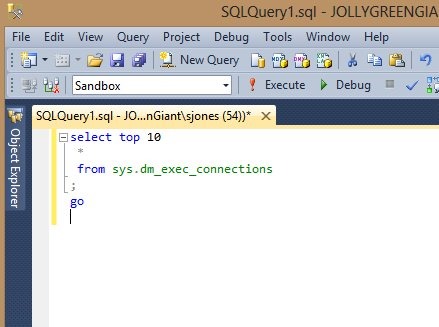
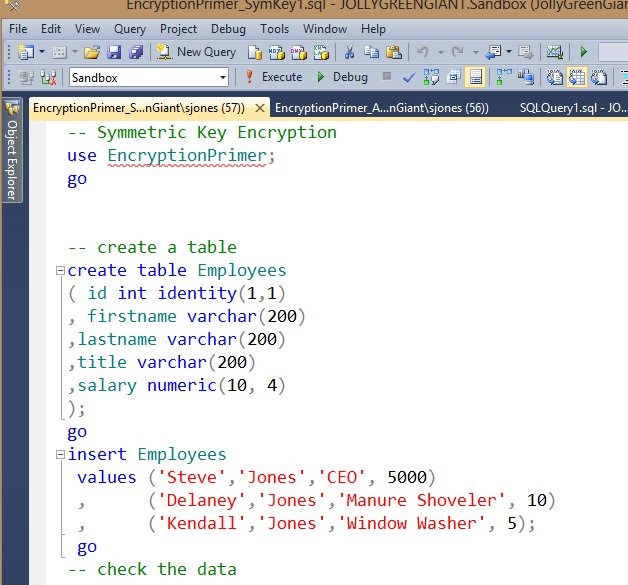
    When you install SSMS, this is what you often get, and how your queries look:

    ssms_f

    Not easy to read, especially for these old eyes. When someone uses the default settings in SSMS and presents on a big screen, I am usually struggling to see, sometimes even when I sit in the front row.

    Customizing

    You can make SSMS easier to read for yourself in a couple ways. The first is the quickest, but it’s a change for only the current SSMS execution. If you close and re-launch it, things will return back to the previous settings.

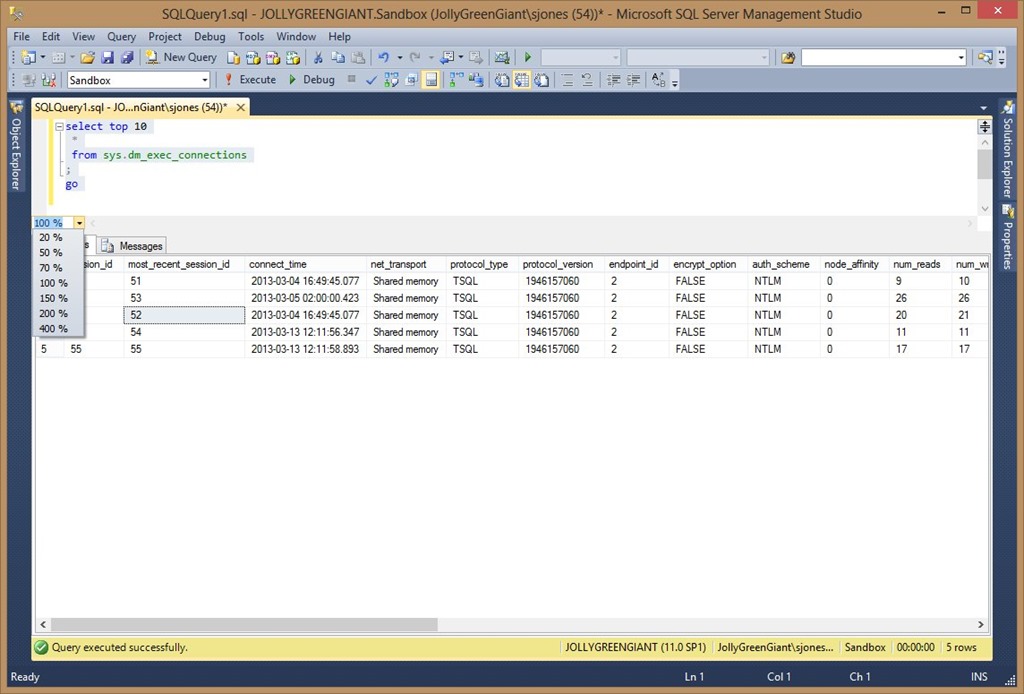
    If you look below the query and above the results, there’s a drop down that says 100% in it.

    ssms_g

    If you click that, you’ll get a drop down of some percentages you can choose.

    ssms_h

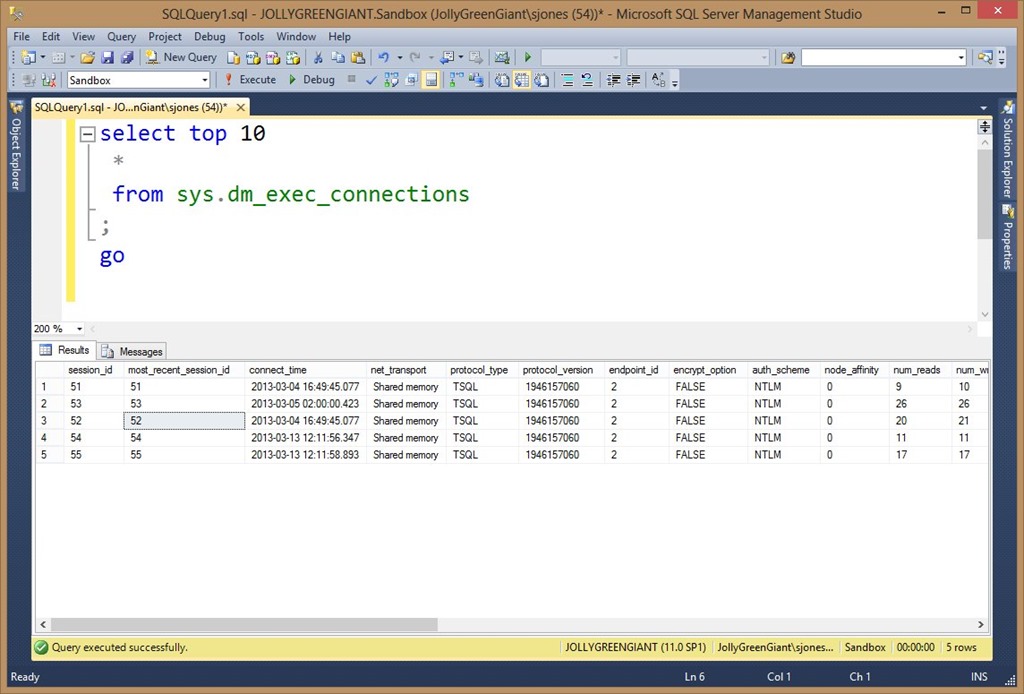
    These percentages will change the size of the query pane. For example, if I choose 200%, you can see things are much easier to read. The query pane is much better than the results. This is great for quick changes when you are presenting.

    ssms_i

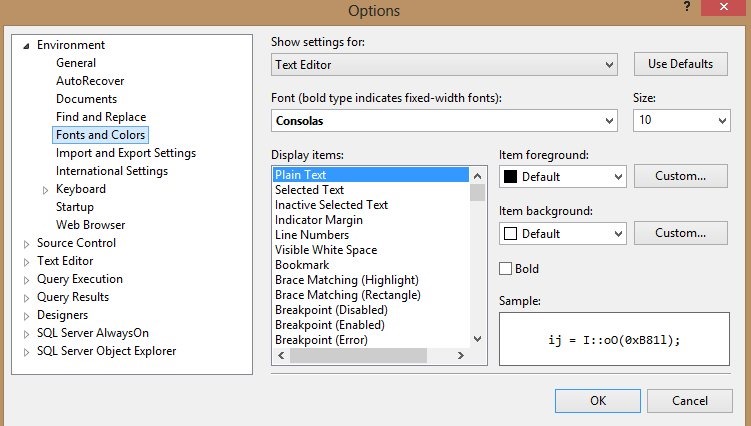
    For permanent changes, this is what I quickly do. Go to the Tools menu at the top of SSMS and select Options. You will get this dialog:

    Capture_002

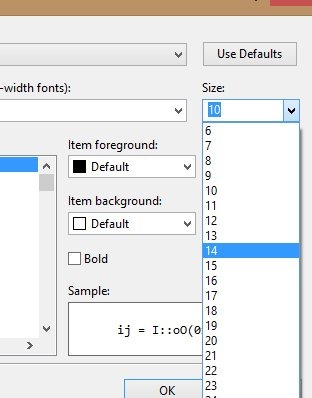
    I’ve selected “Fonts and Colors” from the left already, but once you do that, there’s a “Size” drop down on the right. Choose that.

    Capture_003

    I usually set that to 14 and it looks good for me. A balance of large size, but still being able to get lots of code on the screen.

    Capture_004

    This make it easier to read your code. In another post I’ll talk about results.

  • Zettabytes and Beyond

    Billions and billions of stars don't seem so large anymore.
    Billions and billions of stars don’t seem so large anymore.

    The old Carl Sagan quote about billions and billions of stars in the universe doesn’t seem so large anymore. In fact, a billion of anything, while a large number, seems immense only until we talk about the scale of data. How much data is there in the world? I’m not sure. As I was researching this for a new presentation, I’m not sure I can even conceive of the scale of data creation occurring in the world today, much less how much data we have.

    Think back 30 years ago, as computers were just starting to become household items. The high density floppy disk (not really very floppy) was a 1.44MB disk. At the time, this held what felt like lots of data in terms of text pages. However many songs we listen to today wouldn’t fit on this media. As we’ve progressed through CDs and DVDs to flash drives, we’ve grown the storage capacity of our hardware by unbelievable amounts. My phone has 64GB of storage, which is a level of growth so far removed from the Apollo guidance computer’s 2kb that comparisons don’t do it justice.

    We used to create data storage analogies by listing the number of books that would fit on the device. Today that’s meaningless. The 30,000 ebooks on Bookworm fit in 20GB. That’s a number of books that’s hard to conceive of. My local library branch has about 20,000 books, so I can somewhat grasp that scale, but not really. Two libraries worth of books is a level of words and knowledge that I’m not sure I appreciate. Trying to understand the amount of storage a library like the Vatican needs, is beyond comprehension.

    The grasp of how much digital data we create is even more mind boggling. I saw a talk recently that said 24 hours worth of digital video is being uploaded to YouTube every second. Every second. That’s an impressive statistic, but I’m not sure we can even comprehend what that means. An even more daunting statistic is that all the knowledge recorded from the Gutenberg printing press invention through the next 500 years totaled about 1 exabyte. At current rates, we create an exabyte of digital data in less than a month and that’s only going to increase. If you read some of the analogies in this report from EMC, they’re almost silly, and certainly not something most of us can relate to. I certainly can’t picture 75 billion iPads.

    These days the amount of data we are dealing with is growing faster than ever, and that means it’s a good time to be in the data business. From “Big Data” to data warehousing to the common OLTP databases we manage, there is no shortage of bits and bytes we will get the chance to manage. For pay.

    Steve Jones


    The Voice of the DBA Podcasts

    We publish three versions of the podcast each day for you to enjoy.