Author: way0utwest

  • Baselines

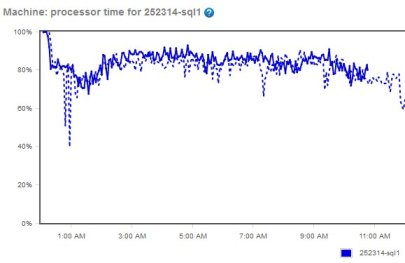
    You come into work one day and as you sit down, your phone rings. It’s one of the business groups complaining that the database is running slow. You check the server and find CPU at 80%, 800 pages/sec, disk IOps of 230 and 124 transactions/sec. Is the database the problem?
    Baselines are important to understand how your system is performing.
    Baselines are important to understand how your system is performing.
    Good DBAs know that baselines are essential. If you don’t know what values to expect from your server, it’s often hard to determine if the system is running slower than normal. Normal is something you need to define for each system, preferably in an automated way that updates your baseline over time.

    When building a baseline, however, how do you average out the information?

    That’s the poll this Friday. Let’s assume that you are examining the CPU percentage for a SQL Server and you have data points from every 5 minutes across the last month. What’s the average? Do you take the straight average? Do you break this down to hourly segments and then create further analysis that looks at different business periods?

    It can become problematic very quickly. Many of us have slow and busy periods. Do we want an average that’s perhaps lowered by the slow periods in our workload? Do we want to break out the averages for maintenance periods separately from normal operations? If you are looking to compare today’s values, do you look at yesterday’s for the same time period? Last week? An average of all points across the last week?

    Let us know what methodology you use and if you’d like to describe it in more than a paragraph or two, we’d love to have some articles published here on the site.

    Steve Jones


    The Voice of the DBA Podcasts

    We publish three versions of the podcast each day for you to enjoy.

  • Activating Windows 8 from MSDN

    I installed Windows 8 recently and needed to activate it. I didn’t do this on the install since I didn’t have an Internet connection when I first set things up. This is a hardwired desktop, and I had to move it to my office to plug it in. However I didn’t have a spare monitor to use with it once it was moved, and when I connected over RDP to start setting things up, I realized it wasn’t activated.

    No problem, I’ll just run the Activation from the Control Panel/Action Center. How to get to the Control Panel? I didn’t see an easy way, but I did remember that if I right clicked the desktop, I’d get a “Personalization” dialog, which was a sub-folder of Control Panel. That worked, I made my way to the Action center, which gave me a spot to click on to Activate things. I did and got an error:

    Activation Error: Code 0x8007232b
    DNS Name does not exist

    That threw me. It said if I had issues, look for other methods in the
    Control Panel. I didn’t see any, so I asked the Google what to do.

    The first result was this KB article, which talked about the install being from a volume license of some sort. That was true, as I’d used my MSDN license to install. Since I didn’t have a local activation server, I used the first method of running the slmgr command line with my license key.

    That worked great and I was up and running. I hadn’t seen that before, so it was an interesting experience.

    Working with Win 8 across RDP, without a touch screen was interesting as well. Definitely a few things to get used to here.

  • A New Type of Colocation Facility

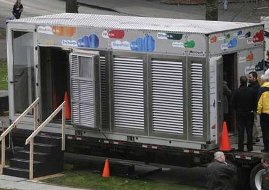
    Having a data center like this would certainly make it easy to grow your computing capacity quickly.
    Having a data center like this would certainly make it easy to grow your computing capacity quickly.

    Many of us in the technology industry have worked with a data center of some sort. It might be a closet in our employer’s building, a dedicated room with separate power and cooling, or perhaps rented space at a data center facility. In my career, I’ve worked with a variety of data centers over the years, and it’s been interesting to watch them evolve as new knowledge and technology becomes available.

    I remember having a dedicated room so cold that I kept a coat in by cube, even during the 95F summers. These days I have space in a Denver center that has hot and cold aisles. The latter still requires me to carry a coat, but any significant amount of time in the former means I’m down to just a t-shirt.

    As cloud computing grows, capacity becomes important (along with bandwidth and reliability), but the ability to scale your computing capacity up or down may be more important as your customer base grows. Microsoft is taking on this challenge and looking to build”generation 4″ data centers, which may be empty buildings that have power. In some places, these data centers might just be parking lots with power feeds and a fence.

    The cost of construction can be extremely high for new facilities, but imagine a section of a parking garage, or even a secured lot next to your building. A container of servers is dropped off and you connect power, network, and maybe cooling lines (or maybe no cooling). We could potentially even have containers of computing machines and containers of storage. If we ever get cloud computing software inside of companies, this might be the way in which we handle our future data center needs.

    Steve Jones


    The Voice of the DBA Podcasts

    We publish three versions of the podcast each day for you to enjoy.

  • SQL and Skiing – SQL Saturday #183

    This weekend of SQL Saturday #183 in Albuquerque, NM. It’s the first SQL Saturday in that state, and it’s a relatively short drive from Colorado. Six hours from my house, S of Denver, and a nice city. My brother used to live there, and I made a few trips to see him.

    I’m looking forward to going back, but not to tour the city. I’m sure that would be fun, but there’s a side diversion between Denver and Abuquerque:  Taos.

    Taos, NM has two ski resorts nearby: Taos Ski Valley and Angel Fire. I’ve never been to either of them, and I’d like to see what it’s like to ski in New Mexico. A few of my fellow Coloradans feel the same way and we’ve organized a bit of a caravan trip.

    Two or three of us are planning to drive Thursday night with two or three passengers, for a total of 5 or 6. We’ll ski Friday and then continue down to Albuquerque for the speaker event Friday night and SQL Saturday #183 on Saturday. A few of us will then go back to Taos on Saturday. Whether we will ski on Sunday depends on how these older bodies feel.

    I love the SQL Saturday events, and think they’re a great chance to teach people things, learn things, and give vendors a chance to meet potential customers face to face. However the networking is one of the best opportunities that I’ve seen from these events. The chance to meet other SQL Server professionals, find out what they are doing, learn about new features, functions, applications and opportunities is amazing.

    The chance to bond and make a new friend or acquaintance is one you shouldn’t pass up. You never know when you network might help you, and there are plenty of companies that view networks as more important than recruiters.

    I’m looking forward to some networking on the drive, getting to better know the people I’ve met at many local events. I’m also looking forward to speaking on Branding at the event and meeting even more SQL Server pros from New Mexico.

    If you get the chance to attend an event, it’s worth your time if you meet people and talk with them. I encourage you to try this in the future, especially at a SQL Saturday. Talk to people in sessions, between them, or even later at the after party.