Author: way0utwest

  • Office Work

    rg_buildingI have been working at home for over 8 years, sharing an office with my wife for most of that time. I like working at home, though I do notice that if my wife is gone for a few days, I go a little stir crazy being completely by myself. It’s almost “too quiet” for me and I end up sometimes going to a Starbucks to work, just to have some ambient noise.

    This week I’m in the UK, visiting with my group at Red Gate Software. Typically I spend a few days in a conference room with my group and then a day or two in the office. Today is an office day, and it’s amazing just how busy and crowded the Red Gate spaces have become.

    You can see the Red Gate building here, two wings, with the upper two floors being completely Red Gate space. When I came last year, the quadrant where my group is located was fairly empty. Now it’s quite full, with most desks in use.

    rgoffice

    Most of the space is busy, and the lunch service from the in house cafeteria is very busy. It was so busy I forgot to get a picture before eating, being slightly worried about getting my own food and finding a seat. I went back near the end of lunch and snapped this one:

    lunch


    The SQL Servery, as it’s known, was just getting going before, but now it’s in full swing, with the menu’s posted, and lots of choices. Yesterday I had a lamb ragout and today was a spicy pasta vegetarian dish instead of the bangers and mash (shudder). Juices of all sorts are around, along with the most important piece of technology in the office:

    coffee

    I have made liberal use of this machine in the two days I’ve been in the office. The food is mostly healthy, which is good to see. At first I was a little put off that the only sodas in the office are in a vending machine, requiring all sorts of strange UK coins, but on this visit I’ve rarely had a soda all week and it’s been fine. I think if I had a company these days I’d consider providing healthy snacks and drinks for free and letting people buy the unhealthy stuff if they want.

    minimeMy “mini-me” is still there, which is cool. I thought this was one of the coolest pieces of art produced by the Red Gate designers. When I first saw it, I thought it was great. There are a few other walls that are decorated with various paintings and drawings.

    The office is bright and airy, and surprisingly quiet given all the people there.

    But there’s lots of them, more than I’m used to, so it’s a bit strange to walk around to get water or coffee and dodge people. Usually I’m just dodging a dog or two.

    One other very interesting thing is the memory wall. A long wall, with some cork sections, and some metal sections, where people post photos from company events and various press articles. It seems there are regular Red Gate events (which I rarely get to) that build bonds and help keep the company close together. I need to send something over to place up there.
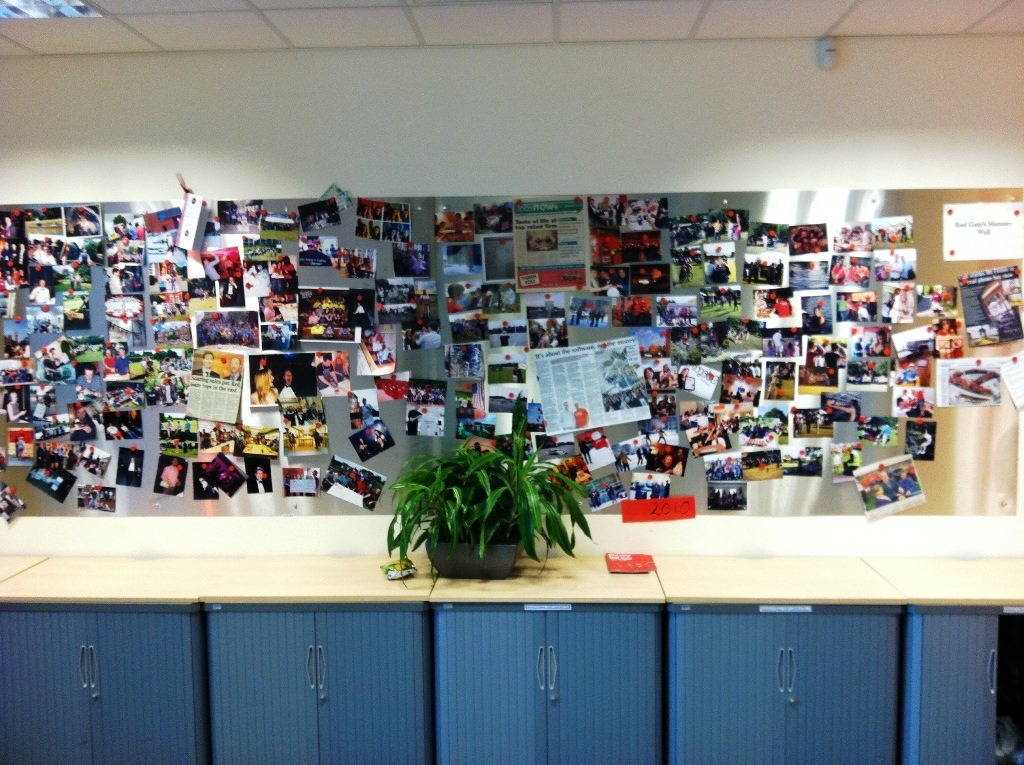
    memory_wall

    I’m not much of a foosball player, but I see games going on regularly in the lower lobby area. There is a ping pong table, and it makes me think I need to get mine set up in the basement back at the ranch.

    Not much work getting done this week, but it’s a good trip and good to see so many of the people I correspond with on a regular basis and others I’ve known for years.

  • DRI or No DRI?

    This editorial was originally published on Feb 19, 2006. We are reprinting pieces this week as Steve is traveling in the UK.

    There is a great debate going on in the forums about using PKs/FKs to enforce RI, in other words, declarative referential integrity (DRI) as opposed to using code logic to ensure that proper relationships are maintained in a schema. The opening post is a DBA stunned that developers in his new company do not use DRI. The reason given is performance is degraded, and that’s one that I can buy. There is additional overhead for checks with DRI, but it’s minimal and actually David Poole has a great article about this topic coming soon.

    It’s interesting that one of the questions is about how many 3rd party applications do not use DRI in their databases. Who knows why, though my suspicion is that they can easily “fix” issues with the applications with backend updates rather than maintaining good DB design practices. Or that they can easily alter the application to meet changing needs at various customers’ sites.

    I think it’s mostly the latter reason. That and laziness. I think the vast majority of developers are lazy by nature and dealing with DRI constraints when building an application is a pain. It’s a pain for me, but I still think it’s a good idea. Just like stored procedures add some overhead, so does DRI and many developers I have seen, both building shrink wrap and corporate software, don’t want to deal with the overhead.

    Personally I like having DRI implemented for the same reason that developers use objects, libraries, functions, and other consolidation techniques. It centralizes the “rules” about your application and ensures that they are always used. I agree there is overhead, but it’s a minimal amount and if you are seeing this on most servers then you are probably underpowered.

    My big concern is that often multiple applications or even multiple modules of a single application often need the same business rules: like no orders unless we have a valid customer number. If you depend on the application to enforce this, then you are gambling that every developer will do it correctly and the same way. In small, tightly controlled and managed environments, this works great. But as you grow your development teams, then it is easy for someone to forget to implement some RI rule or implement it differently than others.

    And those bugs are hard to find.

    I don’t think that every application needs DRI setup in it, but if you choose to not implement it, be sure you understand the consequences of your actions. And your boss does as well.

    Steve Jones

  • Here’s a Reason to Document

    A search engine for code

    This editorial was originally published on Feb 17, 2006. Steve is traveling in the UK this week and we are re-printing some old pieces.

    A new search engine, Krugle, set to launch next month, is supposed to focus on code. Mostly open source code, but also places like SQLServerCentral.com, which has scripts and other types of code available. Wired has a good article on the idea behind this search.

    It’s an interesting idea, though given the types of comments and the wide range of ways that things are described, I wonder if it will work. I know that we get lots of posts in the forums that I easily find answers for using Google when other don’t. I suspect that I am just searching on better terms than others. Course that doesn’t always work for my own questions, so perhaps it’s a second set of eyes that really help.

    However this also depends on the actual coders spending some time to properly describe their system. That’s always a difficult task. But even assuming that they will describe their code well, how will you know if it will “plug in” easily to your system? I’ve seen lots of code that wouldn’t easily integrate with something I was writing.

    And if I checked out 3 or 4 of these incompatible, or not easily integrated systems, from a search engine, I’d be tempted to just write my own. Actually I think lots of developers write their own code, or build on a base and then do everything themselves because it takes so long to integrate disparate code at times.

    Still it’s a great idea and I hope it works.

    Update Jul 13, 2011: Has anyone used, or is using, Krugle?

  • Bad Eyes

    This editorial was originally published on Jan 9, 2006. Steve is traveling to the UK this week and we are reprinting a few older editorials.

    It seems that most DBAs that I know are a little bit older and more experienced. It’s fairly rare that I see someone really young, right out of college, early 20s, etc., as a DBA. So when I saw this question on Slashdot about computers and vision, it caught my eye. I’m one of those “visually challenged” individuals that asked the question. And I’ve been working with computers pretty much since 1991 as a career. In middle school I slowly found out that my vision was failing. That was when my career as a baseball catcher ended. With glasses on, I couldn’t pull off the mask without pulling the glasses with them and ensuring that I’d catch the ball with my cheek instead of my glove 🙂

    I’m not a 15 hour a day computer user, but I am a 7-8 or more user. Fortunately it’s not all at one stretch. Usually it’s early am, then a break, then most of the day until the kids come home, and then late at night. At least the last few years it’s been like that. Before that I was mostly a 7-8 hour stretch person and a little at night.

    Through all that, including 5-6 years of working as a bartender in a late night, smoky atmosphere, I’ve had pretty much the same prescription for about 15 years. I switched to contacts in high school, but since college I’ve pretty much been the same, blind 20-400 in both eyes. I’m getting an eye exam today, so we’ll see if it holds for another year.

    I think the person asking the question has other problems, 15 hours a day in front of the computer being the least of them, but it still is worth asking the question. Is a monitor bad for your eyes? Is it any different than staring at anything in a repetitive work environment.

    One of the things suggested is a light source behind the monitor. That’s an interesting one. Especially for the guys that like to work in the dark. I’ve had a number of co-workers that insisted on working in the dark. Personally I’m an outside, ambient light guy. I like to sit on my shaded porch and work with the laptop in nice weather.

    So do any of you have issues working in front of your monitor? Any suggestions to take better care of your eyes? I’m sure everyone in the community would be interested in this.

    Steve Jones