Author: way0utwest

  • Evaluating Sessions You Attend

    I have seen more than a few posts about feedback that speakers get from sessions in the last couple months. Last week Buck Woody made an attempt to build a better form that could be used for feedback, which I like, but I think it’s a little too long for most events. If you attend 3-6 sessions in a day, filling out forums like this could be a chore.

    Attendees Should Give Feedback

    I know your time is valuable, but please give some feedback. I agree with Buck that the numeric scores are useless, but I know organizers wants something. If you liked the session, give it a 10, if it was OK, a 5, and if it didn’t work for some reason, drop a 1 in there and leave it at that. Let’s just make it a simpler system because no one knows what a 6 is vs a 7.

    But Be Fair.

    The way you perceive a session is not the way everyone else does. If you think the speaker was technically wrong, tell them. If they didn’t cover what was listed in the abstract, tell them. If they wandered around the topic without making sense, tell them.

    But don’t mark up a form with bad scores because you didn’t like their music, or their shirt, or don’t agree with the approach or thought something was too (or not enough) technical. More often than not I find people are so subjective in this area, and the inappropriately send information to other attendees, or impact the speaker’s ability to present in the future.

    If you have specific complaints, speakers would appreciate hearing them. You don’t have to rate everything, but give one specific piece of criticism that you’d want changed. One thing Buck does well is give you a chance to impact a presentation, and you ought to drop one written comment (not a score) on each evaluation you turn in.

    If you don’t have something bad to say, say something.

    I know that many evaluations are used for raffles, so please feel free to fill them out quickly, but I would appreciate some feedback. I do like seeing all 4s or 5s on my scores, but they often don’t help me improve the presentation. Give me one thought about what I could do better.

    For Speakers

    If you’re a speaker, you have some idea of what goes into building a presentation, writing a description, developing flow in your presentation, and pacing. Therefore, you ought to be able to evaluate a few things for other speakers.

    You ought to be able to tell them if they hit their mark in terms of what they said they’d deliver. I think speakers often have a better perspective on evaluating this. Not that non-speaking attendees’ opinions don’t count, but they sometimes aren’t very well thought out

    If you know the speaker, drop them an email, or take a (private) moment to give them an assessment of what you thought. I routinely let others know when I think they could improve something, or have approached a session in a way that turned me (or others) off.

    If you don’t know the speaker, introduce yourself, and say “I have some constructive feedback on your session. You don’t have to do this, but I thought …”  and then explain your point of view. It’s not rude, or assuming, and believe me it’s appreciated.

    Just be aware that it’s an opinion and don’t get upset if the speaker doesn’t make the change you mentioned. You’re still one of many, and while it’s nice to hear your opinion, it’s not a marching order.


  • Cool Tech Tools

    Completely off topic from SQL Server, but cool nevertheless.

    I have been using Skype to communicate with Red Gate on a regular basis for video calls every week. It’s been over a year, and I’ve always had to get my laptop ready for weekly calls. I often take them in another room when my wife has a call scheduled at the same time, and it’s a slight pain. It also means that I sometimes interrupt what I’m doing on the desktop when I have a call, which is annoying.

    I downloaded the Skype app on my iPhone awhile back, and I’ve used it for calls with family, but never for work. It didn’t buy my anything since I’d need to hold the iPhone up, which defeats some of the purpose as I can’t look something up on the call, which I often do as we refer to data, prototypes, or something else.

    I have had a GorillaPod for sometime that I’ve carried in my laptop bag for use with my camera

    41rh8oPpSLL._AA300_PIbundle-1,TopRight,0,0AA300_SH20_

    I decided to search around and see if I could find some mount for the iPhone. I have one that lets me use it as a teleprompter, but it isn’t very portable. I ended up finding a snapmount for the iPhone. They make a bunch of other ones for various phones as well.

    31UFaJknfVL._SL500_AA300_

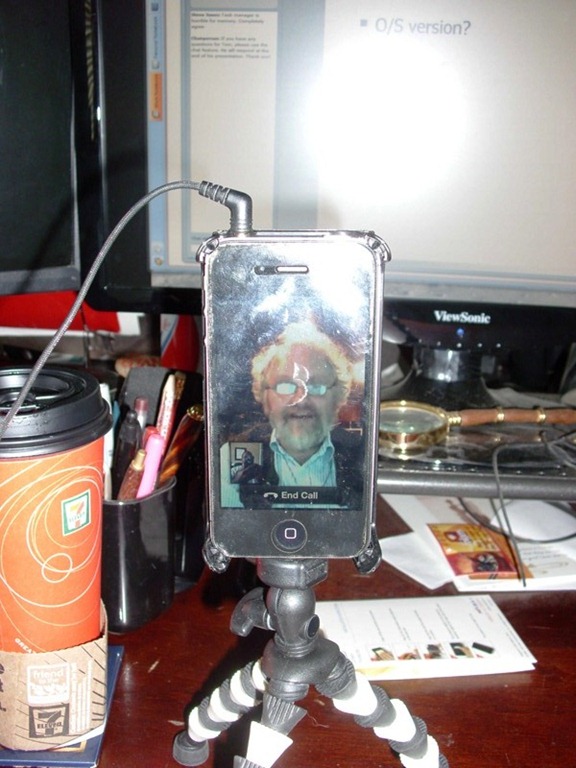
    It arrived recently and I hooked them together. I had a call with Andrew Clarke last week, and I decided to use Skype on my phone, rather than tracking down the laptop. It worked out pretty well, allowing me to see Andrew, and he to see me, as well as letting me still use the computer and send him a couple emails while we were chatting.

    Not the neatest desk, but it worked well.

    I paired this with my wired headphones from Body Glove, which worked well, but the cord is a little short. I like to lean back to talk when I don’t need to type, and this one is a little restricting. However it’s my favorite for traveling.

    21MRYY4KT6L._SL500_AA300_

    however I’m really looking forward to next week when I’ll use my Gogroove bluetooth headset. That will be really cool.

    41JcKvr1g1L._SL500_AA300_

  • Archiving

    This actually looks like an easy way to archive data

    Not many database systems get designed with a well thought out archiving plan at the beginning of their lifecycle. In most cases that’s fine since few databases seem to gather enough data to require archiving, and if there is extra time early in the life cycle of an application, it’s probably better spent tuning queries for efficiency anyway.

    However when archiving is implemented, it can’t be done so in a cumbersome way. That almost always leads to some sort of data hoarding by individuals, which often leads to an application being built on Excel rather than SQL Server. This article talks about the problem of data access from a storage point of view, but it could easily apply to databases. If we require some special function, or intervention by the DBA to allow access to archived data, it’s quite possible that users will take matters into their own hands.

    As SQL Server has grown, we have ended up with a number of features that should make the archival of data much easier. Partitioned views and tables in many cases can allow an application to function with understanding that the underlying data is stored in multiple locations, and potentially even multiple systems. It does take a little more administrative work to seamlessly implement these features, but it’s a skill that DBAs should be able to make work smoothly.

    The problem of large data sets will continue to grow over time, and it’s a problem I suspect most DBAs will face at some point in their career. Take some time to learn about partitioning and how you can both manage data more efficiently over time, as well as improve performance if you find access patterns vary for different sets of data.

    It’s also a good reason to ensure that your applications don’t ever expect to pull back an entire table for any reason. Working with a few rows of data at a time is prudent when you have thousands of rows and essential when you have billions.

    Steve Jones


    The Voice of the DBA Podcasts

  • Multiple Failures

    Imagine this right after a failed RAID array.

    When we have a large scale disaster from a man made system, usually we have had multiple things go wrong. Chernobyl had multiple failures, so did the recent issues in Japan at their nuclear facility. It seems to me that in many cases when Mr. Murphy has struck in my career, he has done so multiple times.

    Recently I was studying some high availability (HA) scenarios. In a mirroring situation the implication of a long mirroring queue was shown dramatically as a the primary server failed and the company experienced data loss in a failover to the secondary server. The data was eventually recovered by bringing up the primary server, extracting the missing data, and then manually merging it back into the system.

    Incidents like that are never fun to deal with, but are they common? It seems that the old adage about “when it rains it pours” has happened more than a few times in my career, but for this Friday I wanted to see if that has been the case for the rest of you.

    How many of you have had multiple failures at the same time?

    A RAID drive fails and shortly thereafter a network card dies. You find corruption and while working on that, the server hardware crashes. Have any of you had two or more failures occur on the same system at almost the same time?

    Let us know this Friday, along with any lessons learned. Have you changed the way that you prepare for disasters or plan for issues in your career? I’m sure there are many people that would love to learn those lessons from a post rather than experiencing them first hand.

    Steve Jones


    The Voice of the DBA Podcasts