Author: way0utwest

  • The Standard Edition Wish List

    The SQL Server Platform. What does Standard Edition Need?

    I wrote recently about what might differentiate Enterprise Edition from Standard Edition, and there were some great responses from people. I don’t know if Microsoft will change the way they manage editions, but I know they are aware of the discussions on SQLServerCentral.

    This week, however, I wanted to turn things around. I’ve seen a few people talk about the reasons why Enterprise Edition makes sense, or what value you get. That’s good, but what about the people that are just stuck on Standard Edition? Corporate budgets are still tight, and many people might not even upgrade from their current version to SQL 11, even at Standard Edition.

    I wanted to see what might make the different for people in those situations. If there’s no hope for Enterprise Edition and you are even debating upgrading to the next Standard Edition version of SQL Server, answer this:

    What would you like to see in Standard Edition?

    If you had a wish list and could decide that one feature would get moved to Standard Edition, leave us a note in the discussion. Is there any one feature that would make a compelling case for your company to upgrade half their database servers to SQL 11?

    Enterprise has many things that you get with that large licensing cost: data compression, larger clustering limits, Resource Governor, partitioning, mirrored backups and more. It’s quite a list of features, but for me,  I’d like to have the ability with Resource Governor to limit the impact of certain groups of users on the server. I’d especially like to be able to throttle down the maintenance operations so they didn’t impact performance as much.

    Let me know this Friday what you really want to see in Standard Edition.

    Steve Jones


    The Voice of the DBA Podcasts

  • Social Networking Prowess

    Swarms can be an amazing

    If the Gartner Group is correct, and we are looking at a workplace that is more dynamic, more disconnected, more virtual, and involves us working with many more people that we are not very familiar with, are you prepared? Do you know how to work with a team that might come together in a short period of time and disband a few months later? Do you know which people in your company you like working with, and perhaps more importantly, which ones you don’t?

    The idea of swarming teams that come together for projects and then disbanding them is one of Gartner’s predictions for the workplace over the next decade. I met someone recently who works at a company that is trying some of these techniques. People are working in virtual teams, and it seems to be working well.

    Some time ago I was giving a talk on the Modern Resume, and someone asked me what they should do on LinkedIn or any social networking site. This person had signed up and didn’t know what to do after that. My response was to start networking with people, which is a hard thing for many people. I had to go back and spend some time thinking about what networking really is, reading a little about the topic, and coming up with a list of things that you can do to build your network online.

    I think social networking is an interesting skill that might become more valuable as we interact with an ever increasing number of people in a virtual sense. Whether your company decides to implement swarms and virtual teams, there are plenty of opportunities to meet other professionals in your field outside of work, and many of these opportunities are over social networks like LinkedIn or Twitter.

    Steve Jones


    The Voice of the DBA Podcasts

  • SQL Saturday #63–Dallas

    I have been trying to get to Dallas for a SQL Saturday for nearly a year, when the first event was announced last May. I finally made it this past weekend with the third SQL Saturday in less than a year taking place on April 2, 2011 in Richardson, TX.


    The Location

    The event was great, lots of people (nearly 400) and it was an extremely smooth running event. Sri, Tim, Sean, and the rest of the North Texas SQL Server User Group put on a great event and made me and a number of other out of town speakers very welcome.

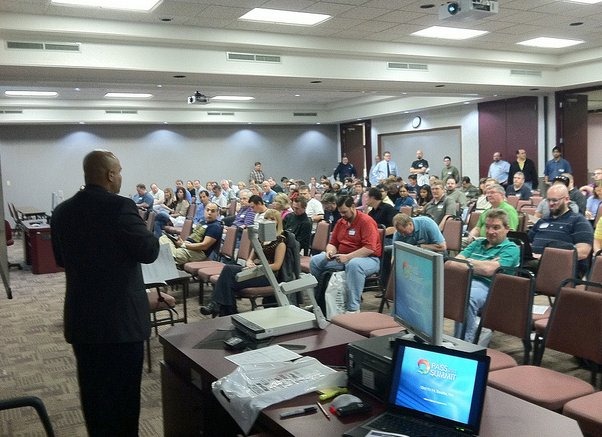
    The event was at a local training center, Region 10, with large rooms and large projection screens for the most part that made it easy to see what was being talked about.

    Saturday started with a crowd of people arriving early and ready to check in. I set up a Red Gate table with some swag and flyers, all of which were gone before the opening session. Sri gave a short opening, recognizing Andy Warren (LinkedIn | Blog | @sqlandy) and I as the founders of SQL Saturday. We each said a few words, nothing memorable, and we are both amazed that in four and a half years there have been over 70 events and over 15,000 people that have gotten a free day of training.
    sri

    I appreciate the recognition, but it’s not about us. It’s about the people getting some knowledge and help in their careers, and I struggle with how to get that message across. This whole franchise/framework was really about how to help people grow, people that can’t afford to go to a conference. Any ideas on how to get the focus on that and not the events would be appreciated.

    There was a few minutes when people were asked to remember to network and they took a minute to introduce themselves. After a few logistics announcements, the first session kicked off  in the beautiful Richard 10 training center, and the hallways emptied. I was about to get ready for my session during the next hour when I saw a tweet from Jessica Moss that she needed a ride from the hotel. The power of Twitter! I drove back since it was only a mile or so and picked Jessica up since we both had sessions at 9:30.

    My Session

    I did The Modern Resume: Building Your Brand with a packed room. A small room, but still packed with a few people sitting on the floor. Quite a few students, with some good questions on how to get started, but overall a fairly quiet presentation.

    People must  have enjoyed it as the 20 or so evaluations I got were almost all 5s. Nice to see that but I’m not sure if I need to change anything. I did make a couple notes based on questions to add to the next time.

    Other Sessions

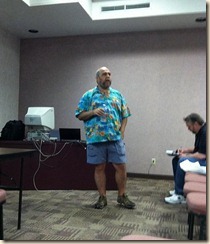
    I went to see Andy Warren’s “Building a Professional Development Plan, which I highly recommend. It was excellent, and while it was a bit of “tough love” at times, there are some things in there that I would highly recommend to people.
    sqlandy

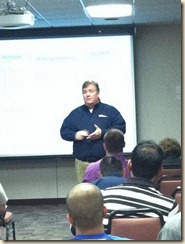
    I caught a bit if Tim Costello’s introduction to dimensional modeling. I met Tim last year in Baton Rouge, and gave him some feedback on his session. I went to this one to see how he did and also to get a little info on a topic that I don’t know much about.
    timcostello

    I thought he did a nice job explaining the topic, walking through different aspects of what a dimension is and how they are defined. Worth seeing Tim talk on BI stuff if you get the chance.
    jessicamoss

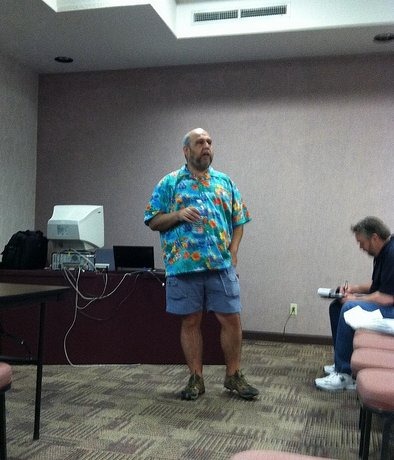
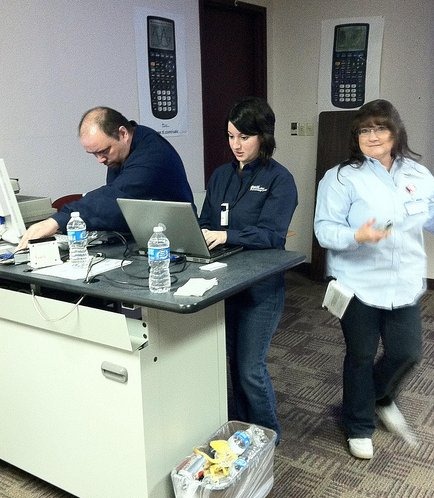
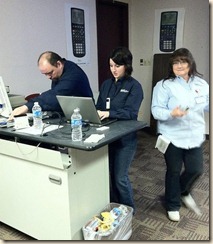
    Jessica Moss had a bit of a technical snafu at the start of her talk, where the projector did not want to pick up her laptop. She left it alone in the capable hands of David Stein, Jeremy Marx, and a few others and walked around, starting to talk to the audience about data management topics. Once the projector was fixed, she dropped right into her slides and demos.

    Jessica is a great speaker, and a popular author at SQLServerCentral, and if you get the chance to read her work or see her speak, do so.

    I glanced into a few more sessions, many of which were almost full of people and it seemed that everyone was focused on learning at the event.

    Food

    The food was plentiful, with lots left over from what I could see. Breakfast was a series of muffins and danishes with apples and bananas available as well. Most of this was left in a break room for the day, so you could go get more if you wanted

    Lunch was a boxed deal, set up outside, and I had to follow the crowd to find them setup in a small courtyard, so a few more signs would be nice, but people walked through one door, picked up a lunch, and went through another one, so things flowed smoothly.

    The afternoon snack was a gelato cart that created a line stretching through the middle of the center. There were 4 or 5 choices, and plenty of the tasty dessert. Quite a few people, including myself, went back for seconds.

    Afterwards

    The speaker dinner and the after-party were both held a Dave and Busters, with lots of drinks, billiards and shuffleboard for everyone. I enjoyed both nights there, getting the chance to catch up with lots of old and new friends.

    afterparty

    I wandered around, talking with different people, and had the chance for some long conversations with David Stein, Jessica Moss, Tim Mitchell, Kevin Boles, Jim Murphy, and Sri Sridharan. I have probably missed a few people, and I apologize, but it was a long weekend that came right after SQL Server Connections.

    Both nights I managed a late dinner with Andy Warren and a few other people, getting back to the hotel ready for sleep.

    It seems that more and more I find that people all over the country are running very smooth events with almost no issues. I found the center easily, speakers showed up, people learned things, and there were no real issues.

    I enjoyed the event in Dallas, and am looking forward to going back next year if I can work out the scheduling.

  • You Don’t Know Enough

    Always be learning

    We always expect developers to test their own code and be sure that it works as expected before they release it for anyone else to use. However we should be aware that developers won’t think of all the edge cases that might break their code, so a good software process includes another group (QA) that tests the software separately, and hopefully also reviews the code as well.

    Why do we do this? It’s because you can’t be sure that just because code passes your own tests that it is well written. You can only be sure that it passes the various tests you have designed, which is likely a subset of all possible tests it ought to pass.

    Bruce Schneier wrote a piece that talks about this from the security perspective. If a system fails initial testing, we know there’s a problem. However if it passes those tests, we still don’t know it’s secure. There still might be other vulnerabilities, perhaps even obvious ones. Only through exhaustive testing and review of the code, can we gain any sense of confidence in the security of a system. Even then we would still want to include some monitoring of the system as vulnerabilities might be discovered at a later time.

    Each of us has some limited amount of knowledge about the technology we work with, but there is one common thing we all share: we can all learn more.  Those limitations of our knowledge carry over to the code we write, and mean that we won’t necessarily completely test our code to cover all possibilities.  We might not even remember to test for some things as our work gets more complicated.

    We need to work with others to ensure enough code coverage and have some level of confidence in the quality of our work. Today’s systems are just too complex for one person to completely understand. Once you accept that and learn to work in a team, critiquing the code of others and accepting criticisms from them on your work, you will find the quality of your software will rise.

    Steve Jones


    The Voice of the DBA Podcasts