Author: way0utwest

  • I Can’t Make You Learn

    Oh, how I wish I could make you learn. How I wish I could coach, guide, inspire, or even bribe you to learn more about your job, or things related to your job, or even things in life. I wish all of you would improve your skills, but more, I wish you would want to improve your skills. I find lots of people who do want to get better at things, but far too often, people aren’t trying to improve because they want to coast along at their jobs. Or really, anywhere.

    I get it. You’re stressed and busy at work, though hopefully not too often. You have challenges at home, kids to raise, parents getting older, financial stresses, concerns about politics or sports or exercise or diet or just about anything in the world. We all have things that take mental energy in our lives. How/why/when should I add another thing to the list?

    My view in the past has been that I invest in my knowledge and my skills because that helps me in the future. Whether that’s learning to write better T-SQL, or it’s learning a new thing about T-SQL, or it’s learning how to find information about the new thing in T-SQL. Or it’s something completely different. In the past, I’ve spent time learning to write better with a blog, knowing this might lead to a future job, but also to experiment and decide how much I liked writing. I’ve learned to organize presentations better, partially because I wanted to impress people at a user group, but also because I knew this skill would help me argue for a raise or communicate well in a job interview.

    I thought about this recently as a fan switch went out at the ranch. That’s not related to work, but I like to learn everywhere in my life. We have a whole house fan that cools the house at night. Someone else installed it years ago, but the switch stopped working. My wife wanted to call someone right away, as none of us are a) electricians, or b) have worked on a hard-wired fan. However, I thought this couldn’t be difficult. It’s worth a small experiment. I ordered a part that was vaguely familiar to the broken switch, not having much confidence that it would work.

    My son and I found the breaker (which was an adventure) and disabled it. We disassembled the switch, matched up wires, and replaced the switch. We turned on the breaker and were excited that the fan worked. We of course, had another adventure putting it back together, as the first time things didn’t work when we enabled the breaker, but we solved the issue. A couple of hours in total and $40 for a switch when it would have been easy to call someone and (likely) spend $150 or more.

    I always ask questions when work is being done. Whether that’s a tradesperson doing building or repair work, or a fellow tech professional writing code, or a fellow marketer authoring content. I want to learn to be self-sufficient and more capable. Even if there are things I’d really never do and happily pay someone to do them, I want to know how they are done.

    At the very least, I want to be able to judge future quality. That’s a skill I need with electricians and AI technology.

    Steve Jones

    Listen to the podcast at Libsyn, Spotify, or iTunes.

    Note, podcasts are only available for a limited time online.

  • A New Word: Attriage

    attriage – n. the state of having lost all control over how you feel about someone – not even trying to quench the flames anymore, but lighting other fires around your head just hoping to contain the damage.

    My first thought is that this is a crush-type of feeling, of young love and desire. However, I quickly think of my wife and while I am so in love with her, and there is still passion, I’ve definitely lost control of myself in other ways.

    I can’t imagine living without her. I don’t handle it well when we argue. She means so much to me, that there is attriage and I flow with it. Enjoying the struggle and appreciating I have someone like her in my life.

    Then I think about others.

    My wife lost a student and friend this weekend to cancer. I’ve lost friends, and I keep following Hugo’s blog, worried that I’ll never get the chance to hug him and speak in person. I sent a birthday message to Steve Hughes, who is amazing and inspiring, and makes me sad.

    I have attriage about those people, more from worry and loss and yet I have to continue to go on, understand this is part of life, and it sucks.

    Having amazing things in your life means you also have really bad things in your life. You care, and you can’t help but see the differences. If you’re luck, you get into attriage and go with the pain and excitement.

    From the Dictionary of Obscure Sorrows

  • A Quick Second Opinion

    I saw this article and thought, surely there’s nothing I could use in here: 10 Best AI Prompts for Everyday Tasks. Quite often, when these articles appear, they are very high-level and contrived examples of things that I rarely find myself doing.

    So I clicked the link.

    For most of the prompts, I didn’t think these were the types of things that I do often, nor were the prompts useful. I’m rarely looking for AI to draft emails or perform some of the simple creative things. I’m not sure these are big burdens on time for others, but perhaps I’m wrong. I know many people struggle to build plans or rewrite things, but I do those often and have gotten good at them. I tried using an LLM, but it wasn’t helpful. I do sometime ask Claude to turn things into checklists because I’m being lazy, but getting the things organized is usually the hard part. Pasting them into Word/Powerpoint and changing the bullet format is easy.

    If anyone finds value in these items, and you should try them, that’s great. I find an LLM to be a great quick assistant that can do something for me while I move on to another task. If you struggle to get drafts started, or you need a second opinion and don’t want to call/slack/message/text/etc. a friend, use an LLM. I don’t know using an LLM like this provides an ROI, but it definitely prevents your blocker from interrupting others and forcing them to context-switch to respond to you.

    I found another article on prompts for professionals, which has other prompts that might help you get that second opinion. Perhaps you can use these in technical ways, asking for an evaluation of your algorithmic approach or your message to co-workers. If you find them valuable, or you try them in a situation, let me know. Leave a comment. This AI stuff is new, and we can help each other learn.

    If nothing else, experimenting with an LLM will teach you about communication and how clear and direct you are being with your assistant. Do a poor job and the LLM often won’t quite give you the results you want. Get something back that you can use? Examine how well you communicated to the assistant. Many of us can improve here, and learning to be clear and concise with an LLM will also aid you in those communications you send to other humans.

    Steve Jones

    Listen to the podcast at Libsyn, Spotify, or iTunes.

    Note, podcasts are only available for a limited time online.

  • Capturing My Own Metrics: #SQLNewBlogger

    A customer was trying to compare two tables and capture a state as a performance metric. In this case, they were wanting to use Redgate Monitor and custom metrics, but since the tables were in a Memory-Optimized table, they couldn’t as Redgate Monitor runs inside a transaction.

    Note, there are workarounds, but they’re clunky.

    Fortunately, I had a quick solution, which involved SQL Server User Settable Objects. This post looks at how this works.

    The Scenario

    Let’s take the transaction out of the equation by using my own metric. SQL Server includes a few procedures that fall into a pattern. They are named with numerics as shown:

    • sp_user_counter1
    • sp_user_counter2
    • sp_user_counter3
    • …
    • sp_user_counter10

    Each of these corresponds to a value that is captured in a perfmon counter. The counters are in the objects called “SQLServer:User Settable”. The counter name is “query” and the instance is “User Counter n” where n is the number corresponding to the stored procedure.

    By default, these are 0, and you can see them here:

    2026-06_0191

    You can also see them in Perfmon

    2026-06_0192

    I’ll stick with SQL Server.

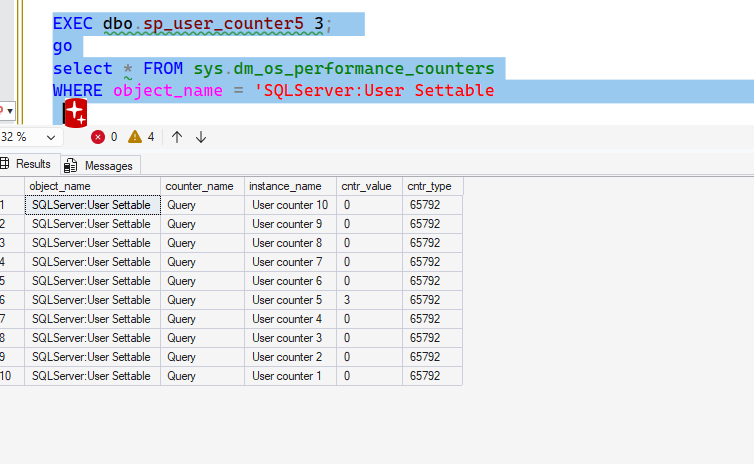
    If I want to alter a value, I call the appropriate procedure. I can do something like call the proc for 5 and set a value. I’ll then query the counters from T-SQL. You can see this below as the value for counter 5 is set to 3.

    2026-06_0193

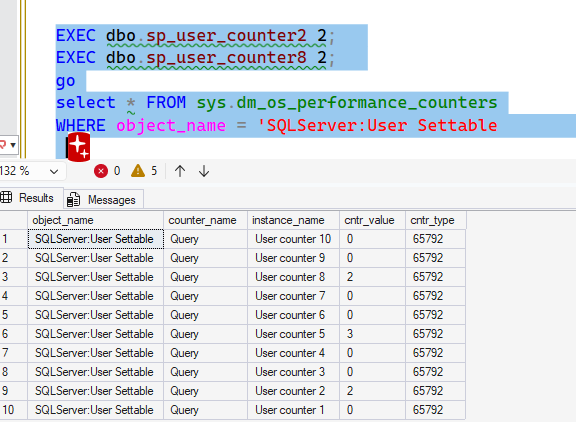
    This value remains set. I’ll set counters 2 and 8 to 2, and then query again. Note that 5 is still set.

    2026-06_0194

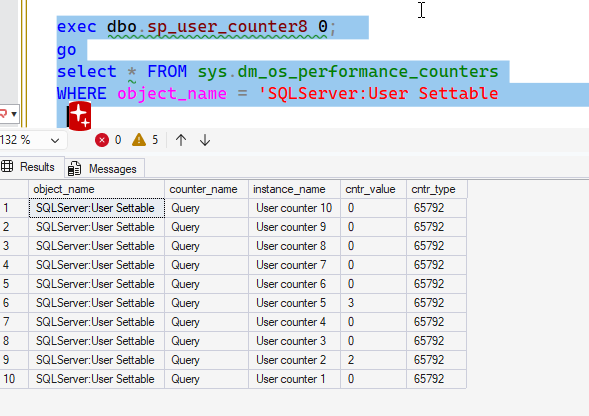
    If I want the value set to 0, I need to set it. I’ll do that for counter 8.

    2026-06_0195

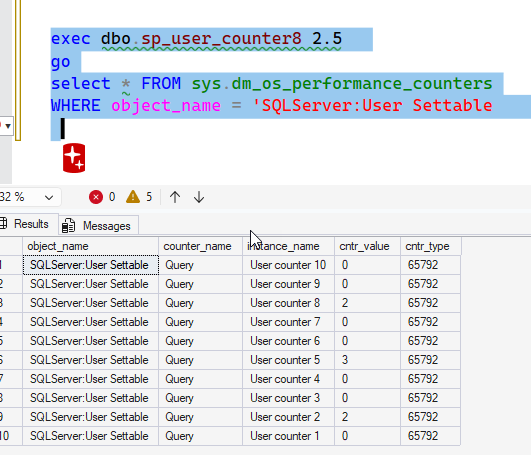
    These are metrics, so I need to pick an integer. I can’t set a decimal (or other type) and have it work. If the implicit conversion works, it works, but the value is a decimal.

    2026-06_0196

    If I make this a string, it fails with an error as ‘2.5’ doesn’t convert to an int. Same for a date. Using an int, like ‘5’, works.

    Solving the Issue

    In this case, for the customer, we solved the issue with a proc that performed their query The result of this query (and int) is sent to a counter value like this:

    CREATE or alter proc My_Checker AS BEGIN declare @i int select @i = count(*) from dbo.Customer a INNER JOIN dbo.Candidates b on a.CustomerName = b.PersonName select @i = @i + 1 EXEC dbo.sp_user_counter1 @1; END

    This can run from an Agent job on their schedule, updating the counter as appropriate.

    For their alerting, they can query this metric and set the boundaries that matter to them. In this case, whenever this is greater than 0, they want an alert.

    The user settable values aren’t that useful, especially as there are 10, but I’ve used them in a few places when I wanted to get instrumentation for an application. This allows me to easily capture values and watch them from any monitoring system.

    Worth knowing about and using if you need random things captured.

    SQL New Blogger

    This post took me around 15 minutes to write, though I spent about 10 minutes mocking this for our customer based on their system and then stripping out a few items that are specific to them.

    This is a post that shows how I can use features of SQL Server to solve a problem, which is something every employer wants. An AI would make this code easier, but I have to know to guide an AI in this direction and evalaute if this works. I’d certainly need to check if other apps were using these counters, which isn’t something an AI might think to do, especially as there could be lots of repos to scan.

    You can write something like this, showing how you’re use this features. Bonus points if you use an AI to help you (and disclose how).