Author: way0utwest

  • Deciding to Submit to Conferences–#NewStarNovember

    I wrote about getting started last week, with invitations from others. I think the first time I actually made my own submission was to the Indy Tech Fest in 2007. At the time, Andy Warren and I were in SQL Saturday discussions about how things had gone the year before and we wanted to get some info on other events. John Magnabosco invited us to submit something to their event, so both Andy and I did.

    It wasn’t much of a submission, and I think John just accepted what I sent without thinking about it. However, at the same time, SQL Saturday #7 – Orlando was coming up and Andy wanted me to come down. This was their second event, so I also prepared a career based submission based my life and sent that in.

    That first talk in Indy was OK, but nothing special. The one in Orlando, however, was very exciting for me. I was nervous, especially as the room filled up. Eventually there was standing room only, with some people sitting down around the sides of the classroom. The session was OK from my perspective, but people really enjoyed it, I had a lot of questions, and some good reviews.

    That was in 2008 and it got me a little excited. I gained confidence and I submitted that session to two events in 2009 and got accepted. Then in 2010, I expanded my reach, submitting to more events and getting in 10 talks at 7 events.

    Since then, I’ve worked on my abstracts and submissions, getting advice from others and trying different things. I’ve also spent time recording and watching myself, taking feedback, and practicing more to become a better public speaker.

    I still get nervous at times, but delivering a good talk and having people give me positive feedback is exciting each time it happens.

    Part of a Series of #NewStarNovember posts. If you want to help promote new speakers, consider writing a post as well. Some ideas at the New Stars of Data.
     

  • Daily Coping 8 Nov 2022

    Today’s coping tip is to set a goal that brings a sense of purpose for the coming month.

    For me, I’m going away from primary work to secondary work. I’ve been working on a head coaching certification (part of my goals) and I’m about 40% in. I want to get to 75% this month.

    I started to add a daily coping tip to the SQL Server Central newsletter and to the Community Circle, which is helping me deal with the issues in the world. I’m adding my responses for each day here. All my coping tips are under this tag.

  • Data Manipulation with Word and Excel

    Recently I had to go through some training that asked me to evaluate some text. I needed to tally some data up, and decided Word and Excel were quick and dirty ways to do this.

    The Task

    The instructions were:

    • Read the text
    • Put a check by the sentences you agree with
    • Put a question mark by those you are unsure about
    • Leave others blank
    • Determine how much in agreement you are with the text

    The challenge was this was 5-6 paragraphs, each with 3-5 sentences, so trying to mark these on the screen and then tally them wasn’t easy. Being a data person, I wanted to calculate something more accurate and easy.

    So, I thought about getting this data into a better format and wanting to use math to calculate percentages. While there are lots of ways to split text in T-SQL, Python, etc. I decided for a one-off, Word and Excel worked well.

    Word Formatting

    I started in Word because, well, this is text and Word is for text. I’ve also pasted lots of text into Excel and it often keeps enough formatting that things are combined into one cell.

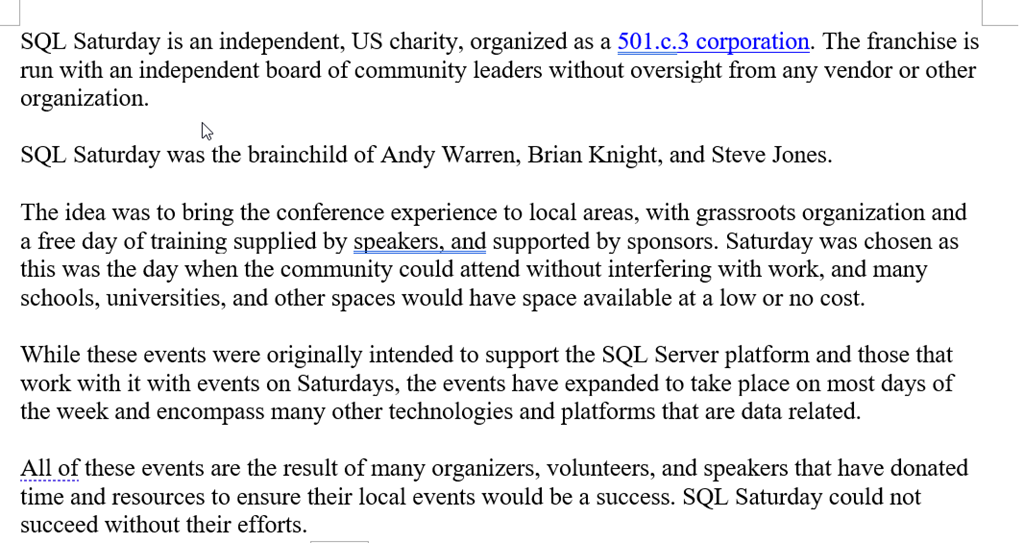
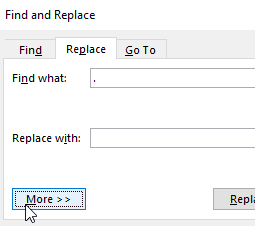
    Since I needed sentences, I pasted text and did a search and replace for a period and a space, as shown inbrackets [. ]. The replacement was more complex. I tried \n and /n and a few things, then I noticed the “More” button at the bottom.

    2022-10-31 08_26_56-Find and Replace

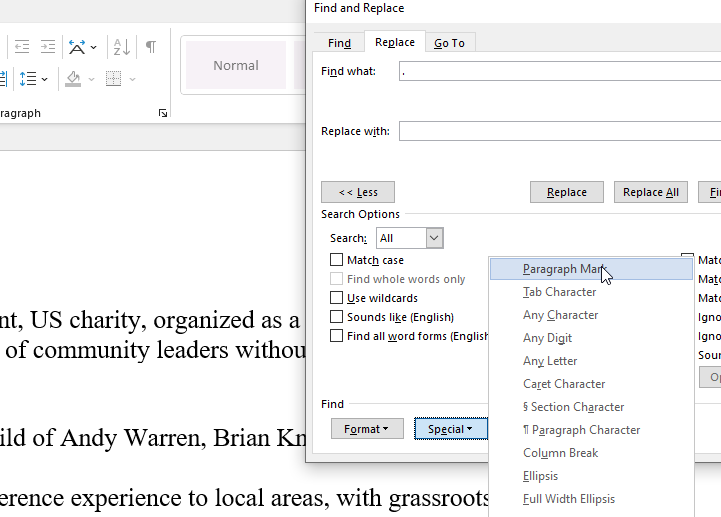
    When I expanded this, I saw a number of options, and I used the paragraph mark, since I wanted each sentence on a separate line.

    2022-10-31 08_26_32-Document1 - Word

    This isn’t the text I was using, but I grabbed this from sqlsaturday.com for this post. Here’s the before:

    2022-10-31 08_28_07-Document1 - Word

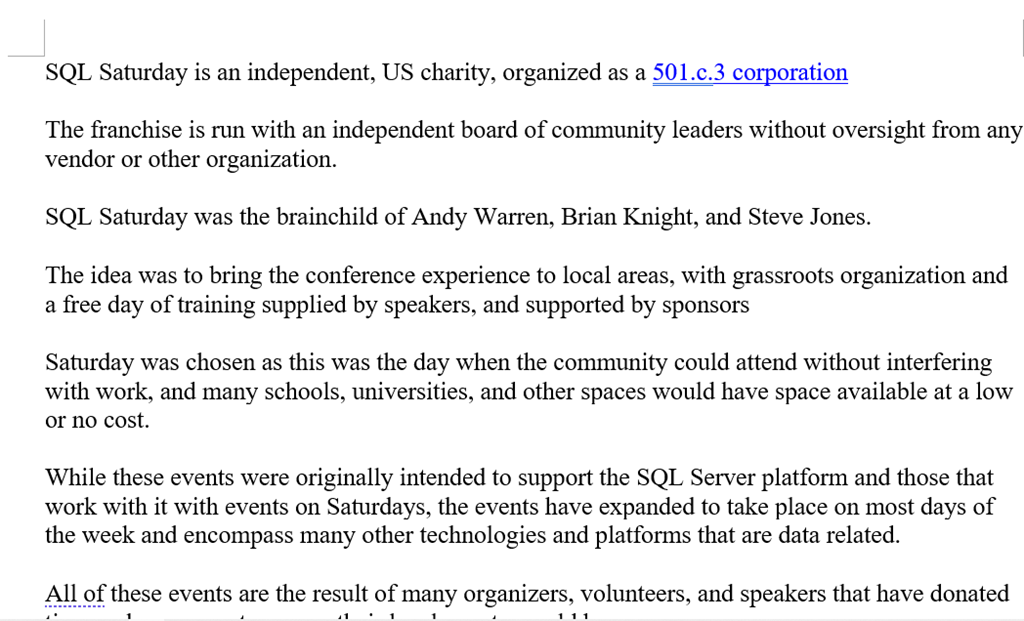
    Here’s the after:

    2022-10-31 08_28_27-

    It was well formatted text, so this gave me the split of data into sentences.

    Excel for the Math

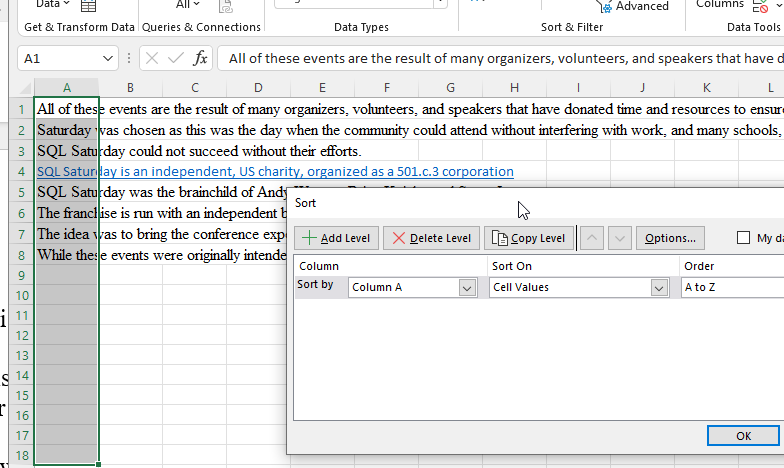
    I then copy/pasted this into Excel, which put each sentence into a separate cell in a column. I had a few blanks, but easy to sort the data (ordering didn’t matter here) and get all my data at the top.

    2022-10-31 08_33_09-Book1 - Excel

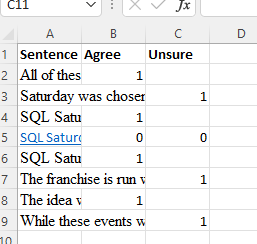
    From here, I just added my marks to the columns at the end. I also added a title row, just for me. I then used a “1” for agreement in the columns. For those where I wasn’t marking either column, I used two zeros, just to make things look better. I had something like this:

    2022-10-31 08_51_26-Book1 - Excel

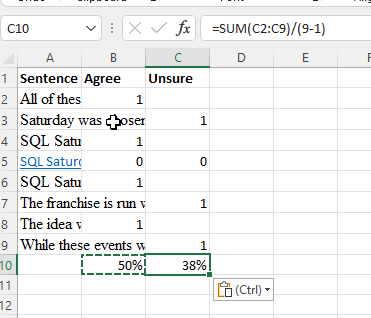
    The formula I used was a sum, divided by the count. For the count, I just used the final row number (9), subtracting the title row. This way I could copy this across each column.

    2022-10-31 09_07_39-Book1 - Excel

    Easy way to calculate some one-off totals from data that I need to evaluate for text data with a little Office ELT.

  • DevOps is Culture

    DevOps is a culture shift in your organization. Technology enables things inside of this culture, but the culture is important. If you don’t know how to build a new culture and support individuals as they adopt it, often you’re just renaming an existing broken process inside your organization.

    Often, I think the failure to reach the efficient levels of a Spotify, Capital One, or any other DevOps success story is because of a failure of management to change culture.

    There are any number of anti-patterns for organizations wanting to adopt DevOps. Renaming teams without changing how they work together, including incentives and punishments, doesn’t help. Just buying technology without process and culture is just spending money on new toys. Keeping your existing organizational constraints in place without encouraging and supporting teamwork, changing incentives, eliminating silos/fiefdoms for managers will ensure that you will struggle to make a digital transformation that enables your organization to realize a return on their efforts.

    What things do help with culture change? Certainly, many changes start with a team or two, learning about how to build a better software pipeline, both with better code and more automation. They have to be allowed to fail fast, make some mistakes, and review issues without blame. Management must support this.

    We need to optimize systems, meaning the flow of code from developer to production system, without optimizing the effort in any team. People need to put theie name on work, owning failures, and celebrating the success of others. Collaborate and pitch in to work together, regardless of the title, position, or responsibility you have been assigned.  If someone needs help, they need to be supported and not punished. We need psychological safety to do the best we can, but understand we all need to ask for, or be ready to give, help at some point.

    DevOps is teamwork. It’s coordinating and collaborating to agree on the best code and process that gets code to production quickly. Safe, secure, performant, and high-quality code of which everyone is proud. If we’re not, then we ought to be working together to make the code better or agree an exception is allowed for some reason.

    Above all, we need to respect the autonomy of individuals and teams. Trust them to get the work done their way and take responsibility for it. Most people are accountable, especially when they can accept and help fix their mistakes without punishment. We all make mistakes, so let’s do our best to move forward and help everyone avoid repeating mistakes with learning, not yelling.

    Steve Jones

    Listen to the podcast at Libsyn, Stitcher, Spotify, or iTunes.