Author: way0utwest

  • Daily Coping 16 Aug 2022

    I started to add a daily coping tip to the SQLServerCentral newsletter and to the Community Circle, which is helping me deal with the issues in the world. I’m adding my responses for each day here. All my coping tips are under this tag.

    Today’s tip is to thank someone you’re grateful to and tell them why.

    One of the things I’ve seen recently is a thank you series from Grant, letting people know how he appreciates them in his life. I like that, and he’s made some nice choices. All of those people have impacted my life as well.

    While I have many people, I’m choosing one for this post. Erin Stellato is someone I’ve known a long time. I don’t know exactly when we met, but I have many memories:

    • Being a gracious host at a Cleveland SQL Saturday and hanging out with her and her daughter by the slide in the building.
    • Sitting in the lobby of the Seattle convention center chatting about something SQL Server.
    • Doing yoga together in a class before some event
    • Skiing with her family and grandfather in Colorado
    • running through the streets of Bellevue in the morning before the MVP Summit

    Lately, however, I’m really grateful for some counsel from her on diversity and harassment issues. These are not pervasive, but they are present in the SQL Community (and others). My perspective and view is limited, and I have asked others for help in finding a way forward to prevent future incidents. Erin has been great about listening and give me things to think about.

    I’m really grateful for her help on a very difficult topic.

    I’m also grateful for her friendship and hope we find time for some future yoga, skiing, or some other fun activity.
  • Creating a HEAD utility for Windows 10

    One of the things I did often in my first career job was create utilities that we could use as a network support team. I was an intern coming from university, where I used SunOS and Solaris all the time. I was used to a command line for a lot of work. While DOS worked well, there were things I missed, like whoami, head, tail, etc.

    I rebuilt a bunch of those as DOS batch files for myself, but I expanded this to more useful things. We supported over 1000 people, and finding their phone extensions was a pain, especially in the early 1990s with phones that had cords and pagers. We had a common file share that contained a text phone directory, so I built 411.bat, which took a parameter and searched that file for a matching name. Then returned the line of data. It was immensely helpful to us.

    The other day I had a large file that I wanted a glimpse of. I opened it in Notepad++ (this was GBs of data), but it took time. That made me think I’d really like HEAD on Windows. I tried it, but it’s not there.

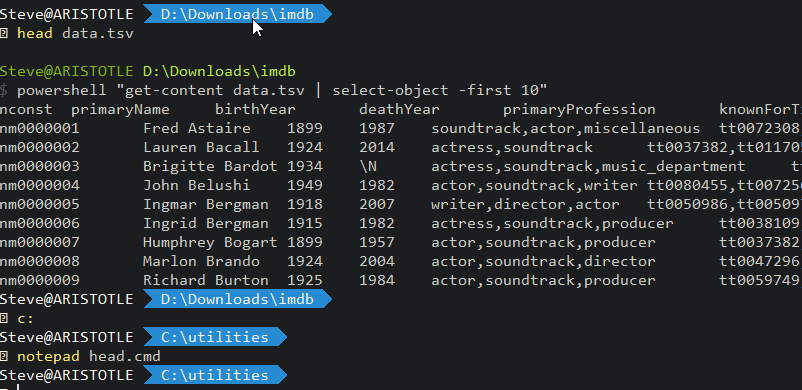
    So I built it. This is my command file:

    powershell “get-content %1 | select-object -first 10”

    I save this in a utilities folder in my path. Then in other folders, I can run it and get a glimpse of text files I’m importing or working with. Way, way faster than Excel or trying to open this in another program. I often have a cmd open, so this is useful to me. You can see it working below.

    2022-08-04 08_55_24-C__utilities

  • Reducing Debt and Increasing Security

    Many of us know that reducing financial debt in our lives leads to a bit more security in our minds. We are better able to cope with unexpected expenses when we have the ability to get credit or pay for something in cash. If you’ve ever had a major house repair, car calamity, or (hopefully not) medical issue, you know what I mean. At least in the US. That last one is less of an issue in many other countries.

    We know that our code has technical debt, and often we fight a battle with project managers and business people over whether we should spend time paying down that technical debt or developing new features. We certainly can do both, but often that’s not a choice we are given. If we do get the chance to reduce technical debt, it’s a tiny fraction of the time that is allocated to adding something new.

    There might be a better argument for reducing some technical debt: security. There’s an article that talks about the security risk posed by moving too fast and not ensuring there is rigorous security testing. This is a common problem in many companies that adopt some parts of DevOps, but forget that quickly deploying new code isn’t the only principle. We also need to learn from our mistakes and quickly correct them.

    I am a big fan of releasing often, especially for security purposes, but those releases need to build on each other with not only new code but refactored old code that doesn’t perform well or has a security issue. More importantly, we need to ensure when we find issues in code, that all developers are aware of the problem and don’t repeat the issue. We also need to update our testing to ensure that humans don’t continue to write code in a style that causes known issues. We want to avoid antipatterns in our code.

    This is less of a developer issue than a managerial one. The C-suite and all management that are involved in software need to prioritize security so that known issues are fixed quickly. This also should involve ensuring that technical debt is kept under control as a lot of this poorly written code increases the chances that a vulnerability is in the code. Either because the code isn’t well written or because developers avoid touching the code in the future.

    The best solutions, to me, involve DevOps. Make small changes, deploy them, instrument them, and learn if they work well. If not, fix them quickly. While this might end up delaying some features, ultimately it ensures that our software is in better shape, with a reduced risk of simple security mistakes upsetting our customers.

    Steve Jones

    Listen to the podcast at Libsyn, Stitcher, Spotify, or iTunes.