Author: way0utwest

  • Advanced Incident Response

    Early in my career, I worked at a few smaller companies where a problem with the computer systems meant I went into the office and stayed until things were working. As I went to a few larger companies, I wasn’t alone when a system went down, but the process was mostly the same. We figured out what was wrong and found a way to fix or replace things, occasionally with help from a vendor. Those were the (not necessarily) good days before our internal networks were connected to a public Internet.

    Companies developed formal incident response plans to deal with various issues, whether these were problems we caused ourselves or failures of an application. I had the fortune, or misfortune, to be involved in more than a few issues and learned a great deal in how to solve problems as well as how to manage the impact to a large number of employees.

    As email and Internet use grew, so did the attacks with viruses and other sorts of malware. Antivirus software helped a great deal, but these days ransomware seems to be a common problem that isn’t as preventable as I would have hoped. Quite a few friends have dealt with ransomware issues, most of which have not been widely reported in the news.

    I saw an article about a few things that you might want to consider adding to your incident response plan. While some of these items might be unique to the ransomware threat, the thing that struck me was that there is a need to react quickly, in real-time, in response to any detection of an issue. I can only assume this means that there needs to be some advanced monitoring of nodes to detect issues, and I’m not sure how many organizations would adopt this, but in today’s world where we want systems available 24/7, perhaps they will.

    Being on call is a part of working in many IT departments. Having a response plan, even the general outline of one, helps to coordinate resources and ensure that we use people effectively. Tools are important, especially in today’s complex world, and it is important that one of those tools is a simple backup, preferably air-gapped from your main systems. If you don’t have these things in place, you might suggest someone start assembling them. These days it seems it’s not if you will get attacked, but when.

    Lastly, I don’t often see this addressed in plans, but make sure you have spelled out some guidelines on rotating staff and getting rest. Far too many companies want “all hands on deck” and forget that normal business still needs to occur. Any incident could last longer than a day, and you want to ensure that some of your staff is fresh and ready to take over from those that do need rest. Don’t be afraid to send some people home, or better yet, don’t call them in the first place.

    Steve Jones

    Listen to the podcast at Libsyn, Stitcher, Spotify, or iTunes.

  • Removing a LocalDB Instance

    Another post for me that is simple and hopefully serves as an example for people trying to get blogging as #SQLNewBloggers.

    This might be obvious and easy, but I spent a couple minutes learning how to remove a LocalDB instance.

    I tried to use remote, but that didn’t work:

    2022-03-03 09_17_39-C__Windows_System32_cmd.exe

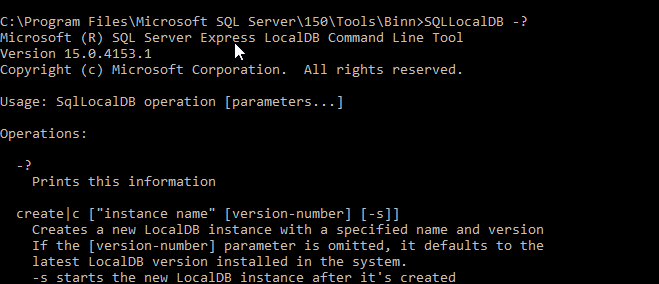
    There error reminded me that in my day, most commands use –? or /? to get help. A lot of CLIs these days use –help (two dashes). That doesn’t work here. But /? does.

    2022-03-03 09_18_33-C__Windows_System32_cmd.exe

    This shows me the delete option is the one to use. I tried that, but I needed to stop the instance.

    2022-03-03 09_19_55-C__Windows_System32_cmd.exe

    Running stop and then delete allowed this to succeed.

    2022-03-03 09_20_51-C__Windows_System32_cmd.exe

    SQL New Blogger

    After writing a previous post, which took me 10 minutes or so, I went to clean up my environment. I realized this was easy, but also worth a post about how I learned this.

    Just 5 minutes. You could write posts like this to further your knowledge and help your career.

  • Daily Coping 6 Apr 2022

    I started to add a daily coping tip to the SQLServerCentral newsletter and to the Community Circle, which is helping me deal with the issues in the world. I’m adding my responses for each day here. All my coping tips are under this tag.

    Today’s tip is to mentally scan your body and notice what it is feeling.

    I’m writing this just under a week in advance, but this is good one for me today.

    We had a hydrant fail in a field. It really just rusted out, but this is a metal tube with a valve at the top of bottom, which self-drains to prevent freezing issues. Here’s an example of what I have.

    What that image doesn’t show is that the frost line for me is about 48”, and in my case, we needed to dig a hole down to about 5 feet (60”) to find the pipe. Actually the plumber offered to dig for US$80/hour and expected this would be about a $1000 hole for him to dig.

    My two sons and I went out and did most of the work. Not enough, as the plumber had 3-4 hours of digging to do still, but we saved likely $700-800 in doing some of the work. Here’s us about halfway into our work. We were deep, but had to widen it quite a bit.

    20220326_145502

    The worse part, for me, was the day after the hydrant was replaced. The hole was unfilled and rain was forecast. I got out there early one morning, listening to a couple MVP Summit sessions on headphones as I tried to fill in the hole before the light rain turned heavy.

    20220329_090010

    It’s the day after. How do I feel?

    Not too bad. My core and lower back are sore and ache-y, but not too painful. My forearms are definitely tired and sore, and typing is a little difficult. My legs are doing pretty well.

    Overall, I feel like I worked hard, but didn’t overdo it. I’m paying for my mostly desk job life turned dirt worker, but I kept within my abilities and am using a little ibuprofen to get through the day.

  • Daily Coping 5 Apr 2022

    I started to add a daily coping tip to the SQLServerCentral newsletter and to the Community Circle, which is helping me deal with the issues in the world. I’m adding my responses for each day here. All my coping tips are under this tag.

    Today’s tip is to cultivate a feeling of loving and kindness towards others today.

    Cultivating is to help something grow. It’s been a couple of rough weeks for me, in dealing with some difficult subjects and experiences with others. In that time, I try to experience emotions (anger, sadness, disappointment, concern), and at the same time show loving and kindness.

    Show compassion, show kindness, help support someone through tough times. Help support myself as well.

    We are human, which means we are frail and make mistakes. We get emotional, we get upset, we make bad decisions. We also do many good things, and I think, we are inherently good, albeit somewhat selfish in ways. That means we want to hold others accountable, but not unreasonably so.

    For me, this means seeing the world not in black and white, but lots of gray.