Author: way0utwest

  • Daily Coping 21 Jun 2021

    I started to add a daily coping tip to the SQLServerCentral newsletter and to the Community Circle, which is helping me deal with the issues in the world. I’m adding my responses for each day here. All my coping tips are under this tag. 

    Today’s tip is to create a new playlist today of songs that make you happy.

    I love music, and the last year has a number of coping tips along those lines. Variety is neat, and for today, I have to credit my wife. We have some similar tastes, but she likes a lot more R&B music and seems to search out new artists more often than I do.

    She turned me on to PJ Morton last year, but this year I heard her playing something by Phonte, which I enjoyed. I decided to add a new playlist, inspired by her, with some his songs, a few by PJ, some by Rhapsody, and a couple others. As I hear her play music, I ask for the artist and I’ll listen to a few things, picking items to add to my playlist.

    It’s a neat break from my normal routine, as well as a lovely reminder of when I heard the songs, with my wife.

  • Deceptive Visualizations

    I’m sure there are plenty of examples, but I’ve seen deceptive data visualizations far too often in mass media. I don’t often watch the news, but at times I’ve been at the gym, saw a graph on a television and been a little surprised. The issue is similar to what’s discussed in this SAS article on deceptive graphs.

    In this case, the problem is likely what the author describes. An axis was moved, which what I often see in the news. Rather than starting at 0, often the image might start at 20 or 30 on a scale of 1 to 100. As a result, the differences between two bars, lines, or whatever is on the graph is distorted.

    This might be unintentional, as more and more graphing tools try to “size to fit” in a space, and can alter graphs, but in many cases, I think the author of the report is deliberately emphasizing something to evoke a reaction in an audience.

    I suspect this also happens inside companies. Someone might change scales or axis starting points to emphasize or de-emphasize some part of the data. I could see sysadmins wanting to de-emphasize downtime, but they might want to emphasize a cost savings to get management to make the decision they would prefer.

    The article linked above makes a good point. If you do this, your credibility is undermined if someone notices. Maybe the media doesn’t care, but I know that trying to deceive the person that signs your checks, or has some impact on your future employment, is a bad idea. These days, it is hard to find good help, but that doesn’t seem to stop a lot of companies from getting rid of bad help a times.

    Present data the way you’d want to see if your positions were reversed. Or if you wanted a decision to be the opposite of that you are hoping for in this instance. You might get a short term win, but in the long term, I would argue your credibility and reputation are worth more than a short term win.

    Steve Jones

  • Evaluating a DBA (or AI)

    Interviewing is difficult for many organizations. Often they don’t have a consistent process, and very often the people that do initial screening don’t know much about what a DBA does. Many of the somewhat trivial questions I see on Internet lists (what’s a clustered index?) are suited for someone getting started in the business, not for hiring an experienced DBA.

    Sure, an experienced person ought to be able to answer those questions, but the real world often requires more nuanced questions that relate to the situations we find ourselves in. I found a list from Joey D’antoni recently, which has lots of open ended questions, designed to allow someone to talk about what they know and think, giving the interviewer the chance to gauge their level of expertise.

    I especially like the questions around tuning and configuration. Tell me what you’ve done in the past and why. That way someone can tell you a story about their experience and then relate this to practice solutions. There is no good way to talk about these situations if you haven’t lived them. You might read someone’s blog, but a few follow-up questions on details will show whether you really understand the solutions or not.

    Of course, you need a good interviewer that knows something about these topics to understand whether the answers make sense or not. An HR person or manager isn’t likely going to be able to judge how a candidate performs. While a developer or sysadmin might be able to gauge whether the person has spent time with SQL Server, if you need a really experienced person, you need someone equally experienced to interview them. That can be a challenge for some companies.

    Hiring is difficult, but with more junior or intermediate positions, it might not matter as much. Evaluate whether the person has some knowledge and fits with your team. Can they work with others, which isn’t the same as just agreeing with them. Maybe more importantly, can they learn. Do they learn from your questioning, or have they shown they are learning.

    For more senior people, references and networking matter a lot. If others recommend them (or don’t), that says a lot. It’s good to initially decide if this person is a good fit, and then engage someone like Joey or Glenn Berry (or Tim Mitchell in the BI space) that might provide a better evaluation of your short listed candidates.

    Steve Jones

    Listen to the podcast at Libsyn, Stitcher, Spotify, or iTunes.

  • Are You a Diverse User Group or Event?

    One of the things that I’ve seen crop up at various points in my career is a question of diversity. I know there are many people that don’t think this is a problem, or maybe more specifically, their problem. They don’t think that it is their fault that not enough women or minorities are represented in their industry.

    One thing I’d ask user groups and events to do is publish a diversity scorecard, either after a schedule is selected, or annually for user groups.

    What do I mean? Here’s a short look at something I noticed. I went out and grabbed a set of data from a few user groups and event that I thought of. I have no real idea of what to make of this:
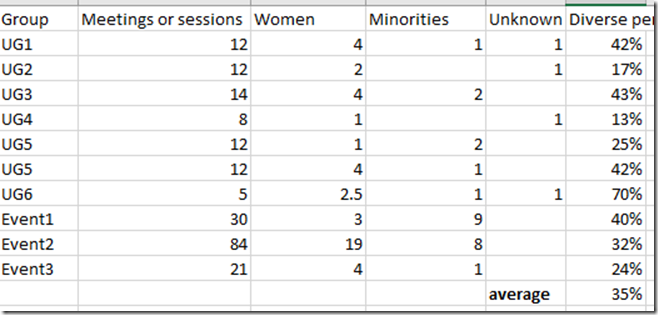
    2021-06-14 11_53_42-Dviersity in User Groups.xlsx - Excel An average diversity of 35%, though I could have made some mistakes. I counted women, and separately counted minorities that were not white males as diverse. I think I counted those I know as LBGTQ as minorities as well.

    It’s not scientific, nor is it necessarily some quota I’m looking to meet here. As a minority (I’m in a few data sets above), I think 35% is pretty good, but likely it ought to be higher, especially with regards to women. They make up half of the world, but are underrepresented in our industry.

    A quick anecdote, in case you think that this isn’t important. Early on, the computer jobs were mainly for women. They programmed a lot, and helped get things working in various industries. The job was seen as “secretarial”. Once companies started to pay more, men wanted those jobs, and took over the industry. Hiring practices, and men being comfortable with other men, not because of talent. Good programmers come in all colors, creeds, and genders.

    That has happened in other industries as well. It’s not a malicious thing, but it is a trend when there isn’t visibility or attention paid to the issues. Those that are in charge tend to aim for homogeneousness, or some level of uniformity. That displaces others.

    I’d like to call on all user groups to add a report to their main meeting page. Just cull the data from the last 12 months (or meetings) and report on it. Microsoft does something like this for their company, as does Apple, Google, Facebook, Redgate, GE, Walmart, and many others.

    Do us all a favor and pay attention to your actions in this area, and encourage others. I was happy to speak to the local WIT group years ago on how to give a presentation and managed to get one person to start speaking. If I did that every year, we’d have a lot more women speakers, so this is on me as much as on many others.