Author: way0utwest

  • Daily Coping 15 May 2020

    I’ve started to add a daily coping tip to the SQLServerCentral newsletter and to the Community Circle, which is helping me deal with the issues in the world. I’m adding my responses for each day here.

    Today’s tip is to show your gratitude to people who are helping to make things better.

    I go to stores and town a few times a week. Part of this is fresh food, part is needing things to keep the ranch going. Spring is often maintenance and repair time, along with regular feed items for horses.

    As I go, I’ve made it a point to thank people for being open, coming to work, and even just doing their job. I’ve been tipping extra in many restaurant places, because I can afford it and I know many of others are struggling.

    Small things, but I do appreciate everyone doing their jobs, however small, at a time like this.

  • Formatting Code in ADS with SQL Prompt

    One of the most popular and widely used features of SQL Prompt is formatting code. The SQL Prompt extension is in public preview and you can get it here. I have another post that walks through the  installation.

    Once it’s installed, you will likely want to use it, and one of the things you can do is format code. This post looks at a few of the basics for formatting code.

    Quick Format

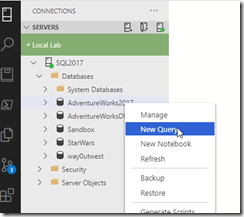
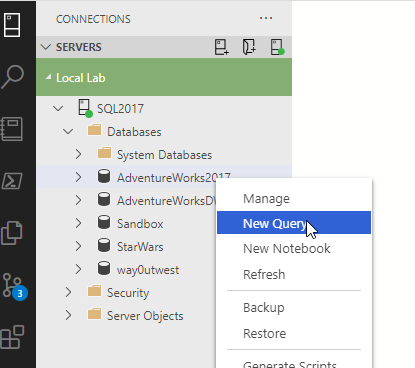
    Let’s see how this works. First, we open ADS and choose a connection from the Server pane. I right click a database and choose “New Query”(shown here).
    2020-05-13 12_05_06-Data Analysis - Azure Data Studio

    Next, I’ll enter the query here into the pane:

    SELECT DISTINCT Name
    FROM Production.Product WHERE ProductModelID IN (SELECT ProductModelID
                                                     from Production.ProductModel
                                                     where Name LIKE 'Long-Sleeve Logo Jersey%');
    GO

    Once I have this, you can see in the image that the subquery has some  poor formatting. The subquery is quite wide and some keywords are cased differently.
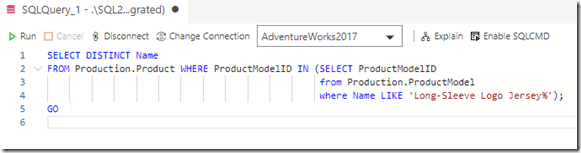
    Query shown in ADS

    Let’s CTRL+Shift+P to get the command palette. If I type format, I’ll see some options in the image below for formatting (or something similar).
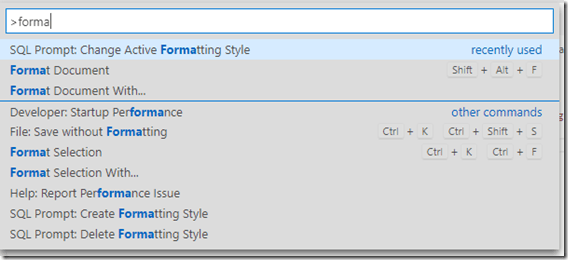
    command palette with format options

    I’ve been testing, so the recently used commands show the format document commands, which you will often use. In this case, I’ll select Format Document with. When I do that, I’ll get a list of formatters for SQL code installed on my system. In my case, I have SQL Prompt, the default mssql formatter, and a PostgreSQL formatter.
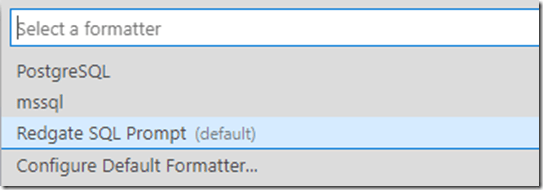
    Installed formatters in ADS

    Once I select Prompt, formatting will begin. I see a note in the lower right corner of ADS.
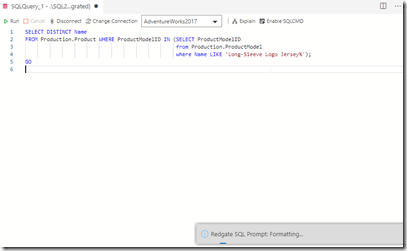
    2020-05-13 12_13_58-● SQLQuery_1 - ._SQL2017.AdventureWorks2017 (Integrated) - Data Analysis - Azure

    When this is done, I can see my query is formatted appropriately (according to my style). The keywords are proper cased and the spacing for the subquery has changed.

    Reformatted code

    Setting a Default Formatter

    I don’t want a two step process every time I need to format code. In fact, the Format Document shortcut is Shift+Alt+F, and I want to use that. In order to do that, I’ll need to configure a default format.

    Note: If you haven’t and you click Shift+Alt+F, ADS will ask you to configure one.

    The command palette (CTRL+Shift+P) is the way to configure ADS. Click that and type “format”. You will see a list of commands, and you want to choose the “Format Document with” option. This brings up the list of formatters, as we saw above, but below this is the “Configure” option.
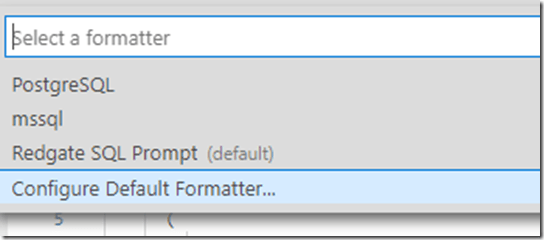
    Configure formatter option in command palette

    We choose this, and again see a list of formatters, but the text at the top has changed. In the image we can see this now says: “Select a default formatter for ‘SQL’ files”. We can pick SQL Prompt to set that.
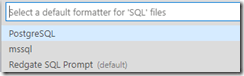
    formatter choices

    Once we’ve done this, Shift+ALT+F will format your query.

    Changing Styles

    One of the things many of us want to do is use a custom formatting style. While the built in styles are handy, many users want custom ones. That includes me. I have a few custom styles I use regularly in SSMS. If you run ADS on Windows, your styles are imported. If not, I’ll do another post for that.

    I can change styles in the command palette. Type “SQL Prompt” in there and you see options:

    SQL Prompt Options in ADS

    The one I’ll use is the recently used one “Change active formatting style” at the top. If I pick that, I see this on my ADS install:
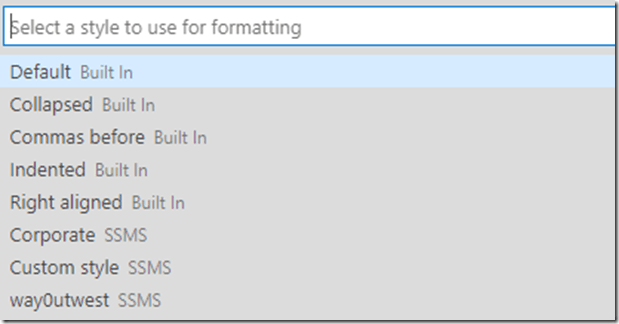
    SQL Prompt Formatting Styles

    There are a number of Built In styles that come with Prompt, but we can see my three custom ones have been imported from SSMS. Each time ADS starts, it imports your styles, so if you change on in SSMS, which has a better style editor, you will see it here when ADS reloads.

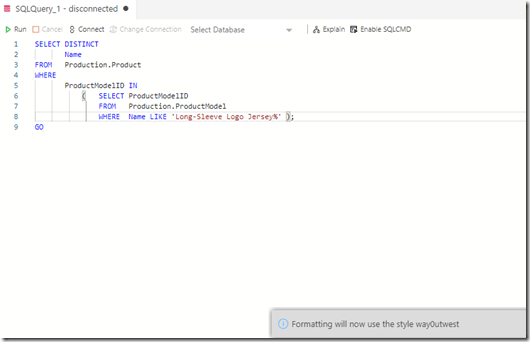
    I will set my “way0utwest” style as active and then reformat the query. I now see this:
    new query formatting

    The parenthesis location has changed. I also see the notice in the lower right that appeared after selecting a new active style.

    Summary

    This is just a basic look at using the formatting and choosing a style. If you are on Windows, all of your styles are available. If not, you’ll have to use the built in ones or edit one for yourself. I’ll cover editing styles in another post.

    I also have a video here of the process of formatting code: https://www.youtube.com/watch?v=EWCk7wUIL_s&feature=youtu.be
  • Remote Sharing and Learning

    Lots of technical people have spent time learning something on a computer. The idea of remote learning isn’t new to many of us that have watched events online for some time. Many of us have had the chance to watch some remote session from Microsoft, Redgate, or some other software vendor. We might learn online from some site like Pluralsight, or maybe we even attend some of the virtual chapters that PASS supports.

    At this time, more of us than ever are remote from others, not just for learning, but most of our daily work, meetings, reviews, discussions, and more. Learning to be effective, and ensure you still perform at the level your employer expects, can be a challenge. I ran across a piece on how to run great workshops, which I think contains some good advice for many meetings, not just workshops or training sessions.

    Much of the advice in the piece revolves around prep and practice. You should ensure your tools work, have documents available, ensure everyone can connect and access the technology. Things we probably should do for in person meetings.

    We tend to do a lot of group work in my company, and I’ve found that being remote is sometimes a challenge. Everyone is now remote, which makes this more equal, and we’ve adapted well. I attend some of the group standups and reviews, where each team shares some progress. We’ve gotten good at switching presenters and keeping things on track, though this is more a one-way delivery of information rather than a discussion.

    While we can share documents, it is hard to sometimes tell what other people are looking at or referring to when they are speaking. Asking them a question is helpful, but it can also be intimidating for some people to ask for clarification, especially if three other people have already asked at different times before. Communication is a challenge when people are remote, and over communicating can be important. Explain what you’re looking at or doing, and ensure you have a summary or a recording to re-watch. This can be invaluable in ensuring that everyone can access the same information.

    I attended a conference a little over a month ago that used a shared whiteboard, which I thought was a great idea. I wonder if that would be useful in some of our meetings. Having someone take notes is good, but being able to review to ideas on a whiteboard is something I’ve often appreciated. I’ve used whiteboards to explain or clarify things in live meetings in the past. A virtual one might be nice to use, though with some easy way to tie together thoughts from different individuals. We sometimes group edit Word or Excel docs, but that often has us looking at different sections of the document, not the same one. Likely a communication issue, but still an issue.

    We need to learn to get better and working together remotely. It’s a skill that will matter more and more over time. After this pandemic ends, I suspect many more organizations will adopt more remote work, which means more remote meetings. Learning to effectively present and absorb information from virtual events of all sorts is going to matter more in the future.

    Steve Jones

    Listen to the podcast at Libsyn, Stitcher or iTunes.

  • Daily Coping 14 May 2020

    I’ve started to add a daily coping tip to the SQLServerCentral newsletter, which is helping me deal with the issues in the world. I’m adding my responses for each day here.

    Today’s tip is today do something to care for the natural world.

    Living on a ranch, I do more of it than I might otherwise need to do. A couple things I’ve done this week, not today. I needed to change the oil in a vehicle, so I did so and captured the used fluid, making a trip (with a mask) to recycle it.

    I also spent some time working on caring for the lawn and shrubs, trying to keep things healthy. I need to take out a few old shrubs, some dead, and then I want to replant some trees, growing something for the future.