Author: way0utwest

  • Scripting Tables with dbatools

    I really like the dbatools project. This is a series of PowerShell cmdlets that are built by the community and incredibly useful for migrations between SQL Servers, but also for various administrative actions. I have a short series on these items.

    I’ve been experimenting with scripting some tables, and I wanted to check to see if dbatools made that easier. I was amazed by the number of new cmdlets in the project, and after hunting around, I found a couple cmdlets: Get-DbaTable and Export-DbaScript. I decided to see how these work.

    My first experiment was to run Get-DbaTable. This takes an instance and database as parameters and returns a set of table objects. I get space and size information and some metadata. As a short look, here’s one table.
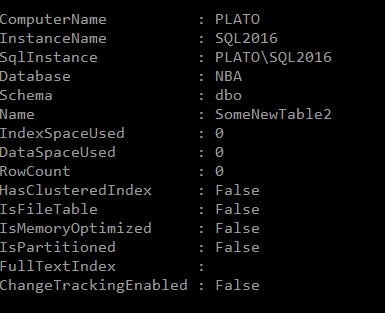
    2018-03-22 14_26_18-cmd - powershell (Admin)

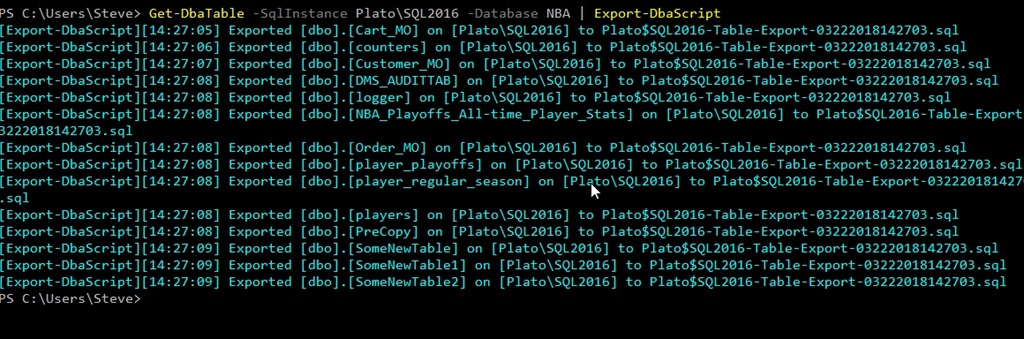
    I decided to use this as input to Export-DbaScript to see what happened. I used this command:

    Get-DbaTable -SqlInstance Plato\SQL2016 -Database NBA | Export-DbaScript

    This gave me some output. It wasn’t quite what I wanted, but it worked.
    2018-03-22 14_27_38-cmd - powershell (Admin)

    Note that all of the tables were exported to the same file. If I opened that file, here’s a snippet of the code. I get a header, and then each table’s code put together as single batch.

    2018-03-22 14_29_06-Plato$SQL2016-Table-Export-03222018142703.sql - (local)_SQL2016.WideWorldImporte

    Not quite what I wanted.

    I can determine the file, using the –Path parameter. This still gets me one file, but I can make this better. I’ll make a folder and change to that folder in my PoSh window. Now I can run this, using ForEach-Object to iterate over the tables, outputting each to a file.

    Get-DbaTable -SqlInstance Plato\SQL2016 -Database NBA | ForEach-Object { Export-DbaScript -InputObject $_ -Path ($_.Name + “.sql”) }

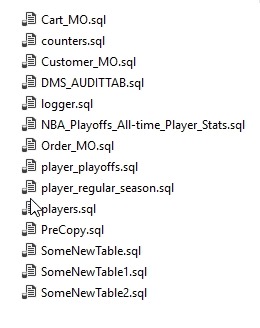
    When I do that, I get this:
    2018-03-22 14_50_27-Tables

    Each table’s code is now in a separate file.

    That’s nice, and with filtering, I could have this generate scripts for specific objects, or types of objects and update them from PoSh, likely a job or task, relatively easily.

    Certainly the Generate Scripts process in SSMS is easier than writing this script, but that’s not programmable. This wraps around the SMO scripting objects and makes the process much easier.

    If you haven’t tried dbatools, give it a go. You’ll appreciate the ease of scripting and might start to enjoy working with SQL Server in PoSh.

  • Ad Hoc Logs

    A long time ago I started working in a team of people as a general systems administrator. I worked in a team of six people managing a large, 1000+ node network with a number of servers. In my first exposure to SQL Server, we had a very unstable application that forced us to provide 24×7 support. With a couple of contractors, we had to ensure someone was on-site all the time, often working with Microsoft and our corporate developers to stabilize the applications. We were constantly trying new techniques to fix our application, and with staff stretched thin, we struggled to understand what might have happened in the previous 12 hours when we reported for work. At the time, I suggested leaving a text document on each server’s desktop, updated with a note for each change.

    That worked well and I brought that technique with me to future positions. In another job, we constantly remotely connected to systems, and having a standard file on the desktop was helpful. As we became more security conscious, and stopped using shared logins, we moved our logging to Exchange public folders. Every action taken by an admin needed to be cut and pasted into a new post. That wasn’t a perfect system, but we built habits over time and we had an audit trail that helped us in understanding the changes we’ve made and assisted in troubleshooting.

    Today I’m curious. I want to ask the question about the data corrections, those quick changes, those fixes that get production working. Do you log everything? Is there some system in place to ensure you know what’s happening?

    I’ve been wondering about this and thinking hard as the date for GDPR enforcement approaches. One of the items that I’d glean from the law’s text is that any change to correct data, any quick fix made, needs to have an audit trail. We need to prove that we know who, when, and why this change occurred. This is especially important if a data subject requested some correction. You’ll need to prove you actually performed the action.

    I’ve never worked anywhere that some admin (including myself) completely avoided connecting to a production machine and making some change. Sometimes we’ve had great auditing, often not, but ad hoc fixes and changes, especially in the heat of an issue, are a fact of life. I’ve learned to deal with it and try to build lightweight habits to help me capture those changes.

    Let me know today. How bulletproof is your auditing?

    Steve Jones

    The Voice of the DBA Podcast

    Listen to the MP3 Audio ( 4.0MB) podcast or subscribe to the feed at iTunes and Libsyn.

  • I learned about the order of logical operations #SQLNewBlogger

    Another post for me that is simple and hopefully serves as an example for people trying to get blogging as #SQLNewBloggers.

    I had logic in a CS curriculum many years ago and I’ve worked with AND and OR statements for years. I’ve sometimes confused myself, but I usually ensure I have parenthesis included to clarify the code. Not just for me, but for anyone that might glance at the code later.

    As a side note, I also try to format code so a quick glance can reveal what happens.

    However, I learned something new this week. I saw a question about the order of logical operations in this form: a or b and c.

    I had somewhat assumed, like math, we’d use a left to right evaluation. However, that’s not correct. Look at this snippet:

    2018-03-22 10_06_22-SQLQuery1.sql - (local)_SQL2014.SimpleTalk_1_Development (PLATO_Steve (57))_ - M

    If we went left to write, we’d have two rows from the OR (n=1, n=2) and then an AND that produces no rows. So no results?

    That’s not correct. According to BOL for OR,  the AND operations occur first. So n=2 AND n > 3 occurs, with 0 rows. Then the OR with n=1 is evaluated to return 1 row.

    Fascinating.

    At least to me. I’ve never thought because I’d write

    WHERE (n = 1 OR n = 2) AND n > 3

    or

    WHERE n = 1 OR (n = 2 AND n > 3)

    and be sure that what I wanted to occur would occur.

    A quick lesson. While it’s good to know what the order or evaluation is for your platform, don’t count on this. If there is a chance for confusion or unintended consequences, use parenthesis. It’s simpler and easier, and I might argue, more elegant.

  • More SQL Server Updates

    This was a busy week for updates. I finished adding new builds to the build lists for 2017, 2016, and 2014, the first time I’ve done all three platforms on the same day. To be fair, two updates were on the 19th and one on the 20th, but that’s pretty close to the same day. In the past I’ve had updates for different versions during different months.

    That will not be the case in the future. SQL Server 2017 is on the CU model where we get monthly updates to the product. No more service packs for this version. If you hadn’t heard that, be ready for the new servicing model that consists of just the monthly updates. I wasn’t sure if I liked this at first, but I do appreciate that we don’t get confused with trying to determine which CU1 is needed as there were different patches for RTM, SP1, SP2, etc. Now I’ve gotten used to expecting an update each month and applying them after a few days. So far, Microsoft has mostly been sticking to monthly releases, though the December release got delayed into January. With holidays, that’s expected.

    This week also saw the update of SSMS to v 17.6. You can freely use this version and download the full install or just the update package if you are running 17.x. We are seeing updates on a fairly regular basis to the tool, every couple of months. I’m hoping we continue to see more fixes and improvements aside from new functionality as SSMS has been neglected for too long. I don’t know how stable this version is, but 17.4 was on my machines for a long time without an ill effects, and I think this seems fine for now.

    Updates have always been a part of software, but often they are fairly rare, with interruptions occurring just a few times a year. That’s changing. Redgate releases software every week, with almost every product updating once or twice a month. For someone that uses relatively few pieces of software, all of a sudden it seems like I have a regular set of tools to update across my SQL Server development platform between SQL Server, SSMS, VS, Redgate tools and more.

    That’s good, as I get fixes and increased functionality, but across a set of tools, I might find myself updating something every day. While the software often updates itself if I click OK, I have to make a decision and the process is disruptive and time consuming, especially when I run into required updates, which happens more than I’d like. I like the idea of DevOps, but one of the unintended consequences is that if everyone does it, there are a lot of changes and updates for users to deal with.

    I don’t have a solution, but I do find myself delaying updates more and more, often moving to only take every 3 or 4 updates. Maybe if everyone had an easy way to apply patches with PoSh across systems, or smoother built-in mechanisms I’d feel differently, but for now I probably click “skip” more often than “apply”.

    Steve Jones

    The Voice of the DBA Podcast

    Listen to the MP3 Audio ( 4.7MB) podcast or subscribe to the feed at iTunes and Libsyn.