Author: way0utwest

  • Valentines Day for Data Professionals

    It’s Valentine’s Day today, and if you’ve forgotten, you still have time to do a little shopping or show your partner that you value them. While this isn’t a public holiday in any country that I know of, many people do want to celebrate with someone special to them. In fact, if you forget about this day, chances are the next few might not be so pleasant.

    For many of us, we’ll spend nearly as much time at work each week as we might spend with our families. Between a few extra hours here and there at work, commuting, and sleep, it may often feel like we spend more time at work. Hopefully that’s not the case, and if it is, you should re-evaluate your current position.

    Most of us do have a relationship with our career. We’ve chosen it for some reason and are often locked into doing certain work in the short term. With today being a relationship holiday, I wanted to ask you to think about if you really love your career?

    I’m not speaking about your current job and employer. You might enjoy being a developer, DBA, or other data professional while not being enamored with the position and place you work now. I’m asking for the long term, are you happy with your career choice and looking to continue moving on this path.

    If you are, good for you, and I hope you find a great position that suits your life. If not, it doesn’t matter what you’ve done in the past. You can start moving forward in another direction today.

    I love my job, and I’ve enjoyed the last 25 years of working with SQL Server. I don’t know if I want to do another 25, but I certainly am still in love with my choice today.

    Steve Jones

    The Voice of the DBA Podcast

    Listen to the MP3 Audio ( 2.5MB) podcast or subscribe to the feed at iTunes and Libsyn.

  • Cloud Safe

    I saw a question recently from an individual that was trying to decide if it made sense to move their databases to the cloud. In this case, management wanted to move, but the technical staff had concerns about Disaster Recovery in the cloud. These are very valid concerns for any system, as technical staff is often responsible for data, regardless of who decides on the architecture of a system.

    The concerns got me thinking a bit. Is the cloud safer for DR? It’s certainly an “it depends” question, especially as the “cloud” isn’t necessarily the same thing for each of us. Some of us would use IaaS, with VMs in the cloud. Others might choose PaaS, with RDS or Azure SQL Database as a platform. Still others might want something like Managed SQL Instances, which is like IaaS+, or maybe PaaS#. I’m not completely sure how to classify this.

    In any case, your choice of cloud architecture can mean better or worse DR. The closer you are to IaaS, the more that you still have the same responsibilities that you might have inside your own data center. The difference is that hardware replacements or options are often quicker to procure, though perhaps with limited choice.

    If you choose PaaS, then you have different DR capabilities and responsibilities. Your vendor might handle some aspects of DR and remove the need for you to worry about hardware, or regular backups, but you might need to worry about other items. Your vendor might give you PIT recovery, but you might not want a database replacement in a busy system, especially if you’ve processed a few thousand transactions since someone ran that UPDATE without a WHERE batch. In that case, perhaps you want to ensure you can restore your database elsewhere, or you have other options.

    Many of us know that managing systems is complex work. Not every environment can be handled in the same way, and we often implement exceptions in both technology and staff knowledge. Ensuring your application and environment can recovery from a DR situation often requires detailed knowledge of both requirements and capabilities of the environment. While I’m not afraid of migrating to the cloud, I’d want to be sure I was prepared to answer questions from management if there are issues. After all, they’re going to look to me, not some vendor, for answers.

    Steve Jones

    The Voice of the DBA Podcast

    Listen to the MP3 Audio ( 3.4MB) podcast or subscribe to the feed at iTunes and Libsyn.
     

  • Door Number One for T-SQL Tuesday #99

    tsqltuesdayThis is a good month for T-SQL Tuesday. It’s the end of single digits for this blog party, which is amazing. I can’t believe we’re 99 months in. I’m sure Adam Machanic is proud of his efforts here.

    Aaron Bertrand hosts this month, and he’s given us a choice: door #1 or door #2. I’m choosing door #1.

    Daddy’s Girl

    I grew up in Virginia Beach, going through high school and playing elementary school volleyball where you could only score when you served. I loved the game, and eventually started to play on the beach during the summers at college and after I graduated. The game faded for me as I got married, had kids, and got busy with my career.

    When my daughter was 8, I signed her up for a recreational league. They needed help coaching, and I volunteered. With another parent, we coached the same group of 7 or 8 girls for 4 years, 8 seasons, and had a great time. A few of us parents also got involved in adult leagues, playing at various levels.

    When my daughter turned 13, she moved to a competitive league, as I watched. Across the years, I’ve watched my daughter play and love the game. As she became more independent, I started to spend time helping other teams, learning the modern game with rally scoring, liberos, and more.

    This year I’ve taken on coaching a team of 14 year olds. Two nights a week, some Saturdays, and as I’m doing less traveling for work, I’m spending my weekends coaching at tournaments, and having a great time.  As my body ages, and I spend less time at my own activities, I’ve turned to coaching others, and I love it. It’s a great way for Coach Steve to spend some time away from work.

  • Migrating MySQL Databases

    A little out of my area, but I need to move the tsqltuesday.com database to a new service. The company running the db decided that they don’t want to keep a lower level consumer type tier. Since their minimum plan is now $20/month, I decided to look elsewhere. My first move was to try Azure Database for MySQL. This is a quick look at moving the MySQL data.

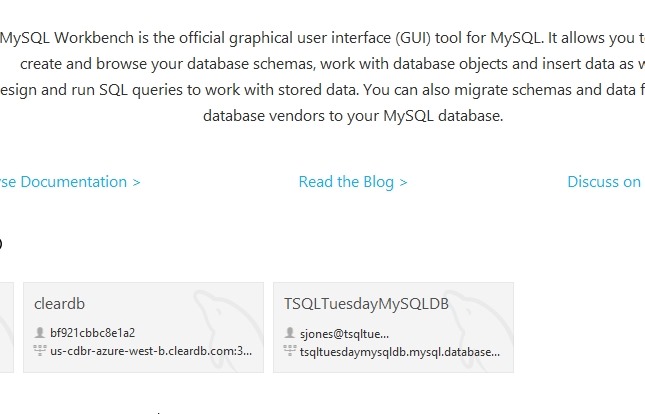
    I have MySQL Workbench, so I started that up. I saw a note that this contained a migration wizard. I first created a MySQL database in Azure, which is really simple. Then I created two connections from MySQL Workbench. One to the existing database and one to my new one.

    2018-02-08 13_50_54-MySQL Workbench

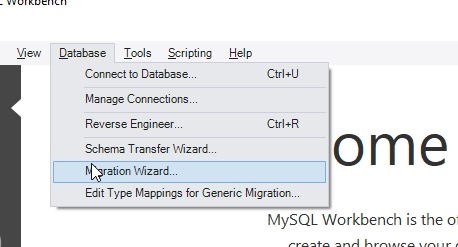
    The next step was to start the Migration Wizard. This is under the Database menu.

    2018-02-08 13_51_07-MySQL Workbench

    As with all wizards, this opens with a welcome page.  I clicked Start Migration to get going.

    2018-02-08 13_51_24-Why GDPR Will Fast Track the Fourth Industrial Revolution _ HuffPost

    The wizard is fairly simple. Once I had this working, I walked through the wizard, choosing my source and destination. This was a simple process and things connected up once I’d opened the firewall.

    2018-02-08 13_51_58-MySQL Workbench

    After verifying connections, I selected everything. Since this is a WordPress site, it’s a fairly small schema and set of objects.

    2018-02-08 13_52_21-MySQL Workbench

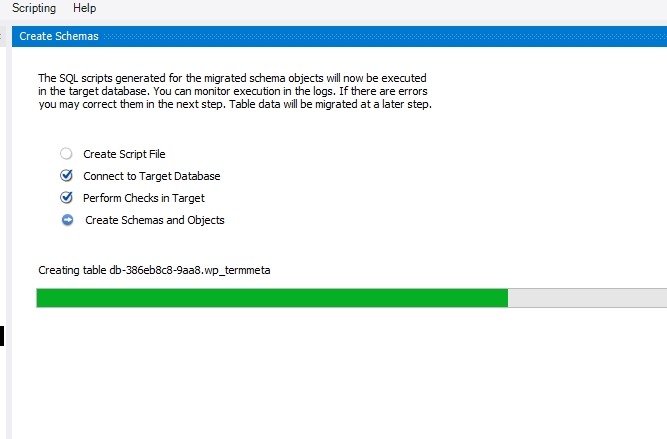
    I basically clicked next, next, and let everything transfer. This only took about 5 minutes.

    2018-02-08 13_52_40-MySQL Workbench

    Once this was done, I queried the database, and everything was working. I saw my data and it appeared complete. No errors, so I assumed things were correct. Row counts seemed to verify this.

    2018-02-08 13_55_58-MySQL Workbench

    This was pretty simple, perhaps even easier than using SSIS and the Copy Database Task since this was built in.

    Now to figure out how to re-point the application.