Category: Blog

  • The PASS Data Community Summit On Guy in a Cube

    I’ve known Adam and Patrick for a long time and I’m thrilled with the content they produce on their Guy in a Cube show. It’s a great resource for anything Power BI, and now, starting to cover Microsoft Fabric.

    I’ve been on their show before, but we did a new episode recently, talking about the PASS Data Community Summit 2023. They are teaching a pre-con session on Fabric and I recommend going to this one if you have a need to do data warehousing in Azure.

    Give the show a watch, and I hope to see you in November in Seattle. It’s a great trip for both you and your employer. You’ll get a lot of value from the event and I’m sure you will bring some knowledge back to your team.

  • Friday Flyway Tips: Visualizing Undo Scripts

    One nice thing with Flyway Enterprise is that it will automatically generate the undo scripts for migration scripts. However, it used to be that finding these and seeing the script was hard. It’s easier after Flyway Desktop 6.5.2

    I’ve been working with Flyway Desktop for work more and more as we transition from older SSMS plugins to the standalone tool. This series looks at some tips I’ve gotten along the way.

    Undo Scripts

    If you have Flyway Enterprise, you can have Flyway Desktop automatically generate scripts: both forward (versioned) and undo scripts.

    The config option for this is in project options, which is in the upper right.

    2023-08-10 15_53_53-Flyway Desktop

    Clicking this

    2023-08-10 15_53_57-Flyway Desktop

    Once have this, if you add a new object, when you generate the migration script, Flyway Desktop will generate the undo script. In the older UI (pre 6.5) this was a script below the generated script, which meant you had to scroll down, or up and down to compare the forward and undo scripts.

    The new UI is better. Now there is just a button. Let me show you how to do this.

    First, I have a few changes in the schema model. I’ll select one.

    2023-08-21 12_27_19-Flyway Desktop

    Now I’ll generate the scripts. When I do that, I see the two scripts. The versioned (forward) script is first, and you can see the “Undo” at the bottom.

    2023-08-21 12_28_05-Flyway Desktop

    Below this, the rest of the undo script is visible if I scroll down.

    2023-08-21 12_28_12-Flyway Desktop

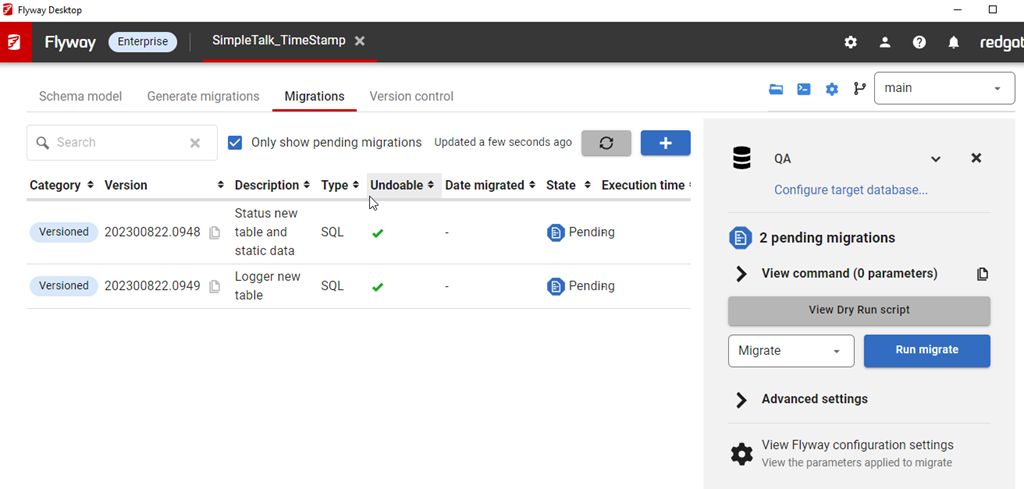
    It’s a bit of a pain to scroll up and down, so there is a small improvement in the migrations tab. If I go there, I can find my script at the bottom of the list and click it.

    2023-08-21 12_30_33-Flyway Desktop

    At the top of the script, in the bar, there is now a set of toggle buttons for version and undo.

    2023-08-21 12_24_35-Flyway Desktop

    I can click back and forth to easily see both scripts. The V script is above, and the undo is below.

    2023-08-21 12_39_44-Flyway Desktop

    Try it out today. If you haven’t worked with Flyway Desktop, download it today. There is a free version that organizes migrations and paid versions with many more features.

    Video Walkthrough

    I made a quick video showing this as well. You can watch it below, or check out all the Flyway videos I’ve added:


  • A New Word: Merrenness

    merrenness – n. the lulling isolation of driving late at night – floating through the void in an otherworldly hum, trailing red jewels in the darkness, your high beams seeming back and forth like a lighthouse.

    This is certainly something I feel often. I don’t go out late a lot, but there are times I’m coming home and I feel merrenness. Not so much the side to side of high beams, but the up and down on the hilly country roads in Colorado. A bit of side to side as I get near the house.

    This is especially something I feel in the Tesla, where there can be a hum and not much else. Watching the world go by, sometimes with music as a background, sometimes silence, reminds me of the wider world around me, both there and muted by the darkness.

    From the Dictionary of Obscure Sorrows

  • Finding Analogies with AI

    I saw this article on using AI to help that included a few prompts. I decided to try one.

    This is part of a series of experiments with the ChatGPT and other AI systems. Lots of Copilot lately.

    The Prompt

    Here’s what I wrote, since I was reading piece on cloud migration and writing an editorial:

    I am currently learning about cloud migration. Convert the key lessons from this topic into engaging stories and metaphors to aid my memorization

    The Response

    1. The Cloud Island Adventure:

    Imagine your business as a group of settlers on a remote island. They’ve been working with outdated tools and limited resources, making progress slow and inefficient. One day, they hear about a magical cloud island that’s full of modern technology, abundant resources, and a vibrant community.

    The settlers decide to embark on a journey to this cloud island, symbolizing your migration to the cloud. As they arrive, they realize they can instantly access powerful tools, scalable resources, and connect with experts from various fields. Just like in cloud migration, your business gains flexibility and efficiency, leaving behind the struggles of managing on-premises infrastructure.

    Key Lesson: Cloud migration is like moving to a new land of opportunity, where you can harness advanced tools and resources to grow your business.

    2. The Cloud Highway Construction:

    Think of your business as a growing city with a bustling population. However, the existing roads and bridges are becoming congested and outdated, hindering growth and causing delays. To expand and flourish, the city planners decide to build a futuristic cloud highway.

    This cloud highway represents your migration to the cloud. Construction crews work tirelessly to build this highway, which is scalable, adaptable, and has lanes for various services. As businesses start using the highway, traffic flows smoothly, and they can easily scale up or down as needed. The old congested roads symbolize the limitations of on-premises systems, while the cloud highway signifies the ease of scalability and innovation in the cloud.

    Key Lesson: Cloud migration is like building a high-speed highway that allows your business to easily adapt, grow, and efficiently navigate the digital landscape.

    3. The Cloud Carnival:

    Envision your business as a traditional carnival that’s been running for years. The carnival’s attractions are fixed in place, and changing or upgrading them is difficult and time-consuming. Visitors are getting bored, and the carnival is losing its charm.

    Deciding to modernize, the carnival organizers pack up and move to a new location, which represents migrating to the cloud. In this new location, they can easily set up and tear down attractions, experiment with new games, and respond quickly to changing trends. The cloud becomes their dynamic playground, allowing them to create delightful experiences for visitors.

    Key Lesson: Cloud migration is like relocating a carnival to a space where you can easily innovate and provide fresh, exciting experiences to your customers.

    4. The Cloud Puzzle Factory:

    Imagine your business as a puzzle factory, creating intricate puzzles with limited resources and machinery. You’re tasked with making bigger and more complex puzzles, but the factory’s machinery is old and cannot keep up with the demand.

    To overcome this challenge, you decide to move the factory to a cloud-powered puzzle factory. Here, you have access to state-of-the-art machines that can quickly produce even the most complex puzzles. You can rent additional machines when needed and return them when the demand decreases. The cloud puzzle factory allows you to efficiently meet demand without being limited by physical constraints.

    Key Lesson: Cloud migration is like upgrading your puzzle factory to a cloud-powered version, where you can easily scale resources to meet demand and improve production efficiency.

    By associating these engaging stories and metaphors with the key lessons of cloud migration, you’ll find it easier to remember and apply these concepts in your learning journey.

    Thoughts

    I liked these analogies. They got me thinking about how to explain things to customers, though they are all positive and don’t represent the downsides. However, when I asked to alter this to show how this hinders progress, I got the result below.

    Very interesting. Not sure if I think this is that helpful, but it was thought provoking.

    1. The Stagnant Island Settlement:

    Picture a group of settlers who refuse to leave their old, resource-scarce island. They struggle with outdated tools and limited resources, but they’re unwilling to explore the nearby cloud island that offers modern technology and abundant resources.

    As time goes on, the settlers fall behind in their development. They can’t innovate or expand due to their lack of access to advanced tools and resources. The once-promising settlement becomes stagnant and isolated, symbolizing the limitations of staying on-premises instead of migrating to the cloud.

    Key Lesson: Choosing not to migrate to the cloud can lead to stagnation and missed opportunities, as your business remains bound by outdated tools and restricted growth.

    2. The Congested Road City:

    Imagine a bustling city that stubbornly refuses to build a modern cloud highway. The existing roads and bridges are constantly congested, causing delays, frustration, and hampering the city’s growth.

    As more businesses and people move in, the traffic situation worsens. Without the scalability and adaptability of a cloud highway, the city’s infrastructure can’t handle the increased demand. This congestion and lack of flexibility mirror the challenges of sticking with traditional on-premises systems.

    Key Lesson: Failing to migrate to the cloud can result in congestion and inefficiency, preventing your business from scaling and responding effectively to changing demands.

    3. The Stagnant Carnival Grounds:

    Consider a carnival that’s stuck in its old location, unable to adapt to changing times. The attractions become outdated, and visitors start losing interest. Despite the need for innovation, the organizers resist moving to a cloud-enabled carnival.

    As a result, the carnival fails to attract new visitors and struggles to create exciting experiences. The reluctance to embrace the cloud leads to a decline in customer satisfaction and revenue, as the competition adopts modern approaches.

    Key Lesson: Not migrating to the cloud can result in a decline in customer engagement and revenue, as your business fails to adapt to changing market demands and deliver innovative experiences.

    4. The Inefficient Puzzle Factory:

    Visualize a puzzle factory that clings to its old machines and refuses to transition to a cloud-powered system. The factory can’t keep up with the demand for larger and more complex puzzles, leading to delays and frustrated customers.

    Without the ability to scale resources on demand, the factory struggles to meet production goals. The reluctance to modernize impedes efficiency and profitability, as competitors who utilize cloud resources outpace them.

    Key Lesson: Neglecting cloud migration can lead to production inefficiencies and missed business opportunities, as your organization struggles to scale and respond to market needs.

    By exploring these scenarios that depict the hindrances of not moving to the cloud, you can gain a better understanding of the potential pitfalls and disadvantages of staying with traditional, on-premises systems.