Tag: SQL Prompt

  • Using Prompt AI to Help Setup Data Analysis

    I used Claude to build an application that loaded data for me. However, there were a few others things I needed done to help me get the data ready for analysis. I could have used Claude (or another human), but this was a place I’d need to do a lot of directing.

    I did, however, use Prompt AI to help me get this moving quicker and start some analysis. This post covers the way I got assistance inside SSMS from Prompt AI.

    This is part of a series of posts on SQL Prompt. You can see all my posts on SQL Prompt under that tag. This is part of a series of experiments with AI systems.

    Adding New Structures

    As a part of my data analysis, I needed to tag sessions with topics. This wasn’t really done as a part of most SQL Saturday events. While there might be tracks, often the sessions aren’t categorized with tags. It’s a pain, most organizers and most speakers don’t want to bother.

    Plus, search works well on a website. For data analysis, not so much.

    I decided to use Prompt AI to help a bit at this point, since I was low on credits.
    I asked it to add a structure. Possibly I could have written the code in not much more time than it took for this prompt, but here I get to let an assistant take a stab and then critique the work. Here’s my prompt to SQL Prompt AI:
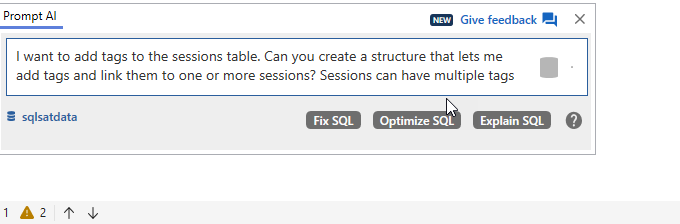
    2025-12_0118

    Here are the results. This has the PKs, FKs, and indexes, some of which I might have forgotten. I don’t love names like “description”, but that’s fine. I could easily fix that.

    -- Create a table to store tags
    CREATE TABLE dbo.Tags
    (
        TagID INT IDENTITY(1, 1) PRIMARY KEY,
        TagName NVARCHAR(100) NOT NULL,
        Description NVARCHAR(500) NULL,
        CreatedDate DATETIME
            DEFAULT GETDATE()
    );
    
    -- Create a junction table to link sessions with tags (many-to-many relationship)
    CREATE TABLE dbo.SessionTags
    (
        SessionID INT NOT NULL,
        TagID INT NOT NULL,
        PRIMARY KEY (
                        SessionID,
                        TagID
                    ),
        CONSTRAINT FK_SessionTags_Sessions
            FOREIGN KEY (SessionID)
            REFERENCES dbo.Sessions (SessionID),
        CONSTRAINT FK_SessionTags_Tags
            FOREIGN KEY (TagID)
            REFERENCES dbo.Tags (TagID)
    );
    
    -- Create index to improve query performance
    CREATE INDEX IX_SessionTags_TagID ON dbo.SessionTags (TagID);
    CREATE INDEX IX_SessionTags_SessionID ON dbo.SessionTags (SessionID);
    

    Now, I need to analyze the data.

    Fortunately, Prompt AI helped me. Below this DDL, was a snippet to test my tags. I had this code listed:

    SELECT 
         s.SessionID, 
         s.Title, 
         STRING_AGG(t.TagName, ', ') AS Tags
    FROM 
         dbo.Sessions s
    LEFT JOIN 
         dbo.SessionTags st ON s.SessionID = st.SessionID
    LEFT JOIN 
         dbo.Tags t ON st.TagID = t.TagID
    --WHERE Title LIKE '%n rds%'
    GROUP BY 
         s.SessionID, s.Title;

    I used this to check my tags, which were non existent at this point, so I had all NULL values in the Tags column. Fortunately, I know how to write some code, so in another window I wrote this code, which inserts data, but doesn’t create dups since I might have dups based on my LIKE clause catching the same session twice.

    I also get the list of current tags, so I could change the number used in the insert as needed. There are more elegant ways to do this, but I wanted to get something done.

    INSERT dbo.SessionTags
    (
         SessionID,
         TagID
    )
    SELECT SessionID, 10
    FROM sessions WHERE Title LIKE '%n rds%'
       AND sessionid NOT IN (SELECT sessionid 
            FROM dbo.SessionTags 
         WHERE TagID = 10)

    SELECT @@rowcount
    GO
    SELECT top 30
    *
    FROM dbo.Tags


    There was a sample INSERT statement for tags as well, so I modified it to use tags I cared about. Then I started running my test query to look for NULL values and start filling them in.

    Here’s a look at a run. I’ve added some tags, but there are some nulls. There are also multiple tags for some sessions. I added the description field as well, but for most of the data, this doesn’t exist, so I don’t have it. Yet. That’s another project.
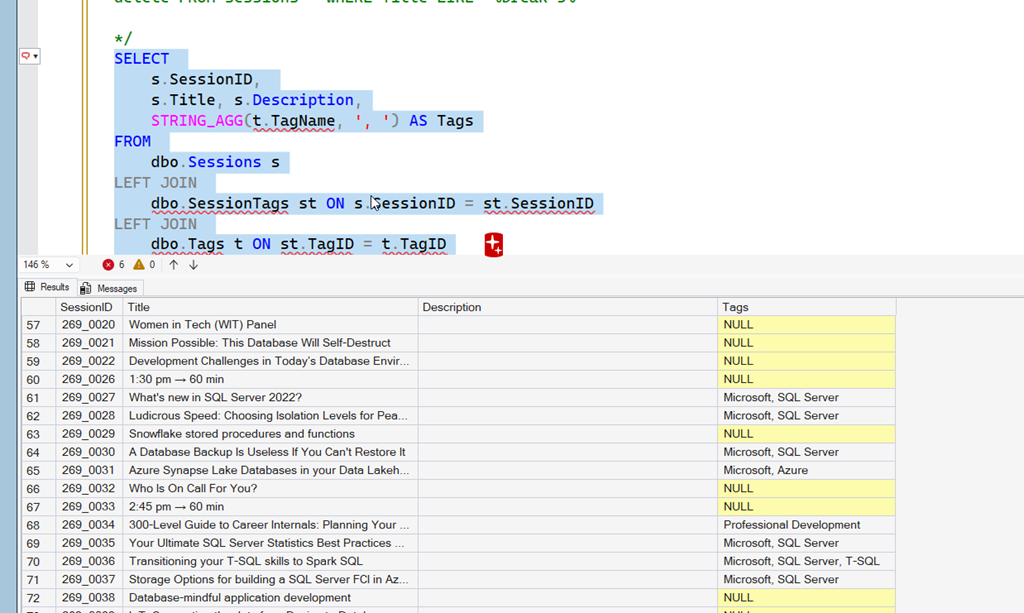
    2026-01_0130

    Line 63 is for Snowflake, which isn’t a tag. So I edit my commented out code to include Snowflake and then execute it. This is commented, so as I hit execute it doesn’t run automatically.
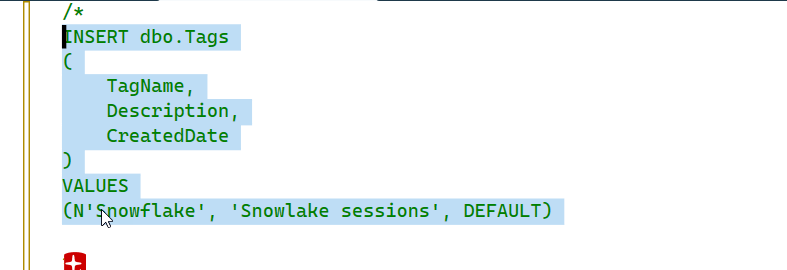
    2026-01_0131

    Now I get a list of tags and use that to edit my numbers in the SessionTags insert statement. In this case, Snowflake is number 17, so I change the insert to that, and edit the LIKE statement. This will add that tag to all sessions with Snowflake in the title.
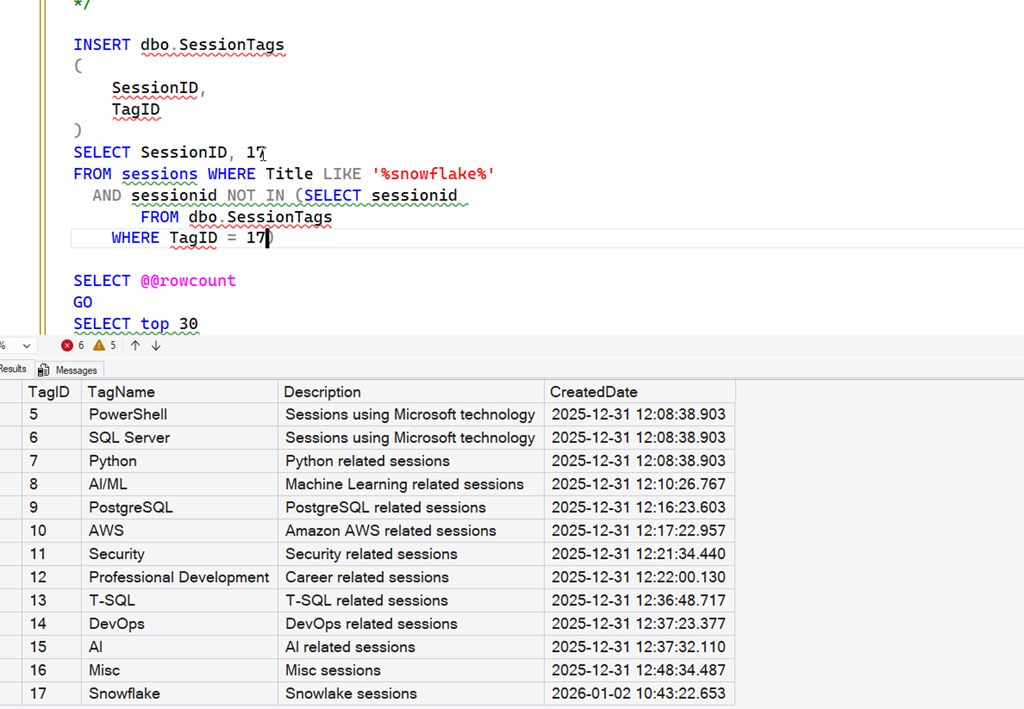
    2026-01_0132

    I repeated this for a number of sessions. Below, I’ve re-run my tag query and now we see Snowflake is added.
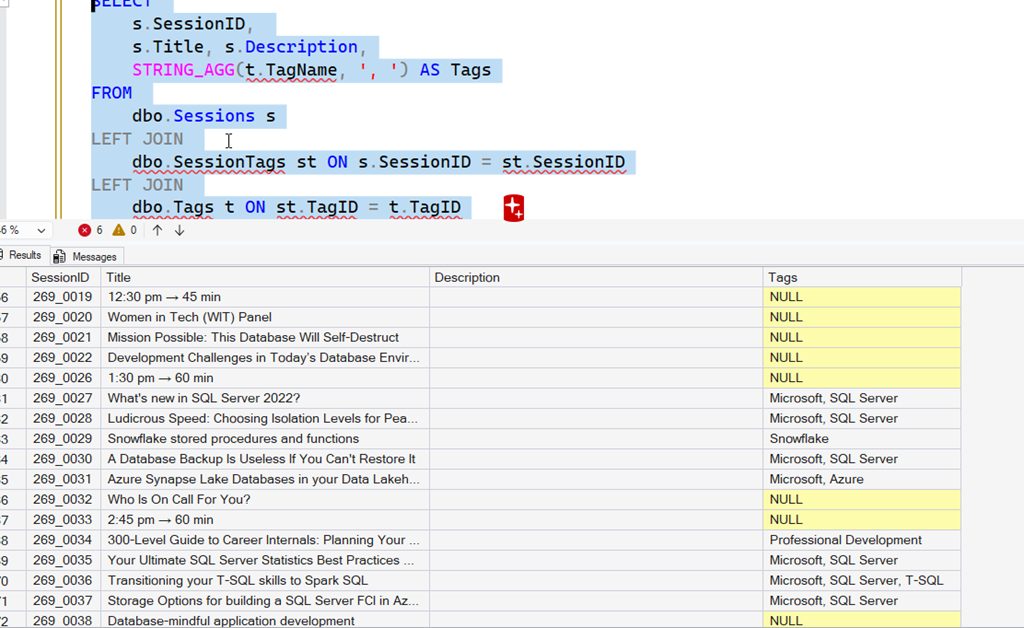
    2026-01_0133

    Why I Didn’t Use an AI for This

    I built an application that loaded this data with Claude Code. I could have asked Claude to add the tags as well, but I didn’t have any data to put in there. I wasn’t even sure what I would do, especially as a lot of these sessions aren’t really sessions. Notice the timings above, the breaks, the panels, etc. There are also lunch breaks and other items that aren’t really sessions.

    Claude could have cleaned this data. However, I want to be sure of what I’m removing. Having Claude write the delete (or run a select first) and then ask me what to do doesn’t seem to be a good use of its cost or my time.

    I still need to be the human in the loop. There were some times I ran a select for certain words and then check the list before adding the tags. For example, here was what I did for Snowflake.
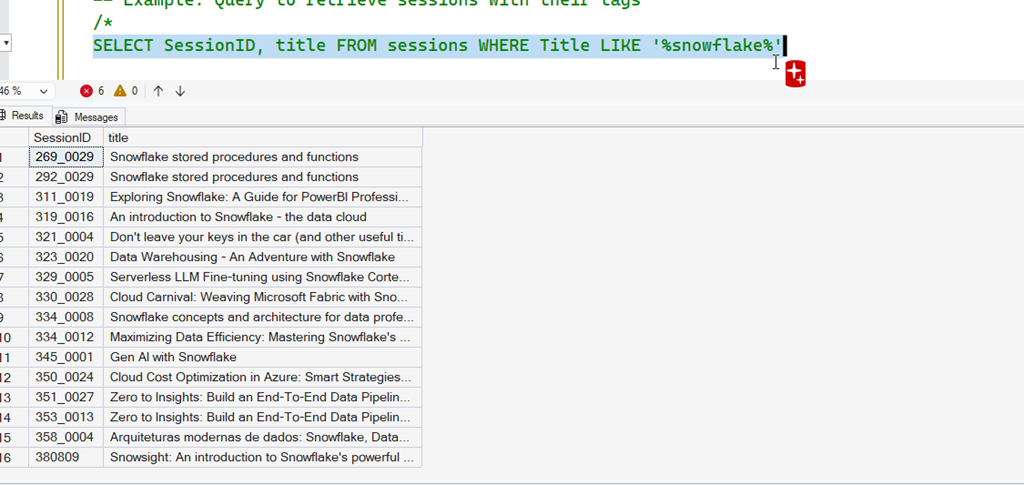
    2026-01_0134

    All those are good, but when I ran a search for Agent, I found mostly AI based results, but a few were SQL Agent sessions. Tagging those as AI wouldn’t make sense, so I had to find a better way to update the data I needed updating.

    Summary

    SQL Prompt didn’t do a lot here, but it did quickly get me moving on the task I was focused on rather than the details to support it. I could have written the DDL, but it would have taken focus away from me in thinking about tags. This did as good a job as I could do, or more importantly, as good a job as I needed.

    It also gave me a query and insert statement to get moving, again, reducing my mental load. I could have written that query, but I would have spent a few minutes doing it rather than thinking about how to assign tags.

    Ultimately I think this was a good use of AI, saving my time and energy, allowing me to focus on the task I was trying to accomplish without distraction.
  • Using Prompt AI for a Travel Data Analysis

    I was looking back at my year and decided to see if SQL Prompt could help me with some analysis. I was pleasantly surprised by how this went. This post looks at my experience using this to help me write a few queries.

    This is part of a series of experiments with AI systems.

    New York City

    This year was a big one for me and New York City. By my count, I went there five times. I wanted to see if that was right.

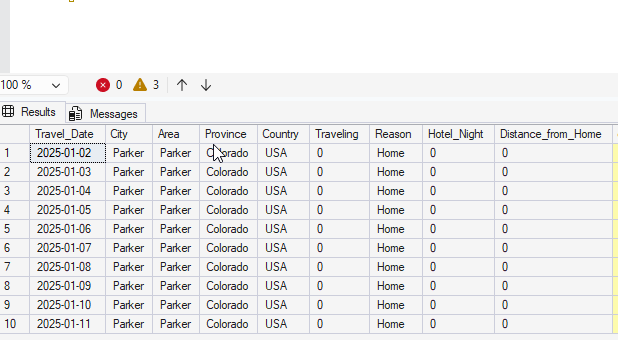
    I started by loading up a bunch of travel data I keep into a database. I do this to keep an eye on where/when I’m going places, so that I have a few of how busy I’ll be. In this case, I loaded data into a table. Here’s a short sample of data.

    2025-12_0217

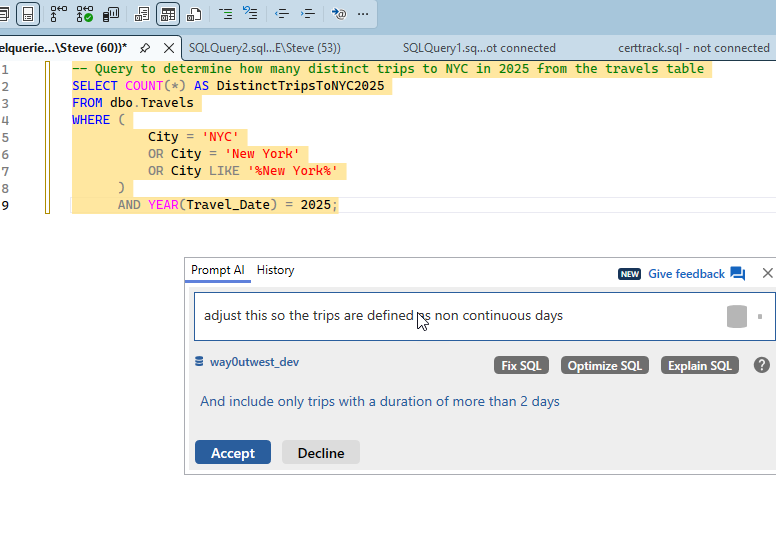
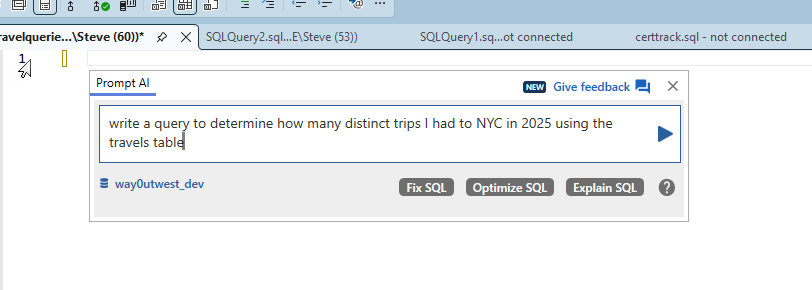
    I started by asking Prompt AI to write me a query. Here’s the prompt:

    2025-12_0212

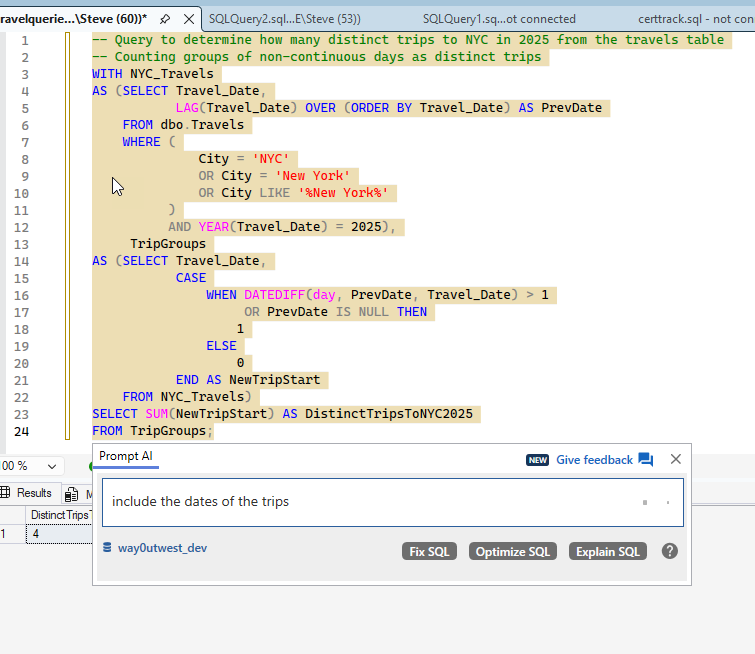
    Simple enough. I could have written what it gave me, so I asked for more. Since I’m not tracking trips, but where I am on days, I needed something better. My prompt is what I might express to someone else, non-continuous trips.

    2025-12_0213

    2025-12_0214

    I got a 4 back from more complex code, which is looking for entries with the city being NYC or a variant. It then adds a LAG(), which is what I was thinking before I decided to let Prompt do this. Notice above I was already asking for dates.

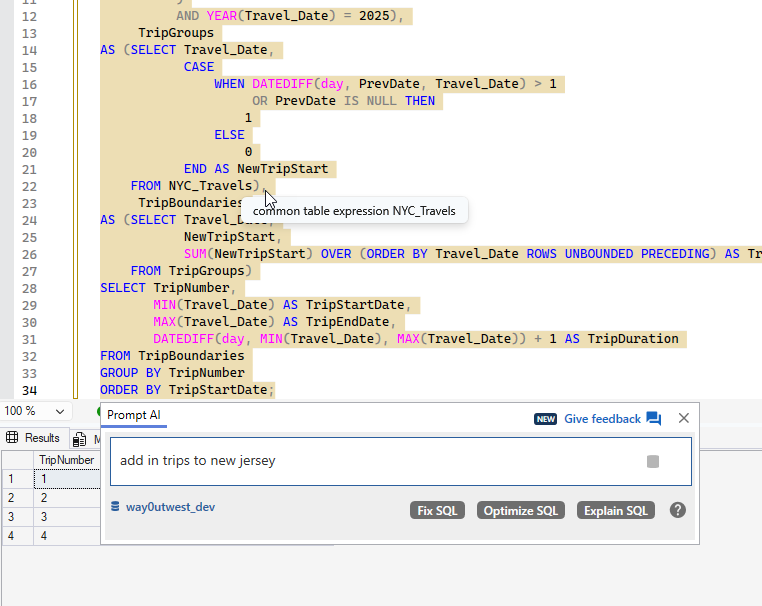
    2025-12_0215

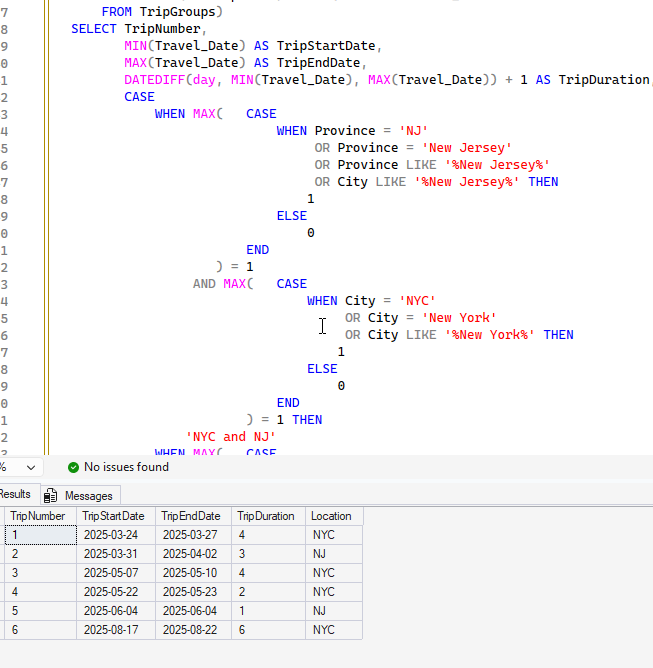
    I got my dates, but still 4 trips. I know I flew to the NYC area more times. In looking at the dates, I realized that one of the trips, Mar 31-Apr 2, was only to Jersey City. So I had asked for that above.

    You can see more more complex code, which adds in New Jersey. The results were interesting. This has 6 trips, because on one another trip, I went to New Jersey for a day. I had forgotten that one.

    2025-12_0216

    Checking Countries

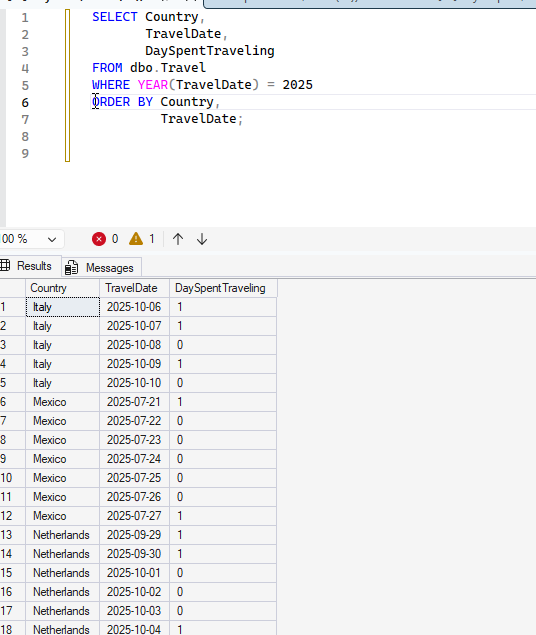
    I wanted to do some country analysis. I knew there was a bunch of country data from 2025 in there, so I wrote a simple query. That gets me some data, but it’s a bit of a mess. I really want to know when I visited countries.

    2025-12_0227

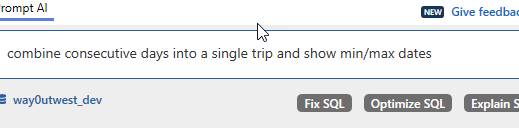
    I used PromptAI with a simple request.

    2025-12_0228

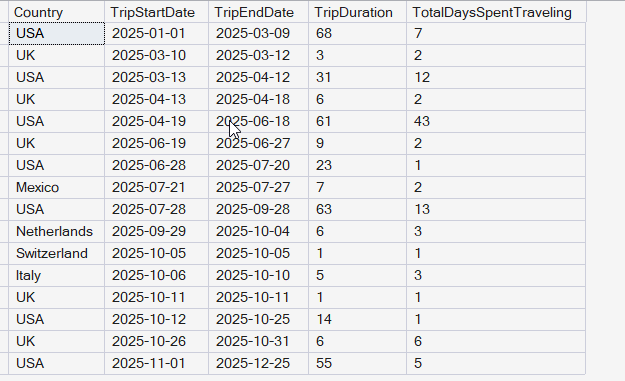
    I got some results back, which were good, but included the USA. I then asked to remove this and you see the result.

    2025-12_0229

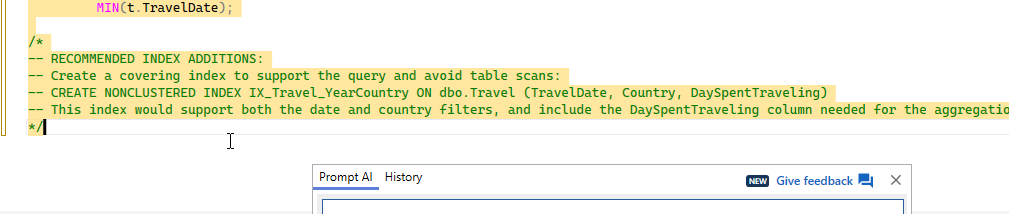
    This was a good query, overall, so I clicked the “Optimize SQL” button. I got these items added as comments.

    2025-12_0230

    There isn’t a lot to do here, but I created the index. The “optimize” had also added a FORCESEEK, which I didn’t realize at first, so I removed it.

    Eventually I added back the USA, partially as this improves performance, but also, with the results, I got a good look at travel patterns. In this case, I can see when I’m in the USA and when I’m not. I liked that I had asked for the trip duration, but the GenAI also added days traveling on the trips, which was fascinating.

    2025-12_0233

    The final query is here:

    ;WITH TravelCTE
    AS (SELECT Country,
                TravelDate,
                DaySpentTraveling,
                ROW_NUMBER() OVER (PARTITION BY Country ORDER BY TravelDate) AS RowNum
         FROM dbo.Travel WITH (INDEX = IX_Travel_YearCountry) -- Use existing index to improve performance
         WHERE TravelDate >= '20250101' -- Using efficient date literal format
    )
    SELECT t.Country,
            t.TripStartDate,
            t.TripEndDate,
            t.TripDuration,
            t.TotalDaysSpentTraveling
    FROM
    (
         SELECT Country,
                MIN(TravelDate) AS TripStartDate,
                MAX(TravelDate) AS TripEndDate,
                DATEDIFF(DAY, MIN(TravelDate), MAX(TravelDate)) + 1 AS TripDuration,
                SUM(DaySpentTraveling) AS TotalDaysSpentTraveling,
                DATEADD(DAY, -RowNum, TravelDate) AS GroupingKey
         FROM TravelCTE
         GROUP BY Country,
                  DATEADD(DAY, -RowNum, TravelDate)
    ) AS t
    ORDER BY t.TripStartDate;

    Summary

    This was an interesting experiment in having an AI help me do some data analysis. I could have written these queries, but it would definitely have taken me as long as it took to ask the AI and write this post to do so. I’d be messing with data, double checking myself, and trying to decide what I wanted.

    I also found it interesting to have the AI write the code and I could think more about the data being returned. I found a few data anomalies that I corrected along the way.

    Prompt AI is proving useful, though when I was going back and forth a lot, I got this message.

    2025-12_0223

    There are limits to how much and how often you can query.

    Video Walkthough

    I’ve tried to duplicate this in video below.

  • Prompt AI helping with Auditing

    I had a conversation with a customer asking this question: how can I tell who called a stored procedure so I can audit the action?

    I decided to see if Prompt could help me here.

    This is part of a series of experiments with AI systems. This is also part of a series of posts on SQL Prompt. You can see all my posts on SQL Prompt under that tag.

    The Setup

    I had this code, which is a simple stored procedure. I sketched this out, but I’m looking for a function to add to my code that helps me audit the caller.

    2025-09_0128

    I opened the Prompt AI (ALT+Z) and asked the question you see in the image. I also asked to assign it to the variable, but didn’t exactly specify everything.

    2025-09_0129

    In the image below, you can see the code that changed. Prompt AI added the System_User function, which is exactly what I wanted.

    2025-09_0130

    I accepted this and then asked to change this to the user instead of the login.

    2025-09_0131

    Again, the function I wanted was added: CURRENT_USER.

    2025-09_0132

    I know what I needed, or I had an idea. However, if I wasn’t sure what function to use or if there was one, this is handy. I’m working inline, rather than going to a browser and hitting Books Online or Googling for the answer. I can keep coding or looking at my code as the AI runs.

    If I ask for an explanation, I get one, which helps me judge if this is actually the code I want.

    2025-09_0133

    If you have SQL Prompt, get Prompt AI a try by opening it with ALT+Z.

    If you haven’t tried SQL Prompt, download the eval and give it a try. I think you’ll find this is one of the best tools to increase your productivity writing SQL.

    Video Walkthrough

    I show this live in the video below.

  • A Prompt AI Experiment

    Prompt AI released recently and I decided to try a few things with the tool that might help me in database work. I’ve had to do this task, but I had a customer recently ask me about this as well. They were wondering where they were short FKs.

    This post showed what I tried with Prompt AI.

    This is part of a series of experiments with AI systems. This is part of a series of posts on SQL Prompt. You can see all my posts on SQL Prompt under that tag.


    Help Me Query the Database

    In a recent post, I looked at the MSSQL agent in VS Code to query my database. I decided to try a few things with Prompt AI, working inline. First, I connected to the database and then I asked a question of the AI: who hit the most home runs.

    2025-09_0342

    From the time I shot the video, I had updated Prompt, and possibly the AI got smarter, because this was the result: I had a qood query.

    2025-09_0343

    I wanted more, so I asked for seasons. You can see the prompt at the bottom, but seasons were added.

    2025-09_0344

    Click Accept and then run it and I get the correct answer.

    2025-09_0345

    How nice would this be for some of the BI analysts to use this to get work done?

    Getting Help Fixing the Database

    In this db, there aren’t any FKs. I decided to (poorly) ask about this.

    2025-09_0347

    Note the misspelling. One of the amazing things is the AI recognizes little errors, just as a human would, and corrects them. I get an OK result, but not great.

    2025-09_0349

    I rewrite my prompt to ask which ones “should” have FKs. I get this:

    2025-09_0350

    Helpful, but I don’t want to work through this list.

    2025-09_0351

    I get this. No code, and I feel like I’m talking to a junior dev who is either trying to avoid work or doesn’t have the understanding that I want work done. I’ll try again.

    2025-09_0354

    I get something I can use. I wouldn’t likely create all these at once, I’d test things, I might start to add these as migration scripts I can deploy over time, after I’ve verified this isn’t going to break an app or cause issues. Or there aren’t already data issues.

    2025-09_0355

    Still, this is one  of those nice time savings for me writing a script to try and create these or working through time one by one. Now I can just set up tests.

    Or ask Prompt AI to help Winking smile

    Summary

    The new features in Prompt AI let you keep coding inline, but add some AI help to what you do. I’ve seen some neat things, and some frustrating ones, but overall, it’s helpful to produce code.

    If you haven’t tried SQL Prompt, download the eval and give it a try. I think you’ll find this is one of the best tools to increase your productivity writing SQL.

    Video Walkthrough

    This isn’t exactly what is above, because LLMs aren’t deterministic.