Tag: car update

  • Car Update October 2026

    This month I want to look at a few of the things I’ve seen posted about cars during the last month. These are a few headlines, as well as some questions I’ve seen on Quora around EVs. Lots of people still worry about the cost and time for charging, so I wanted to add some notes based on my experiences.

    I don’t think EVs are good for everyone, and for most people, this is likely a bit of a calculation that you have to make for your situation.

    UPDATE: I had the Escape cost at $0.81. It’s $0.081.

    Charging Costs

    My cost of power is (usually) $0.14/kWh. There can be a higher charge if I pull power between 4p and 8p, but I can avoid that with scheduled charging. You have to input your own power cost for calculations, which can vary dramatically around the world.

    My Tesla used to use around 260Wh/mi over the long term (75k miles). For the Lucid Gravity, I tend to use more like 285Wh/mi. Those are strange numbers, but if I convert those to a per-mile cost, I get something like:

    • 2021 Tesla MY – $0.036 / mi
    • 2026 Lucid Gravity – $0.04/mi

    These can be compared to my other cars. For comparison, I’ll use my older cars, with a few stats.

    • 2012 BMW X5 – 23mpg
    • 2021 Ford Escape Hybrid – 48mpg
    • 2022 RAM 3500 – 12mpg
    • Gas in the Denver – avg about $3.90 today
    • Diesel in Denver – avg about $5.40

    If I use those numbers, I get calculations that look like this:

    • Tesla MY – $0.036 / mi
    • Lucid Gravity – $0.04/mi
    • 2012 BMW X5 – $0.17/mi
    • 2021 Ford Escape Hybrid – $0.08
    • 2022 RAM 3500 – $0.45

    Clearly the truck is the worst, but a gas SUV which is about the same size as the Tesla, is 5x more expensive to run. The Lucid is larger, and it’s 4x more expensive. Even the hybrid is 2x+ more than the EV.

    There are also the maintenance costs, which are higher, but the quicker tire wear from the EVs offsets some of this for regular maintenance. For longer term stuff, gas cars cost more to maintain.

    What does this mean? I tend to drive in the 12k-15k a year range. At 15k, this is:

    • Tesla MY – $546
    • Lucid Gravity – $600
    • 2012 BMW X5 – $2.550
    • 2021 Ford Escape Hybrid – $1,220
    • 2022 RAM 3500 – $6.750

    The truck tends to run just a few thousand miles, but those are pretty good costs. My charging station cost me $750 installed, which is slightly above the savings from the hybrid. Across 2 years, it’s not close.

    However, if you spend more on power, or your charging station costs more, or you charge at expensive public chargers (Denver Superchargers can be $0.50-0.60), then the savings go away.

    Of course, if you can charge at home, you have lots of time savings as well over the year.

    Charging Time

    What about time? There are plenty of horror stories where people say it took an hour or more to charge. That’s a common concern, as the 0-100 time for a large battery, say 80-100kWh can be high.

    I charge at home, and in 5+ years of owning EVs, I have probably charged 30 times away from home. That’s about 6 times a year. I think the longest I charged was about 45 minutes while eating dinner, but we didn’t need to charge that long.

    Almost all of my charges were while traveling away from home and staying overnight. Most of those sessions were 15-20 minutes. The EVs calculate how much charge you need to get to your destination, which isn’t something most of us are used to with gas/diesel cars. We think in terms of miles.

    For me, 99.9% of the time, I plug in at night (10s) and unplug the next day (10s) and that’s it. Almost never do I exceed a 200mi a day drive. If I do, I might or might not charge. If I’m going 300 mi, which I have done, I would likely charge somewhere along the way for 10 minutes, which is about what a gas stop is with a fill up, bathroom break, purchase a coffee.

    Overnight, whether I’m at 10% of 60%, the car is charged by 7am. I typically set my charger at 34A and start at 10p. Most of the time it’s a 2-3 hour charge if I’ve been driving around.

    Plenty of people worry about taking a long trip. If you do that a lot, then you have to make a calculation of how much extra time you might need. For lots of people this is maybe an hour or two on a long trip, like 1,000 miles.

    How often do you do that? Almost never for most of us. If I were pressed for time on a long trip, say an 8 hour drive to Omaha (600 miles), I’d likely rent a car. Heck, I’ve done that in the past to not wear my car and tires. Otherwise, I’d stop and charge at a few places. The EVs might stop you with 50% to charge or 20% to charge, depending on where chargers are, and they calculate a minimum charge time, so you are often only stopping for 15 minutes.

    The reality in my experience, and in a few friends that have purchased EVs is that the “long trip” isn’t really a common occurrence or issue. Think ahead and make the decision that makes sense.

    Of course, I have a friend in an apartment, no charging available. He sometimes has run an extension cord at 110V to add 4-5mi overnight to his car, but he tends to just use public chargers a few times a week, letting the car charge while he shops or eats nearby.

    If you drive a lot, and you have time constraints, charging might be an issue. That’s not most people.

    Is It Worth Buying an EV?

    To me, with no real cheap EVs in the US, I think it’s worth exploring if you want a new or used car at the EV price points. It’s not likely worth it to change your existing car if you’re happy with it.
  • Car Update September 2026

    Software is hard. While I love our Lucid Gravity, I realize that they are behind Tesla with software. A few of the weird UX and software engineering decisions they’ve made.

    This is part of a series of thoughts on cars, just for fun. These are my thoughts and opinions based on my experiences.

    Confirmations

    When I got the car, the phone-as-key wasn’t working. I could open an app on my phone and unlock the doors and enable driving (two buttons), but I had to select these items. Unlike my Tesla Model Y, these weren’t automatic.

    I understand that, as building apps that run with low power and detect things is hard. I’ve had numerous items not work well for doors, devices, etc. though I think Lucid should have made this a priority sooner. However, I’m not trying to start a car company, so what do I know.

    However.

    Phone as a key seems like table stakes for car software, but let’s ignore that. The big thing for me is the confirmation when I open a door or the trunk(s). Why is there a pop up asking me if I want to do this. Engineers might think, of course, give a confirmation.

    For me, if I press a button on the fob, there’s no confirmation. If I hit the button inside the car, no confirmation. Why add one in the software? Or maybe more importantly, why not have this as a toggle the user can enable or disable. Toggles are cheap, they are often implemented anyway for testing, so why not expose them?

    There are UI/complexity considerations, but most of us are used to changing settings in the various apps on our mobile phones.

    Deep Linking

    On the main screen for a Tesla is a set of buttons on the bottom, one of which is a menu. There’s also a settings button. There are 5 (or 6?) customizable buttons, which I can pick a function and then drag that onto the main toolbar, so it’s available. For me in the Tesla, I had:

    • Spotify
    • Radio
    • Heated Steering Wheel
    • Energy usage
    • Bluetooth
    • Cameras (not sure if this was always there)

    Everything on the screen is a function/method call in software. Likely an event calling a method, but still. Why wouldn’t we make things available.

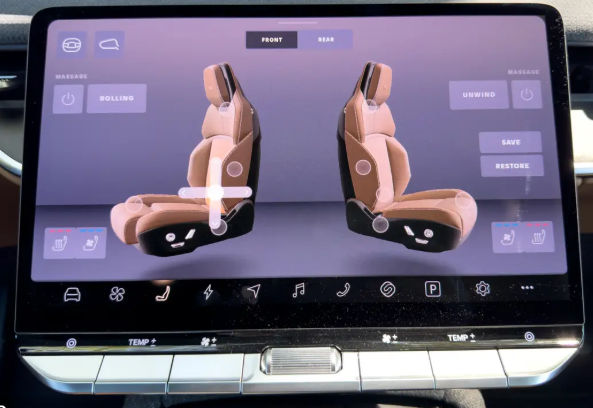
    On the Lucid, I only have top level categories available: home, fan/climate, seats, charging, nav, media, etc. You can see these below. I can remove some, or add them back, but I can’t change say, media to radio. I always to to the main media screen and then select radio or Bluetooth or Spotify, etc.

    2026-09_0098

    Everything is a function, so why not offer linking those functions to quick buttons?

    Summary

    There are a few other things I don’t like, but I can guess why the software works that way. I am looking to work with the software, and in some cases, stop doing silly things I would have done before and try to let the car do things for me.

    I’ve gone back and forth with Android Auto, and while it sometimes gets in my way, if I live with it and accept it, I’m a safer driver. I do less stuff on screens when I should be driving (or mostly paying attention at red lights).

    This is still a fantastic car and I look forward to driving it whenever I can.

  • A Worse Computer; A Better Car

    A few weeks ago, my wife and I purchased a Lucid Gravity for our second EV. We’ve owned a Tesla for almost five years, and it has been an amazing car. However, we decided that we spend a lot of time driving, and we wanted something a little more luxurious. The Tesla has a bit of a stiff ride, and it’s not quite as lush a car as some others EVs that have come out since we bought our Model Y. After trying a few different brands, we were excited by the Lucid and decided to get one.

    Like the Tesla Model Y, this is really a computer on wheels. A lot of software and screens drive the vehicle, though it’s not quite as minimalist as a Tesla vehicle. There are physical buttons and controls in various places, and more than one screen. Some things work better, and I like that.

    However, some things are worse. While researching online to learn about the car, we saw someone post this: The Lucid is a better car, but a worse computer. The Tesla is a better computer but worse car.

    I agree with that. One thing I’ve learned in owning two and other modern computerized vehicles is that software is hard. Even something as basic as Bluetooth can be a hassle and operate inconsistently in different vehicles. I’ve also learned that product managers and engineers don’t always think deeply about the end-user experience. Perhaps the Lucid developers are under pressure to get features out, but it seems that I’ve encountered more than a few things that could (should?) have been built differently. Or would have if a little more thought were given to the end-user experience, especially given how easily software can be configured with toggles and switches. I’m always amazed when more things aren’t switchable in software.

    Yes, I know software takes time, and it is hard. My tenure at Redgate has given me appreciation for the challenges of deciding what to build, test, and release. I’ll write about some of the Lucid decisions on my blog, as there are a few things from the software development perspective that make me scratch my head. It’s not just me, as I’ve known people who have had Fords, Cadillacs, and Volvos who complained to no end about their teething pains with the software.  A few were ready to abandon the cars. I don’t feel that way, and I know I’m an early adopter. I have some tolerance and patience for the things I think aren’t built well.

    Overall, the car is amazing, very comfortable, and brings a smile to my face, but there are a few software conveniences I got used to in the Tesla that are missing in the Lucid. It’s definitely a worse computer.

    But a much, much nicer car. And, as the delivery guy noted, this is the worst version of the car I bought. It will only get better over time.

    If you think about a Lucid, use my referral link. We’ll both get some credit.

    Steve Jones

    at Libsyn, Spotify, or iTunes.

    Note, podcasts are only available for a limited time online.

  • Car Update: August 2026

    It’s been some time since I provided a car update, so I decided to showcase a few things I’ve learned about my cars since the last one. In this post:

    • A Second EV: Lucid Gravity
    • Efficiency and Tires on the Tesla Model Y
    • Serendipity with a Suburban

    This is part of a series of thoughts on cars, just for fun. These are my thoughts and opinions based on my experiences.

    Our Second EV: Lucid Gravity

    We bought  a Lucid Gravity after driving it one day. We’d driven a few other EVs and then stopped by the Lucid dealer because we had an hour and it was close. We weren’t expecting to be impressed by the car, but we were. In fact, we immediately stopped thinking of the other cars.

    After a few hours of debating it, we bought one in the airport while waiting for a flight. It’s amazing to see how much easier it is to buy from Tesla and Lucid than other deals.

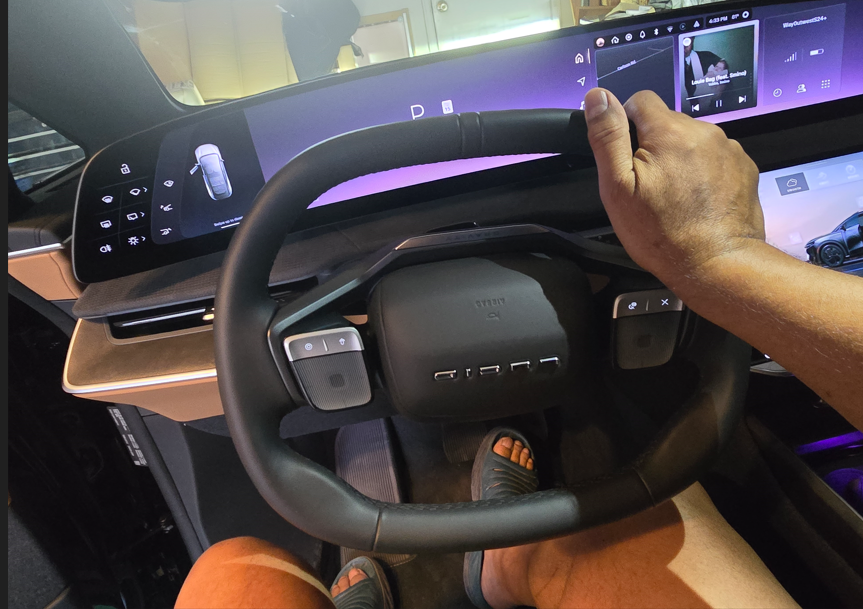
    It’s the nicest car I’ve ever owned, and it’s an EV with great acceleration and handling. It’s also got a squashed steering wheel, which I am surprised I like. It’s easy to control and has a nice space to rest my wrists.

    Lucid squashed steering wheel

    There are some weird things with software, and I have already learned how to “reset” the car. It took me a few minutes to get it right, which is weird. I have to press the brake and then press two buttons on the steering wheel. This didn’t fix the issue I was having with switching profiles, but it was an interesting experience to reboot the car.

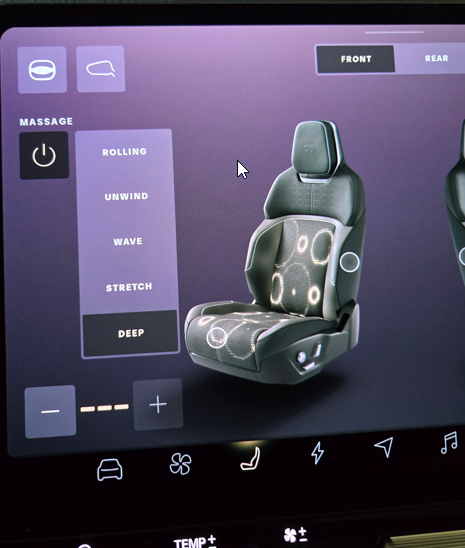
    One of the things I love is the cooled and massaging seats. I might get tired of this over time, but I have a bunch of different settings and there are a few I’ve enjoyed on our drives.

    If you think about a Lucid, use my referral link. We’ll both get some credit.

    Efficiency and Tires on the Tesla Model Y

    In about 4 years of driving the Tesla Model Y, covering almost 60k miles, I had a long term efficiency of around 250Wh/mi. That’s just a bit below the rating for the car. I think I did very well, driving mostly at 45mph and lower in chill mode.

    A friend sold me the spare 18” wheels from his Model 3 when he got rid of his car. I put them on mine, mostly because he had better tread than my summer tires. I didn’t think much of this until I checked the efficiency one day.

    I was in the 205Wh/mi range with the smaller tires. Now, the software doesn’t have a setting for 18” tires on the MYLR, so I left it at the 19” stock tires, so possibly there is a calculation error, but I got > 10% efficiency improvement from changing wheels and tires. Smaller, lighter tires, but still. That’s crazy.

    As we looked for new cars, I was aiming for the smallest tires I could get, both for replacement cost and efficiency.

    Serendipity with a Suburban

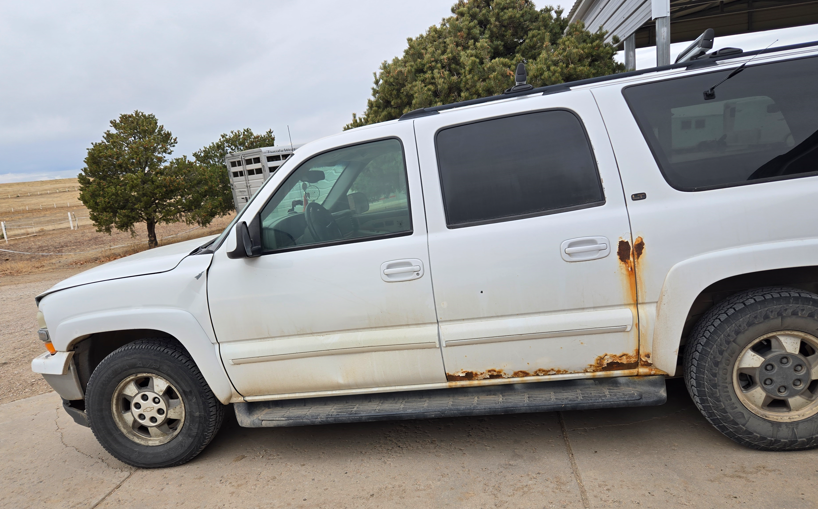
    In 2006, I bought a 2001 Chevy Suburban for $6500. The car had 101,000 miles on it and we were slightly nervous, but with a family of 5, we wanted a car that would carry all of us skiing and on trips. The AC died the next year, but that car has served the family driving all over CO, WY, and NM for many years. Each of my kids had driven it, one even banged into a concrete barrier in the snow.

    I felt this was the best car investment we’d made over the years. I sold it in 2026 with 250,000 miles on it. We’ve basically done regular maintenance (oil, brakes, tires) and replaced minor parts across the roughly 150,000 miles we’ve owned it. The car was old, had rust on it, and in the hot CO summers, it was a car my wife used carrying the dogs from client to client.

    2001 Suburban in 2026

    She wanted something better.

    I had been periodically looking for a good deal when I stumbled on a 2010 Suburban with 203,000 miles on it, It was a 3 owner car, no accidents, lots of records of service.

    It was listed $6500 (I paid $6200).

    I made my wife cut short work one Sat and we drove down to a dealer, getting there just before they closed. A bit of a test drive and we bought it that night. So far, about 8k miles in, it’s performed as well as the old one.

    And it has AC.

    Still feels like a good deal and a good choice. 20 years later, same price.