Category: Blog

  • SQL Data Generator–Getting a value based on another column

    This is a series on SQL Data Generator, covering some interesting scenarios I’ve run into. If you’ve never tried it, SQL Data Generator is a part of the SQL Toolbelt. Give it a try today with an evaluation today.

    One of the things that people often want to do is generate data, but limit the generation to some data in another column. Here’s a good example. Let’s suppose I have some data that represents a balance in an account. That’s in a column we’ll call Balance. In another column, I have a status that is either OK or Overdrawn, depending on whether the Balance column is positive or negative.

    If I perform a random generation on these columns, I’ll get some strange data. Sometimes the data below matches up, sometimes it doesn’t. I have positive numbers as Overdrawn and negatives as OK

    2017-10-05 10_51_08-SQL Data Generator - New project _

    Let’s fix that.

    In Data Generator, I have a variety of choices for the generators. Let’s look at what I can do for the Status column.

    2017-10-05 10_52_27-SQL Data Generator - New project _

    Certainly there are RegEx and Python scripts, but there’s a nice “Cross Column” section with some examples. In this case, let’s look at the Age in Years generator. The definition is:

    2017-10-05 10_53_11-SQL Data Generator - New project _

    In this case, it’s a simple .NET date function and some math. I can do that. Most importantly, I can see the “Insert Column Name”, which lets me pick another column in my table.

    Python

    The language of choice in SQL Data Generator is Python, specifically Iron Python. Outside of C# Datatime values, Python is needed. If you examine any of the other cross column items, you’ll see we need a main() function that returns something.

    In this case, it’s a simple expression. I’ll use an If statement to check if the Balance is >= 0. Here’s a Python construct.

    def main(config):
         if Balance >= 0:
             return “OK”
         else:
             return “Overdrawn”

    Whitespace matters, as does indentation. If I put this in like so:

    2017-10-05 10_57_57-SQL Data Generator - New project _

    I’ll get this. Notice that the status is correct.

    2017-10-05 10_58_05-SQL Data Generator - New project _

    In a real project, you may have more complicated logic, or more likely, status values. One way to handle those is to use a Python function and return the appropriate values for your system.

    You can build some complex and interesting data generation projects with SQL Data Generator. Give it a try today.

  • Unit Testing T-SQL Code

    Abstract

    Unit testing has become an integrated, expected part of most software development teams. Many database developers have yet to implement unit testing as a regular habit. This session will look at two-unit testing frameworks and show how to implement tests for common types of non-trivial T-SQL queries. You’ll examine the tSQLt framework as well as the Microsoft Unit Testing framework for SQL Server.

    You will learn:

    • How to structure and build unit tests for database code with tSQLt
    • How to structure and build unit tests for database code with database projects
    • Understand the challenges of test data and how to solve them

    Level: 200

    Demos

    These are the testing demos for this talk:

    • Loading and reloading test data
    • Checking standards
    • Checking joins, specifically outer join refactoring
    • Checking function calculations
    • Checking boundary conditions
    • Using the 0-1-Some pattern
    • Checking NULLs

    PPTX and code on github:

    Data Platform Summit – https://github.com/way0utwest/UnitTestingTSQL/tree/master

    VS Live 2017 – Anaheim – https://github.com/way0utwest/UnitTestingTSQL/tree/vs2017Anaheim

  • A Tour of SQL Server Security Features

    Abstract

    Protecting data from unauthorized access becomes more important all the time. SQL Server includes a number of features that make data protection and security easier for developers and DBAs with a framework for protecting data. Come learn how Always Encrypted, TDE, Row Level Security, Dynamic Data Masking, and column level encryption can protect your systems.

    You will learn:

    • About the different encryption and security features in SQL Server
    • Understand the code changes required for encryption mechanisms
    • Gain a basic understanding of RLS and DDM, which do not require code changes to help protect data

    Level: 100

    Demos

    This talk includes the following demos

    • Always Encrypted setup and data access
    • Row Level Security setup and use
    • Dynamic Data Masking for users
    • Column Level Encryption implementation
    • TDE setup and verification
  • Rebooting Ubuntu Linux from the Command Line–#SQLNewBlogger

    Another post for me that is simple and hopefully serves as an example for people trying to get blogging as #SQLNewBloggers.

    Since SQL Server 2017 is now out, and Linux is an option, I thought I’d write a bit more about little Linux things that admins might want to know.

    After installing an update, I neede to reboot my Ubuntu install. Apparently there was a dialog, but it was hidden. Unlike on Windows, I didn’t see an easy way to click a button and restart. However, since I had a terminal shell open, I was sure there was an easy way to do this.

    I could have run a quick search, but I fell back to the old standby:

    man shutdown

    This showed that there is a shutdown, as on Windows, with the same –r parameter. This needs sudo to run, and by default it reboots after a minute. The command I ran was:

    shutdown -r

    Learned something, which I should have known. I almost typed shutdown, but I decided to double check.

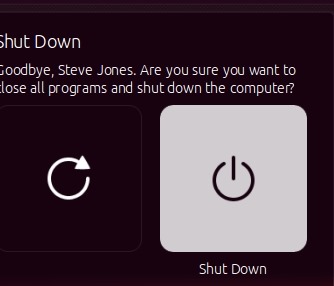
    Note: I realized later that there is a small menu in the upper right. I had the VM in a window and didn’t notice the icon. Clicking the gear gives a menu.

    2017-10-02 10_38_28-Ubuntu 64-bit SQL Server .210 - VMware Workstation

    This lets you then choose shutdown or restart.

    2017-10-02 10_38_36-Ubuntu 64-bit SQL Server .210 - VMware Workstation