Category: Blog

  • Python Command Line Calls

    There was a time I worked in a company any we lived in the command line. This was in the early 90s, prior to Windows v3.1 being released and we primarily used DOS on a Novell network.

    We also had paper phone books on every desk for the 1,000+ people on the property. However, as you might guess, the phone books went out of date, and were only updated a couple times a year. We might get a new sheet, but mostly people learned to cross out a name and write a new extension in for the people they dealt with regularly.

    However updates to the master list happened regularly, every few days. These were done in a small Lotus 1-2-3 file that an administrative assistant maintained. As a network person, I knew where this lived, and arranged a text export of this every night with a scheduled task.

    Why text? Well, I’d come from a university where we had our phone details in a text file and would grep the file to find information. In DOS, I knew we could do the same thing with FIND. However, rather than write the find command with parameters, I put a batch file on our global share that called FIND with the parameters needed and the path to the phone book. I called this 411.bat. When I needed a phone number, I could type

    411 “Andy Warren”

    I’d get Andy’s name, location, and phone number back. It was a trivial piece of programming for me, but the rest of the network team, all non-programmers, were thrilled. I even added a /? check to return help information to the user.

    With my playing with Python last week, I decided to do this for myself as well. I took my Python program to send tweets and changed it to send a tweet when the program was called, and to send the parameter as the tweet. The code looked like this::

    import sys
    import tweepy
    def send_a_tweet(tweettext):
    consumer_key = "X1GWqgKpPP4OuqWJZ7hw6"
    consumer_secret = "QW3EkMHlyzF69AHn8DjyWyRG5CAQ0wjK9RqUZ2"
    access_token = '146009-MqpeZFslj0VGgTSik1fq5klvJpqc1x6HAsiu'
    access_token_secret = '8wIZlPbIqXtczc2LOsJgjMP3dCRRw5ajMvkjEspF'
    
    auth = tweepy.OAuthHandler(consumer_key, consumer_secret)
    auth.set_access_token(access_token, access_token_secret)
    
    api = tweepy.API(auth)
    
    api.update_status(status=tweettext)
    
    if __name__ == '__main__':
    send_a_tweet(sys.argv[1])
    

    I placed this in a “\tools” folder that I have in my path. I also added a “tweet.cmd” file in this folder with this code:

    python c:\tools\send_tweet.py %1

    Since Python.exe is in my path as well, I can do this:

    2015-11-06 15_25_19-Command Prompt

    And I’ll see this on my timeline. I guess you’ll all be able to see this as well.

    2015-11-06 15_25_26-Steve Jones (@way0utwest) _ Twitter


    Why bother? Well, it was partially playing around. As I have been learning Python, I have mostly been playing in an IDE, solving small problems, but not really doing things useful. I also like the idea of command line tools, since I find them quick. Tweetdeck is big and bloated, and if I wanted to send a tweet from my desk, this is a quick way to do it. I could do a “readtweets” as well, and may.

    However I also learned how to call Python programs with a command line, which is a good step to starting to build more useful programs that I can customize. This is also the start of me being able to schedule a program, and perhaps build more automation into my life with Python.

    Mostly, however, it was just fun.

  • Test if a File Exists with Powershell

    Another post for me that is simple and hopefully serves as an example for people trying to get blogging as#SQLNewBloggers.

    Awhile back I wrote a PowerShell script (PoSh) to download the SQL Saturday XML files used for the Guidebook application. These contain a bunch of the information that I wanted to collect, transform, and keep around.

    However the script wasn’t great. It basically looped a set number of times and re-downloaded the files. Not the more efficient solution, especially if I want this to run regularly.

    One of the enhancements I wanted to make was check if the file exists, and if not, then download it. However, if it does exist, then I’ll skip the file. I know this means I don’t get updated files if schedules change, which is possible, but in that case, I can just delete the file from my desktop and go from there.

    I made a quick search, and found a few links to the Test-Path cmdlet. Essentially you give this a file path and it returns true or false. Almost exactly what I need. This is what I added to my code:

    if (Test-Path $DestinationFile) {

    #do something

    }

    However I want to take action if the file doesn’t exist. In most languages, I’d add a ! in front to signify "not". However that doesn’t work in PoSh, just like > doesn’t mean greater than.

    Another search showed me the -NOT operator. That’s what I need, but I can’t do this:

    if (-NOT Test-Path $DestinationFile) {

    #do something

    }

    Instead, I need to have a single expression for -NOT, which means more parenthesis. Not a big deal. I used this code:

    if (-NOT (Test-Path $DestinationFile)) {

    #do something

    }

    That worked great and now I only download the files I need. If I want to re-download (for newer events), I just delete those files and re-run the script.

    SQLNewBlogger

    This post came about when I started working on the script. It actually took longer to write this than find the solution, add it to code, and test it. That process was about 5 minutes.

    This post took about 10 minutes to write. I also had a second post based on similar modifications to the script, so I’m did that in another 5 minutes.

    References

    A few of the links I used:

  • Branding Yourself for a Dream Job–Powerpoint and Questions

    I had a few people ask about the deck, and I’ve uploaded it here: Branding Yourself for a Dream Job.

    I also had a couple good questions at the end after people had left, so I thought I’d put them here.

    What about a picture on my LinkedIn/resume?

    I have had a few people ask this in the past, and I forgot to cover this in the talk. My only advice is that if you want to put one up, use a professional picture. Have someone take one.

    Other than that, it’s a hit and miss prospect. We all have prejudices, and hiring managers/HR people are no different. If you’re a women, or old, or a minority, you might have some people exclude you based on your picture.

    Personally I don’t see much benefit to adding a picture. Keep that information back until you need to disclose it.

    Does it matter how many blogs I have?

    No. However you will likely want to maintain them, so don’t tackle too much. I would suggest no more than 2, one for your career and one for something else.

  • Python and Tweepy

    One of the projects that’s been on my list lately is to programmatically access Twitter for a few ideas I want to play with. Since I’ve been trying to learn some Python, I thought I would take a look using Python to update status and read status.

    A quick Google search showed me lots of Python clients, but Tweepy caught my eye for some reason. I’m not sure why, but I ended up popping a command line open and downloading the library.

    From there, I saw a short tutorial over at Python Central. I started by creating an app at Twitter for myself, which was very simple. Once that was done, I had a set of consumer tokens (key and secret), that I could use. Another click got me to the access key and secret. Note, the easy way to do this is over at dev.twitter.com.

    My first attempt was using this sample code.

    import tweepy

    consumer_key = “ABCDE”
    consumer_secret = “12345”
    access_token = ‘asdfasdf’
    access_token_secret = ‘98765’

    auth = tweepy.OAuthHandler(consumer_key, consumer_secret)
    auth.set_access_token(access_token, access_token_secret)

    api = tweepy.API(auth)

    public_tweets = api.user_timeline()
    for tweet in public_tweets:
    print(tweet.text)

    This gives me a list of my tweets. At least, the last 20.

    2015-11-06 13_30_24-SDTIG - [C__Users_Steve_OneDrive_Documents_Python_SDTIG] - ..._Last_10_twitter_l

    That’s progress.

    I then went to make an update by using this:

    api.update_status('Hello, Pyton')

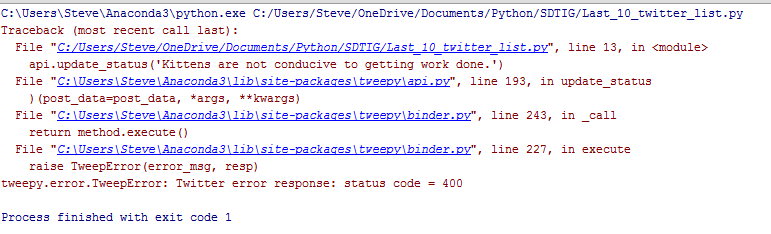
    However that returned an error:

    2015-11-06 13_50_53-Cortana

    Hmmm, I double checked the API, and this should work, but I’m guessing there’s another issue. I searched, and found there’s a bug. However, I should be using named parameters, so no big deal. Change the code.

    api.update_status(status='Hello, Pyton')

    Now it works.

    2015-11-06 13_53_06-Steve Jones (@way0utwest) _ Twitter

    This is the first step for me to look at building an app that might send some tweets on my behalf, perhaps with the data stored somewhere, like, I don’t know, maybe a database?