Category: Blog

  • SQL in the City This Fall

    We’ve got a couple of large SQL in the City events coming this fall.  I’m speaking at both, which I think means my boss is happy with my work for Red Gate Software. At least, that’s what I’ll tell myself.
     
    In a little over a week I’ll be in both London and Seattle, delivering a variety of sessions on DBA and development topics. I start the day off with a session for the DBAs with Avoiding a DBA’s worst days with monitoring. This is based on The DBA Team’s 5 Worst Days in a DBA’s Life where we look at some of the situations you can avoid by keeping an eye on your environment. I then cover Version control and CI Fundamentals for databases, looking at how you can get your database code in a VCS and build a Continuous Integration (CI) process. I’ll also cover testing, using the free tSQLt framework to write some tests against your databases.
     
    It’s a quick set of sessions for me, but I’ll be around all day to talk to you about your database delivery, deployment, development, or administration issues. Or just shake your hand if you’d like.
     
    I fly to London for our event on Fri, Oct 24 and then will be in Seattle on Nov 3 for the second stop on the tour. A lot of travel for me, but I’m sure it’s an easier commute for most of you.  I hope you’ll join us and come learn a bit more about SQL Server than you might know today.
  • Making Better Presentations–Organize Things

    This is part of a series of tips for speakers on how to make your presentations better.

    Organization matters, and it makes a difference to how your presentation goes. The more organized you are, the better the experience for attendees. If you are very unorganized, then it becomes hard for the audience to follow what you are doing.

    I’m am giving a few tips and tricks here, not for the actual outline and focus of your talk, but a few items that can help you smoothly move through your presentation.

    Startup

    Most of us don’t present a talk exclusively from Powerpoint. If you do, that’s great, but often I find people need to move from Powerpoint to Management Studio, or switch to a VM, show code in Visual Studio, run a browser (for Azure), etc. I personally need to sometimes run Red Gate tools as part of my talks, so I’ve learned to get organized.

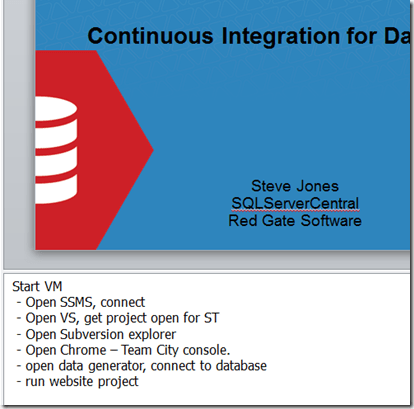
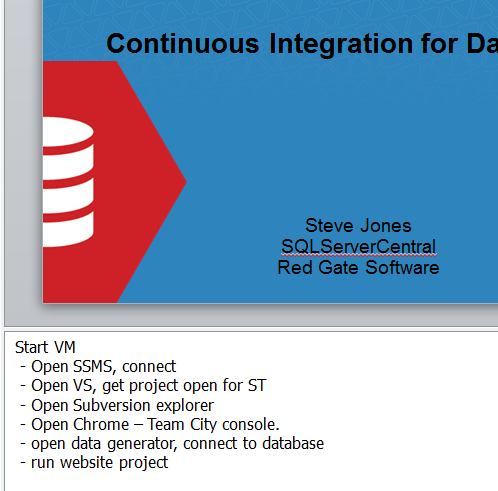
    I actually got this trick from Brad McGehee and I think it’s great. As I’ve written and organized my talks, I’ve learned to make notes in Powerpoint. Every time I need to run some tool or application, I put a note in the first slide of my deck. These are a few things I need to run, and when I get ready for a talk, I have a list of items to start right away.

    Here is the first slide from my Continuous Integration for Databases talk.
    betterpresent_a

    Even if you only have one talk, it’s easy to forget things. I’ve seen lots of presenters forget to run Zoomit, start Visual Studio, or even SSMS. As someone that watches dozens of talks a year live, I can tell you it’s less than impressive or exciting when I get to watch Visual Studio start up on a projector.

    Code

    I’ve tried different methods for organizing my presentations. I’ve put all the code in separate folders. I’ve numbered the files; I’ve named them. I’ve put everything in one long script file with comments.

    All of those have worked, and all of them have failed. The important thing is that you have some organization. When you’re speaking in front of people, you’re concentrating on your topic and flow. Anything that distracts you is PAINFULLY obvious for attendees.

    It will happen, no matter what, but minimize it. Get some sort of organization and ensure that what you’re showing on the screen smoothly transitions from one section to the next.

    Comments

    In line with having code organized in files, I would highly recommend that you include comments and notes in your code for both you and the audience. We are trying to teach and explain our code and concepts. There’s no mystery or magic that we need to keep people from knowing, so the more we can disclose, the better.

    Your attendees will appreciate some instructions in the code when they try to duplicate your efforts on their own machines. However these same instructions can be very helpful for you during a talk. The instructions will guide you alone, allowing you to continue to speak and explain things, without trying to multi-task and remember the flow of your presentation.

    Think Ahead

    All of the organizational items really come down to you thinking ahead. Just as you might do as a DBA or administrator, considering what might go wrong, or what might interrupt your “uptime” as a presenter will help you prepare for a smooth delivery in front of an audience.
  • PASS Rocks SQL Saturday

    I had another piece that looked at some issues with PASS slated for today, but it’s been a tough morning. Both with work, and with the conflict with PASS, so I’m going to move this up and give PASS more praise. As conflicted as I am about the organization, it does amazing things for the community.

    SQL Saturday #318 – Orlando

    I remember when Andy first pitched me on this idea. I was dubious, but we talked about it over months and finally got the first event running in Orlando on Nov 10, 2007.

    This weekend, starting already with pre-cons, is the EIGHTH SQL Saturday in Orlando, SQL Saturday #318.

    8!!

    There have been have only been 14 Summits. I went to SQL Saturday #300 a couple weeks ago. That’s amazing. Free training, probably 20+ sessions at each event, held in countries all over the world, from Brazil to Nepal.

    If that doesn’t make you smile, you don’t get community.

    Now, I know some of you will say “Andy and Steve started SQL Saturday.” True, but it was hard, it was a time sink (mostly for Andy) and while we grew a number of events, we would never have gotten this far.

    It’s mostly due to the efforts of Karla Landrum and I can’t praise her enough for the enthusiasm, excitement, and support she brings to the process.

    But it’s also PASS.

    The organization supports Karla with behind the scenes help from people at headquarters. Without their decision to absorb SQL Saturday and promote it, market it, support local organizers, this would not have grown as it has.

    If you search the hashtag, you’ll find some amazing notes. Tweets, excitement, blog posts, and more. If you have been to an event, then you get it. You know how amazing this is and you should thank the people that work and volunteer for PASS.

    If you haven’t been, you’re missing out.

    Go. Give it a try. Carpool to one near you. Help organize one with your user group. You’ll be amazed.

    PASS has done something special with SQL Saturday and they deserve a lot of praise and credit.

  • People Helping People – Volunteers

    Continuing on with things that PASS does well, since I want to be balanced, I wanted to talk about volunteers.

    I don’t know if you’ve noticed, but PASS gets a lot of volunteers. There are volunteers that run SQL Saturdays. Volunteers that run user groups. Volunteers that help out for both of those, and volunteers that handle all sorts of tasks for the organization from picking speakers to choosing board candidates and more.

    In the past there have been people disillusioned with the usage and valuation of volunteers, but I have to say that I think PASS overall does a great job here. How else can you explain so many people willing to help out each year. They can’t all be treated poorly. Heck, most of them can’t be.

    Every year at the Summit, volunteers are recognized with in meetings and with a party. There’s even an award for the volunteer: the PASSion award.

    I greatly appreciate all the efforts of the volunteers, but I have to give credit to the organization itself for recruiting, managing, and using volunteers. There may be room for improvement, but without a doubt, something is being done right here.