Category: Blog

  • Feedback from SQL Saturday #64 in Baton Rouge

    I did my session on The Top Ten SQL Server Skills You Need for the first time in Baton Rouge at SQL Saturday #64. This was my first time doing this session, which I hate doing at a large event. I had hoped to get to a user group and get this scheduled, but I didn’t have time or the freedom to get it scheduled in a busy summer.

    So I went through a dozen practice sessions and hoped for the best. Once again I was packing in a lot of information into an hour, really 55 minutes, and moving quickly.

    The session was busy, with the auditorium holding about 100 people. I went through the list, and made it through on time. With a clock on the wall, I could watch and keep myself to about 5 minutes per section. I’m blogging about the ten things over time, so most of the info will get out here, and the deck is available from the event site.

    I ended up with 71 evaluations, which was amazing. Usually I get much less, but with this event at a college, and with a beginner session, perhaps that isn’t surprising. The ratings across all categories averaged above 4, and an overall rating of 4.7. I guess I did OK, and am looking forward to presenting this at the PASS Summit in October.

    Once again, not many comments, but a few constructive ones:

    • Maybe more time per slide to make better notes – I can understand this, though I did not at the beginning that I was moving fast and the deck would be available. Perhaps I need to mention this a few times during the session for latecomers or to reinforce this.
    • I was expecting something more in-depth – This is a hard one. It’s always a battle to try and get enough content in there and cover it in depth. One of the things that one hour sessions don’t do well is go very in depth into a topic unless it is very narrowly focused. I’ll have to think about what I could change here, but I’m not sure I can do a lot. I was mostly trying to trigger the idea that each of these skills is something you need to work on and use in your job.
    • Speaker volume dips from time to time – Usually I’m a loud talker, but it was a large room and I was trying to turn from side to side. Have to keep this in the front of my mind as something to watch out for.

    The rest of the comments were very positive, which is nice and helps make it worthwhile.

    I’ve enjoyed my three years in Baton Rouge and looking forward to going back next year if I can.

  • Basic Computed Columns

    I ran into an issue recently with a computed column, which I’ve rarely used, so I investigated them and wrote this short piece in computed columns, mostly as a reminder for me.

    What’s a computed column?

    You can read the BOL definition, but basically it is a column whose value is based on the values of other columns in a table. By having SQL Server perform the calculation, you prevent errors in the logic, or more likely, get around the chance that some application might forget to perform an update.

    Let’s say I have this simple orderdetail table.

    CREATE TABLE OrderDetail
    ( OrderID INT
    , ProductID INT
    , Qty INT
    , Price NUMERIC(10, 2)
    , LineTotal NUMERIC(10, 2)
    )
    

    If I want to add a simple order to this table, I can do this:

    INSERT dbo.OrderDetail
            ( OrderID ,
              ProductID ,
              Qty ,
              Price ,
              LineTotal
            )
    VALUES  ( 1 , -- OrderID - int
              23 , -- ProductID - int
              10 , -- Qty - int
              8.50 , -- Price - numeric
              85.00  -- LineTotal - numeric
            )
            

    Note that in this case I have to perform the arithmetic of having the line total equal to the price multiplied by the quantity. The math is:

    Linetotal = Qty * Price

    85.00 = 10 * 8.50

    However if I were to make a mistake in the arithmetic and insert $84 instead, or even $8.50, the SQL Server would not catch this.

    Instead, I could use a trigger to calculate this value, but triggers seem to have other overhead and force me to maintain them. Instead I could use a computed column, I can save space by not persisting these columns, or I can persist them and index them if needed.

    In my simple example, I could change my table to be this:

    DROP TABLE dbo.OrderDetail
    go
    
    CREATE TABLE OrderDetail
    ( OrderID INT
    , ProductID INT
    , Qty INT
    , Price NUMERIC(10, 2)
    , LineTotal AS (Qty * Price)
    )
    GO
    INSERT dbo.OrderDetail
            ( OrderID ,
              ProductID ,
              Qty ,
              Price
            )
    VALUES  ( 1 , -- OrderID - int
              23 , -- ProductID - int
              10 , -- Qty - int
              8.50 -- Price - numeric
            )
    go

    The LineTotal value is not stored in the table, which isn’t a big issue in this case. In fact, it means that I am saving a few bytes per row, which could translate into quite a few rows for this table (meaning less pages, less I/O, more chance of this remaining in the buffer pool, etc). The tradeoff is the computation is performed for this result set for every query. Which is better? It depends Winking smile

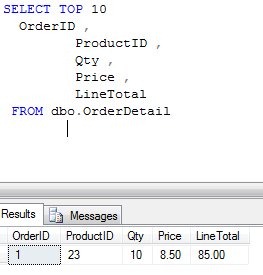
    Notice that I don’t have a value for my computed column in the insert statement, but the results from this version are the same as the previous one:

    computecol

    In fact, if I try the first insert above, which has the LineTotal in it, I get this error:

    Msg 271, Level 16, State 1, Line 1

    The column "LineTotal" cannot be modified because it is either a computed column or is the result of a UNION operator.

    That’s a simple look at computed columns. Are they useful? I’ve never really worried about them, allowing either a stored procedure or the application to handle any logic like this. In general I dislike storing computations, even defined ones like this, but that’s me.

    Use them if they fit your environment.

  • When Do You Take a Full Backup?

    This series of blog posts are related to my presentation, The Top Ten Skills You Need, which is scheduled for a few deliveries in 2011.

    When is a Full Backup Taken?

    Most people might answer this with “every day”, or “as often as needed”, but those are a little nebulous, and not necessarily correct.

    I do recommend that you backup as often as you can, which is every day for most people. Those with large databases might go once a week, or even once a month, but you want to get a full backup periodically. If you have a really large database, say 50TB or greater (in 2011), you might opt for a yearly SAN snapshot of some kind, but you need some full backup as a base.

    So when do you backup your database? Here’s a list of some times you might think about:

    • As often as you can on a regular schedule (daily, weekly, monthly, etc)
    • Before applying a Service Pack or CU*
    • Before applying a Windows patch*
    • Before upgrading your application*
    • Before a large data load*
    • After restoring your instance in a DR situation

    That last one might throw people, but I’ve seen more than a couple situations where someone recovered a database in a DR situation and never setup backups. And there was another failure.

    Whenever you create a database, either from scratch or after a restore, make a backup.

    * Note that if you have Enterprise Edition or above, you can use Database Snapshots to substitute for a full backup in some of these situations.

  • Two Types of Tail Log Backups

    In a recent thread I noted that a tail log backup is essentially a regular log backup, but made with the intention of restoring the database because something is wrong with your data file. Gail Shaw (blog | @SQLIntheWild) pointed out that that’s not quite true. There are two parameters that you need to add to the BACKUP LOG command. Thanks to Gail for the correction, and here’s a little more data.

    There are three options you have with a tail log backup are:

    • WITH NORECOVERY
    • WITH CONTINUE_AFTER_ERROR
    • WITH NO_TRUNCATE

    I covered the third one in doing some practice backing up of the tail log. The second one is noted in Books Online as one that you should use in the event that the database is offline and inaccessible. That will allow you to recover the last log backup (hopefully).

    The first one is recommended as the one you use when the database is going to be restored and you want the end of the log.

    As I mentioned in my previous post, this is a core DBA skill. It is what will allow you to recover a database with zero data loss.