Tag: career

  • The Cost of SQL Bits v the PASS Summit

    UPDATE: This post originally priced Charlotte, NC, but the Summit is in Houston, TX. I have corrected costs and locations. The difference is about $300 less for a flight and about $20-30 more for hotels.

    Recently I was chatting with someone about SQL Bits. It’s my favorite conference of the year, and unfortunately, I can’t attend again this year because of a schedule conflict.

    Still, I think you should go if you can. I’ve had people over the years think it’s too expensive and too costly to go to England for a conference and my friend was speculating if that was the case. I decided to take a look.

    Cost of Attending

    The costs of attending the conference are (generally)

    • Admission
    • Travel
    • Lodging
    • (some) Food
    • Pre-Conference Days (optional)

    I’ve been fortunate to often not pay admission as I speak at events, but I do attend sometimes. Lodging is expensive, and certainly not all meals are covered by the event. If I’m traveling, I do like to do a pre-con, since it’s a good chance to get focused learning in an area.

    With that in mind, let me price out what it costs for each event. I’m looking forward, so I’ll take a look at SQL Bits 2020 v going to the PASS Summit later this year.

    SQL Bits 2020

    SQL Bits takes place from Mar 31-Apr 4. I’m coaching on the 30th and the 4th, so I can’t actually get there and back. Well, I could get there Tuesday, but I’d have to leave on Friday. The event has pre-conference days on Tuesday and Wednesday (called Training Days), and the conference on Thursday/Friday/Saturday. Saturday is a free day, like a SQL Saturday, and I’ll assume two training days here. After all, if I’m flying to England, I want to make the most of the time.

    Pricing is available, and right now I’d be paying £1199 = US$1600. I’m rounding a bit, but this is roughly my cost in the US. This also includes two training days, which are each around US$490. If I dally and don’t register until after 15 Feb, this is about US$2000.

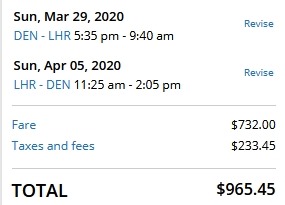
    Flights for me (on United) would be US$966 from Denver. This is the direct, and traveling 29 Mar to 5 Apr. This is a good time of year to fly to the UK, and I’ve done it often. I’m giving myself a day to adjust. In reality, I’d likely make this a longer trip and take my wife. Let’s also factor in another $50 for the train to and from the airport.

    2020-01-10 10_25_19-Review trip itinerary _ United Airlines

    Lodging is always pricey in London. I usually stay ion Hilton hotels, and the DoubleTree near the venue is £122, or £620 for the week. That’s about US$810-ish. Call it $900. I usually travel back to Heathrow that night, so another US$150 for a night there.

    If I were to look for something else in a hotel, I see similar rates. As low as US$90 for a Holiday Inn to $160 for Aloft (where I’ve stayed). AirBnB in this areacan be as low as a room for $30-50 to a flat for about $100.

    Food can be pricey in London. The lunches are covered by the conference, and two dinners at the Thur and Fri night events. Breakfast is provided all the days and there are lots of snacks. I’ve eaten really well at SQL Bits.

    That means I’d be looking at these meals

    • Breakfast – Sun
    • Lunch – Mon
    • Dinner – Mon, Tue, Wed, Sat

    Let’s say $12 for breakfast (it’s a big city) and $50 for dinner. Lunch, call it $20. That’s a total of $242. I do like a few drinks, though you might be able to get sponsors to cover some of your costs here. I’ve roughly included a drink with dinner. I’m guessing that I’d spend another $150 in drinks.

    Total for attending, in round numbers: US$4,062

    • Flight $1020
    • Lodging: $1050
    • Conference: $1600
    • Food: $392

    You could do better by shopping around a bit, but these would roughly be the costs I’d need to go to my boss to cover. Or split the cost with them.

    If I spoke, this would be closer to $2000. Maybe more of you ought to try and speak Winking smile

    The PASS Summit in 2020

    Let’s look forward to the Summit. Their pricing is more staggered, and if you can register really early (like now), it’s cheaper. US$2599 now, but I’ll assume I won’t be able to get this until summer. At that time, the cost of attendance is US$3299. This includes two pre-con sessions as well.

    This year the event is in Houston, TX. For me, this is a nonstop flight from Denver, but not that cheap. I can get a $350 flight if I want to travel early, but I don’t. There are flights around $400 as well. The convenient flights for my schedule are around US$475. The exact pricing for me is $476.80, call it $480 after I tip the car guy. You’ll need a couple Uber/Lyft items, so say $50 here.

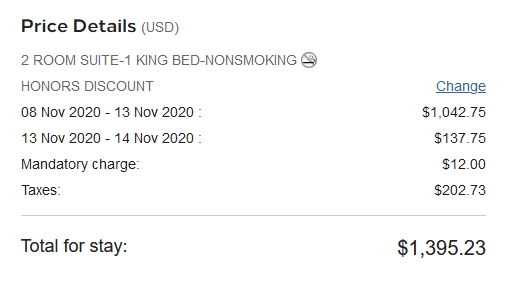
    Lodging is better in Houston than Seattle, where the event usually is held. It’s still pricey. A hotel for me is around US$200 a night or more. I want to be close, so I’ll split the difference with a Garden Inn. This givers me a cost of $1,395.23. Call it $1400 ish with a few tips, as I’ll go over this.

    Other hotels are similar, as low as $125 and well into the $300 range. AirBnbs are like London. I see lots of $50-60 a night for rooms or small 1 bedroom places. Closer to downtown we’re more into the $120 range and up.

    Food will be similar. Charlotte has cheap and expensive places. The conference does cover breakfast and lunch. Dinner is two nights, the opening and the next night in the exhibition hall. I’d need these:

    • Breakfast: Saturday
    • Lunch: Sun
    • Dinner: Sun, Mon, Thur, Fri

    If I go with similar costs, I’d be with a similar $242 + $150 for drinks.

    Total to attend PASS: $5,6921

    • Conference $3299
    • Flight: $480 + $50
    • Lodging: $1,400
    • Food: $392

    The big difference here is the cost of the conference, which overwhelms the small flight difference.

    Conclusion

    It’s cheaper to attend SQL Bits from the US than the PASS Summit. I think so, and while you can do it cheaper than I’ve outlined, you can still likely make SQL Bits cheaper. What’s more, you get to experience another country and culture, along with many, many more people from even other, different cultures. That means a lot to me.

    I also find that SQL Bits is a more casual conference, with less security and hassles. People have been able to bring their wives and kids to the event, or at least the party. Dressing up on Friday night at SQL Bits is a blast.

    ENJJCcTXsAAvm54 orig

    The PASS Summit is an iconic event. I’ve been very lucky to attend most of them, and it’s a huge gathering place for SQL professionals. I enjoy going, learning, and seeing lots of friends. However, it has grown to be an expensive event.

    No matter what you choose, you’ll see some amazing speakers, meet lots of experts and get the chance for incredible networking. If you’ve been to one, consider the other.

    What I would say is that SQL Bits is my favorite, and if you’re in the US, it’s not that expensive to go, even to London. When they move the event to other locations, the transport cost will rise, but hotels will be cheaper. I’d expect I’d save another $300-400 on the trip in Liverpool or Nottingham.

    You do need a passport, so factor in $100 and 4-6 weeks, but you should have one anyway. Traveling is a great way to enjoy and experience more of life.

  • Great Writers Get Hired

    It’s not a guarantee that great writers get hired, but this interview with Basecamp CEO, Jason Fried, talks about their process selecting new employees. Recently they got 4,000 applications for 5 jobs, which is a lot, though not that unusual. As I talk with many human resources staff, they often talk about receiving hundreds of resumes for each job they post. With those types of odds, it is important that you find a way to stand out from the crowd.

    While I suspect many people reviewing resumes don’t review them all, it is possible that some do. Given the large workload, not much time is going to be spent looking at your resume or CV. This really means that it is important that your resume attracts attention and interests a reader. Your goal is to get someone thinking that you are a good candidate and worth hiring.

    In some sense, this means you need to communicate well and write something interesting. Certainly you also want to apply early for a position. Why? Most resumes are boring, and as someone that has had to review them, I find my attention wavering as I go through them. I’ve wanted to do a good job and review all that are received for a position, but when you get over a hundred, I’m not sure that’s even possible.

    We are human, and our focus degrades over time. If you see essentially the same information over and over, it becomes hard to make good decisions about the differences. This is why a resume that stands out, is written well, and intrigues the reader is important. It’s also why it’s important to use networking and get submitted to places quickly.

    Great writers get hired, or at least get opportunities. If for no other reason than because an HR staffer or hiring manager finds the first contact, the resume, to be interesting. Learn to write better, to communicate and showcase your skills, and you’ll get more chances to interview and more opportunities to win the position.

    Steve Jones

    Listen to the podcast at Libsyn, Stitcher or iTunes.

  • Finding Motivation to Learn

    Monica Rathbun wrote a piece on investing in yourself, which I think is a good way to think about spending time and resources on learning. Every time that you spend some brain power on building or improving your skills, you are investing in your career, and giving yourself another way to drive your career in the direction you want to move.

    There are no shortage of excuses that Monica lists, and I’ve heard most of them. These are certainly hardships for your career, but these are things that many other people face, both in this industry and others. While these could be a short term reason to just grind out work, none is not a good long term excuse. I can accept you not progressing for a few quarters, but I’d hope you learned something new and helpful to put on your resume or CV every year.

    Doctors are constantly reading and learning to keep up in their careers. Lawyers and CPAs often give up weekends on their own to continue learning. Even mechanics, carpenters, electricians, and more are often working through continuing education. Some of it provided or funded by their jobs, some not, but plenty of it takes place outside of work hours. It’s just accepted that growing with your career is the norm.

    Most IT people expect they need to keep learning, but I find so many people are unmotivated to do anything their boss won’t provide, whether that’s time or funds. That’s a mistake, in my opinion, as you are one unexpected event from scrambling to find a new job. Plenty of people in that situation find themselves taking a pay cut, getting a longer commute, or finding more stress in their new position.

    Continued learning won’t necessarily prevent that, but it does increase the chance that you’ll be a more attractive candidate and perhaps have you pick of positions rather than settling for just some job you don’t want. The more you know, the more you can show, the more you document with a project, a blog, or elsewhere, the more likely someone is to want to hire you. Hopefully that means you find opportunities that suit you, rather than are just available.

    Steve Jones


  • The Evolving DBA

    The world is changing. Plenty of people have written about the changes in the job of the DBA (DBAKevlar, Brent Ozar), including myself. While lots of vendors might postulate their database removes the need for a DBA, and some might believe that, I think that’s disingenuous. Microsoft doesn’t hire DBAs, but they hide that job under other titles. We still need DBAs, though the job changes a little in the future.

    Recently I saw a post from new PASS Board director, Melody Zacharias, where she notes that DBAs are more important than ever. She gives us five reasons, and I tend to agree with most of them.  There is a need to somehow keep track of and manage data, much of which will continue to live in relational stores. As much as there is grown for key-value, graph, streaming, document, and other styles of data stores, we still use relational databases for many tasks. I don’t see that going away anytime soon, especially for legacy software that will continue to live for some time.

    There is also the aspect of a DBA that involves the cleaning, checking, and verifying that data is in the form and format we expect, not to mention the need to ensure the data is intact and protected, and not changed inappropriately (or corrupt). Every system needs people that can dig through data and help decode its meaning as well as ensuring that business users can get it in to a report of some sort. Those tasks don’t go away. While end users might have more self-service query tools, that doesn’t ensure that they will actually know where the data is or how to reformat it. No end user tool is going to fix mm/dd/yyyy for a user expecting dd/mm/yyyy.

    There is also the need to just manage large amounts of data. I know data scientists have struggled to work with large scales of data in the past, and not just because of hardware limitations. They spend an inordinate amount of time gathering and organizing data that is used for analysis or AI/ML operations. Future organizations won’t want to waste their time on those tasks and turn to some sort of DBA to help manage the large data needs of those people performing high level analysis.

    The DBA isn’t going away, though the job is changing. Checking logs and backups is likely something you’ll do less of in the future if you work in Operations. Instead, you’ll manage more data, and you’ll certainly need some coding skills to ensure you can perform in GitOps environments, where we don’t click on things, but rather use code to define our systems and the configuration that we expect.

    The evolution can be daunting, but it can also be exciting. You have time to learn and change and build new skills. Embrace the opportunity to grow and change in your career as a DBA.

    Steve Jones

    Listen to the podcast at Libsyn, Stitcher or iTunes.