Tag: Cloud Computing

  • Lots of Resources

    I’ve got a small Azure subscription, but there are a lot of resources in my mini lab. Forty seven, to be exact right now.

    2017-07-18 16_31_56-All resources - Microsoft Azure

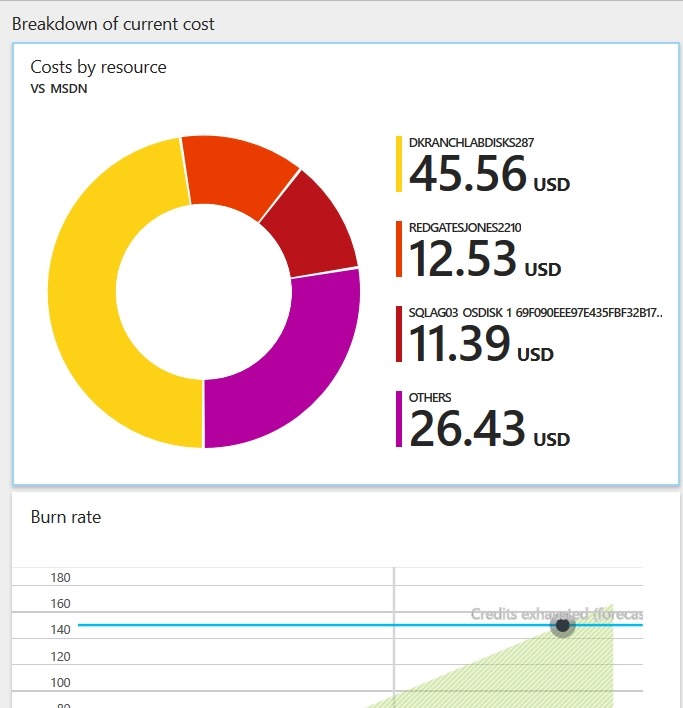
    When I look at my bill, it’s got lots of details, but not always easy to understand.I get a breakdown and burn rate.

    2017-07-18 16_33_17-VS_MSDN - Microsoft Azure

    I can also see details, but tracking these down to ensure I’m making good use of my credits and other charges is hard.

    2017-07-18 16_33_27-Costs by resource - Microsoft Azure

    I can only imagine what this looks like for a company like Redgate, and the struggles between developers, admins, and finance people trying to determine what we have, use, need, and can let go.

  • Naming Conventions for the Cloud

    There are plenty of controversial topics in technology to write about. Today I want to combine two of them into one piece: the cloud and naming standards. I’ll leave tabs v spaces and language choices for another day.

    I like the cloud, and I especially like Azure. I’m not sure that it fits with most applications and organizations and at times I question the value for some parts of the platform, but overall, the ideas are great. I tend to work more in Azure because I’m an MS stack person, but I suspect AWS and the Google Cloud Platform are similar. Many of the cloud platforms, or even the various services from vendors like Rackspace offer lots of opportunity and an amazing set of platform services.

    However, as there are more and more options, tracking the various items and services that you are using becomes an issue. This isn’t a new problem, and I’ve faced the same issue in large Fortune companies. Inventory and management of any technology at scale is hard. This brings me to naming standards. Many of you have probably dealt with naming standards in development and perhaps argued about the choices that your team uses.

    There are also issues for infrastructure, which can be more complex and problematic in the cloud. Because we don’t have complete control over devices, we are limited to managing our objects through interfaces. At least in my data center I can fall back on labeling or connecting to a physical box to determine what services are running. Or even turning a system off to see who complains, something I’ve had to do in the past.

    In the cloud, the world gets confusing quickly because we have many more types of services. Not only items like VMs and databases, but we can have network interfaces, disks, storage accounts, load balancers, and more. In fact, the list in Azure has gotten extremely long. The addition of things like Azure Functions and Azure Logic Apps have me worried that we’ll start to lose control of our infrastructure. The one thing that I appreciate is Resource Groups, which allow me to put groups of items together.

    However, even with these tools, I sometimes find myself confused over what’s running. When I ran across John Paul Cook’s post on naming standards, I realized that I needed to get better organized with my resources. Having some sort of naming standard might help me quickly identify items and keep my portal organized. Even with the various icons, sometimes I get them confused because there are so many different possible icons and services. With a prefix and a resource group, maybe I’ll be better able to track which items I need to keep and which I don’t.

    As you grow the number of anything, the overhead for organization and management grows. It becomes more important to track what you have and use, especially when you’re being charged by the resource. I expect that many of us will be answering questions and reporting on not only usage and performance, but also cost for some part of our jobs as more applications move to the cloud.

    Steve Jones

    The Voice of the DBA Podcast

    Listen to the MP3 Audio ( 5MB) podcast or subscribe to the feed at iTunes and Libsyn.


  • T-SQL Tuesday #89–Changing Times

    tsqltuesdayThis month the invitation is from Koen Verbeeck and it has to do with the cloud changes coming to the data world, especially SQL Server. That’s an interesting topic, not necessarily technical, but it is an interesting one to think about.

    I’m going to be a little short because life is busy, but I think this is an interesting item to keep an eye on for many people. Not necessarily at your current position, but what if you need to move on?

    If you’re interested, I host all the T-SQL Tuesday topics at tsqltuesday.com.

    The Cloud is Changing Things

    I sat in a talk at SQL Bits from Conor Cunningham of Microsoft. He’s one of the principal architects of SQL Server and Azure SQL. In the talk he talked about some interesting ideas in how SQL Server engineering has changed in the last decade. Victoria Holt wrote a short piece on some of the things Conor talked about.

    There are a couple interesting things that the cloud is enabling. First, Microsoft runs their cloud without any Ops team, really having developers be responsible for things in production. This is 1.7mm databases, without any DBAs. Why? They gather lots of data, so they learn when things are broken, unstable, or problematic. They do this with the 600TB of telemetry they gather every day.

    Of course, you and I won’t have that much information, but the cloud does enable Microsoft to think about how to make SQL Server more stable, and also how to add automation capabilities into the product. We haven’t seen much of this change in current versions, but the Query Store is the start of one thing, and Adaptive Query Processing (coming in v.Next) is another. I wouldn’t be surprised to see more, and that means our jobs as DBAs will change.

    I think there will be less, check, configure, verify, maybe even some less tuning work for DBAs. There will always be developer needs, especially with more complex reporting, visualizations, and just understanding large data sets. There will also constantly be the need to write better SQL as the optimizer can only do so much with bad queries.

    The cloud interests me and excites me. There are issues, concerns, and challenges. However, I also find working with Azure through Powershell, being able to access different services from various places, keeping some data there (non PII) and avoiding the need to manage infrastructure to be key.

    I don’t know if it will happen, but I would hope at some point that the Azure cloud, the AWS cloud, the Google cloud would license their service, or even allow others to resell and manage portions to encourage competition and give us some choice in who we might choose to deal with. If so, they I could see more and more companies just considering moves to the cloud for more data, especially when there could be different levels of service and protection for different needs.

    The cloud is changing things, even if you aren’t in the cloud. That can be opportunity if you take advantage of it.

  • The Cloud is Just a Tool

    The cloud is a term that’s full of hype. We hear from various media outlets all the time: the cloud is the answer, the cloud is cheaper, the cloud is the way of the future, the cloud handles your DR, the cloud managers availability, and more. Microsoft has been pushing the message of “cloud-first” (and mobile-first), which has many SQL Server professionals confused, concerned, or  even angry. There are also plenty of professionals that dismiss the idea of cloud anything when it comes to data.

    I’ve felt similar emotions, and certainly I have been skeptical of the cloud versions of databases. I remember the first cloud service, a key-value store, which seemed woefully inadequate for most purposes. Since they I’ve seen the Azure SQL Database grow, and many other products get released. Across that time, I’ve become more and more impressed with what Microsoft has done, and as Visual Studio Team Services has expended, I’ve come to really embrace and get excited by the cloud. It’s still not something I’d always recommend, but I would always start there.

    Mike Walsh wrote a great blog post on the move to the cloud, which I recommend you read. The end message that I get from Mike’s thoughts are that the cloud is a tool, and it can be a tool that really enables you to solve issues without getting caught up in the details of implementing every little part of the system. That’s a mantra that I think many of us embrace, even if we don’t really realize it. How many of you deal with SQL hardware? How many of you install or configure Windows? For many of you, do you even worry about backups or do you have scripts/tools/products that just start backing up new databases? I used to do all those things, but I haven’t even seen a production database server with my own eyes in a decade, despite connecting to many.

    We all move at different paces. Some of us still deal with SQL Server 2008, 2005, 2000, or even earlier versions. Some of us will need to manage those platforms for years to come, even as we may end up helping build applications on Azure SQL Database and deal with data integrity, quality, and security issues through a remote connection. I’d like to be even more hands off. Enabling TDE in Azure is clicking a button. I wish it were that simple on premise (whether really here or in an IaaS scenario), because it should be. I should be able to click a button, get prompted to confirm, pick a backup location for my cert backup, maybe give the cert a name, and it should just get completed.

    The cloud really is a set of tools and services that take away some of the details and drudgery. Sometimes that’s fantastic, and it enables more rapid, more scalable deployment of resources. Sometimes it’s dangerous because the vendors haven’t really thought through the process completely. I really think that’s where we add value as professionals. We shouldn’t be doing too many tasks that can be more easily automated. We should understand what the automation does, and be able to examine it, but we should be spending our time examining problems and evaluating solutions. We should be using tools, of which the cloud is just one, to ensure our organizations become more productive and more efficient over time.

    Steve Jones

    The Voice of the DBA Podcast

    Listen to the MP3 Audio ( 4.5MB) podcast or subscribe to the feed at iTunes and Libsyn.