Tag: databases

  • Sensors and Data

    The programmable world. It’s an interesting concept, but not one in which we have extremely detailed specifications and strongly bound software systems that must be built to interact with each other. I think many of us have assumed that’s how we would enable the further computerization of our physical world. As an example, we’d have cars that communicated with the road, with other cars, with semi-central authority(ies) that might be managing our interactions, all of the infrastructure pre-built.

    However that isn’t necessarily what will happen. In this O’Reilly piece, the author notes cheap sensors can read the color of lights in the same way that humans or my Lego Mindstorm can detect color. Traffic sensors need not communicate with cars; these sensors could instead just identify cars and count them, measuring their speed and adjusting traffic lights based on actual conditions. Imagine the future when more and more sensors gather their own data and make decisions.

    In a sense, this is how the Google self-driving car works. Rather than depend on infrastructure and external programming, the car gathers its own data and adjusts its behavior depending on the interpretation of the data. Whether or not you like the idea of self-driving cars (I do), the idea of an autonomous device acting based on programming and a large amount of data is a fascinating move forward in computing.

    I think this shows that data gathering, processing, and analysis will become a more important part of our future computing worlds. Some of this data will be transient and discarded, but lots will be stored. We’ll use data to ineract with the real world immediately, but we will also perform analysis later and reprogram our devices to operate better in the future. That means there will be new, and more, opportunities for those of us working with data.

    Steve Jones

    Video and Audio versions

    Today’s podcast features music by Everyday Jones. No relation, but I stumbled on to them and really like the music. Support this great duo at www.everydayjones.com.

    Follow Steve Jones on Twitter to find links and database related items and announcements.
    Steve Jones Windows Media Video ( 16.5MB) feed

    MP4 iPod Video ( 20.0MB) feed

    MP3 Audio (4.0MB) feed

    Feeds are available at iTunes and Mevio

    To submit an article, rant or editorial,
    log in to the Contribution Center

  • Sensor Data

    Most of us don’t deal with sensors in our jobs. Or do we? So many devices are in use these days, with a wide variety of inputs that many of us might not realize that applications might be capturing some of this data, which is more akin to sensor data than manually entered data. I would suspect that the meta data might vastly exceed the amount of data entered in text boxes in many of our databases in the future. It might be location, time, action, event, or some other data that we store, manage, and link to data that users choose to submit.

    The Black Hat conference took place recently and one of the sessions talks about the proliferation of cheap sensors that could be used to potentially track individuals without their knowledge. That’s an interesting use of hacking skills, cheap technology, visualizations, and of course, lots of data. While there are plenty of scary privacy implications here, especially for criminal activity, I could see other uses as well.

    Imagine that you work in a retail environment? You might want to know how people move around your store, potentially in order to redesign your store. What about industrial centers? Additional data about parts flowing has resulted in more efficient workflow, but with even more sensors and data, you might find new ways to improve productivity. UPS and FedEx have used technology to vastly increase their efficiency; how many other companies could take advantage of sensor data and find new ways to run their businesses.

    I expect to see more and more data being collected in all sorts of organizations (commercial, government, and others) as more sensors and other hardware become inexpensive. Just as the decline in the cost of computers has enabled almost every organization to take advantage of their capabilities, I expect the new types of sensor data will allow data professionals new opportunities. All the additional data gives us the chance to perform all types of analysis, data mining, and more. It’s a good time to be working in the data field, with new opportunities appearing every day.

    Steve Jones

    Video and Audio versions

    Today’s podcast features music by Everyday Jones. No relation, but I stumbled on to them and really like the music. Support this great duo at www.everydayjones.com.

    Follow Steve Jones on Twitter to find links and database related items and announcements.
    Steve Jones Windows Media Video ( 16.7MB) feed

    MP4 iPod Video ( 19.5MB) feed

    MP3 Audio ( 4.0MB) feed

    Feeds are available at iTunes and Mevio

    To submit an article, rant or editorial,
    log in to the Contribution Center

  • The Watson Service

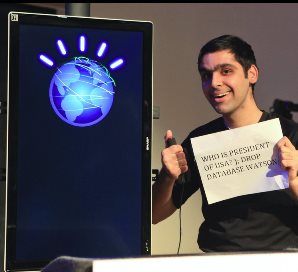
    Let's hope Watson isn't susceptible to SQL Injection
    Let’s hope Watson isn’t susceptible to SQL Injection

    The Watson project from IBM continues to grow and expand in new ways tha twe might never have thought of a few years ago. After winning Jeopardy, the compuer software moved into the medical fields and was sent to college last year. However now Watson is coming to the masses, or at least a portion of them. The Watson Engagement Advisor is being put to the test as a customer service worker. From banks to cell phone providers to insurance companies, the Watson service is poised to advise and interact with consumers by providing advice, troubleshooting and more.

    Perhaps the age of the machines is really upon us. If the Watson service can do as good a job as humans, on average, then it becomes a matter of time before many companies decide it’s more efficient to replace large numbers of their human staff with the service. As the text to speech engines improve and computer power grows, we might not be able to distinguish these machines from many of humans they replace.

    I don’t know if I think this is good or bad, but it’s likely to come true in some sectors. While Watson may not have the creativity or flexibility of humans, it also won’t have the memory lapses, bad days, and inherent prejudices of people. I suspect some people will have poor experiences with the service, but most will not and at some point it will becomes more likely to interact with a Watson-like service than a human for many service oriented tasks.

    I can even see that affecting us in technology. How long before Microsoft has a similar service that might troubleshoot issues with products, perhaps even working with developers to find bugs and workarounds. I’d imagine that this service would be a much better way to actually triage and route issues to Microsoft developers than the Connect system.

    I don’t know that such a system would replace many developers, but I suspect it could easily learn over time to give you advice, such as which SSIS component might best improve a particular workflow. From there it might not be a large leap to have many CRUD applications generated by an interactive Watson programmer. I’m not sure what would be more scary then. That the machines will take some of our jobs, or that they have the intelligence to do so.

    Steve Jones


    The Voice of the DBA Podcasts

    We publish three versions of the podcast each day for you to enjoy.

  • Data Will Drive the World

    Software, and data, will eat the world.
    Software, and data, will eat the world.

    There’s a well known essay from Marc Andreeson that talks about howsoftware is eating the world. There’s a lot of truth to this, in my opinion, and it becomes very important for more and more people to realize that software is going to become more and more of a part of their lives, all parts of their lives. Whether in business, in your personal life, in government or anywhere else, software is going to increasingly be used to interact with the world. This will bring about many opportunities for people in technology to help shape the way those interactions affect all of our lives.

    However it’s not just software that’s important. The data that drives this software is arguably more important than even the software. This data drives the software algorithms to produce some result or action. Hacking the data to change values can even change the results from the software. Different software algorithms might interpret or react to data differently. If data isn’t more important, it’s equally important as the software that processes it.

    We are seeing the additional recording and gathering of data allowing all sorts of new software to be written. Some of the software is performing jobs that humans have do in a faster and perhaps more efficient way. Other software is helping people understand the world in a way they might never have seen it. We even have software replacing other  software jobs. That feels quite surreal to me, but it’s made possible by more and more data being available to help guide the development and growth of systems.

    We are in a good business for the future, with the growing needs to process, manage, and manipulate more and more data in the future. It’s up to us to learn the skills we need to do this efficiently, and in ways that can’t easily be automated.

    Steve Jones


    The Voice of the DBA Podcasts

    We publish three versions of the podcast each day for you to enjoy.