Tag: databases

  • A Broken Data Model

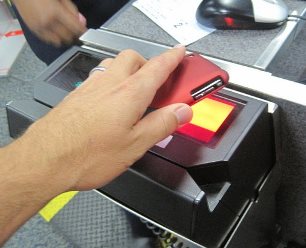
    This apparently wasn't foolproof on one of my trips.
    This apparently wasn’t foolproof on one of my trips.

    On one of my recent trips, there was a delay in leaving the gate. There were two passengers, both of whom had the same seat assignment on their boarding pass. You’d think there would be some sort of primary key that prevented this situation from occurring, but with the constant reassignment and movement of passengers at the gate, I can understand this happening. We print passes at a point in time, but since data can be revised, and new passes printed, there potentially would be a conflict.

    However what came to light as we waited was both disconcerting and puzzling to me. The real problem was that one of the passengers was supposed to be on a later flight to the same city.

    Apart from the security implications, it seems to me that the ability of someone to get through the scanner near the jetway with a boarding pass for the wrong flight implies a broken data model. I can only guess that the scanner is reading a passenger’s name, destination, and seat number. Or that the flight data model is broken and there are two flights on the same day that share a flight number. The journey was short, so I suppose this airplane could have actually been making two round trips in a day.

    I can’t image the complexity and problems that programming an airline’s flight system must bring to the data models and applications. With the constant shuffling of people, flights, and seats, I’m regularly surprised that it works smoothly most of the time. As my airline has modernized their systems, I’m even amazed at how much data they disclose on monitors to passengers waiting for upgrades or standby flights, and how quickly my mobile app updates with new data when there’s a change.

    I’d never experienced someone getting on the wrong flight before, and was surprised to find their software allowed it. However given that so much of the airline industry relies on systems that were developed decades ago, perhaps I shouldn’t be surprised.

    Steve Jones


    The Voice of the DBA Podcasts

    We publish three versions of the podcast each day for you to enjoy.

    Due to some technical issues, there is no podcast today, but we will return with a new episode tomorrow.

  • Small Data

    Big data is a hot topic these days. Like the “cloud” terminology we’ve been hearing about for the last few years, there isn’t a good definition of what “big data” really is. The best one I’ve seen so far is data that “doesn’t fit in Excel,” which I like. So many people perform their analysis on a spreadsheet of sorts, that if the data doesn’t fit inside their edition of Excel, they’d probably consider it big.

    The problem with big data, however, is that it while it contains more information, it can also contain more irrelevant information. That’s noted in this piece on small data (from Brent Ozar, PLF), where the author states the signal to noise ration may be decreased when you examine very large data sets. You may find that there are correlations that appear to causations. With enough data, with enough things to examine, you can often start seeing patterns that aren’t really there. These ghost patterns can lead you to draw incorrect, or at least less correct, conclusions if you do not investigate further and test your ideas on portions of your data set.

    Some of you might have noticed fractal patterns like this:

    Mandel_zoom_00_mandelbrot_set

    This is a well known Mandelbrot Set pattern. However if we were to zoom in on this picture, we’d find that the patterns repeat over and over again. What holds true for the largest image we have holds true inside smaller sections. The pattern repeats.

    The same thing can happen with patterns in business. We may see a pattern in a large set of data, but we should verify that it also holds true for subsections of the same data set before we make a decision based on that pattern.

    Steve Jones


    The Voice of the DBA Podcasts

    We publish three versions of the podcast each day for you to enjoy.

  • Flight Data

    I'm hoping this isn't the flight board when I travel tomorrow.
    I’m hoping this isn’t the flight board when I travel tomorrow.

    I’m getting ready to fly tomorrow, heading to SQL Saturday #175 in Fargo, ND. I have a morning flight, to give me a little time in the afternoon to go see the woodchipper. That’s if I don’t have any delays. I am planning on working in the airport and on the plane, so I won’t be less productive if there are, but I might not get the chance to see the famous machine from the movie.

    I’ll have a quick turnaround after this trip as well, coming home for a little over 24 hours before I turn around and head to the UK for meetings at Red Gate next week and SQL Bits XI next weekend. I’m hoping that none of the airlines have data issues since those can severely impact my travel times. Last week American Airlines had computer issues, and while United hasn’t had any in awhile, my fingers are crossed that this won’t be the weekend their systems go down.

    We have gotten so computerized with many of our transportation systems that problems can interrupt service, usually just causing annoyances, but there is a potential for lives to be lost. Since we don’t often know why the systems fail, it’s hard to know to what extend we have poor coding issues, improper secure development, incorrect configuration, employees susceptible to social engineering or something else. We even had a computer failure in space, though I’m sure the astronauts weren’t annoyed by the alert.

    These days it becomes increasingly hard to roll back to manual processes, not because of the complexity of the systems, but also because the knowledge on how the processes should work is being lost as employees leave the company. This means more delays, but hopefully not important safety rules being ignored or forgotten. I know the airlines have invested heavily in IT, and flights record a lot of data, but I hope they’ve done so in a distributed fashion. Lots of caching, fault tolerance, and most importantly, communication to allow their operations to proceed when the real world interferes.

    Steve Jones


    The Voice of the DBA Podcasts

    We publish three versions of the podcast each day for you to enjoy.

  • Natural Data

    Can you patent a gene, which is essentially data?
    Can you patent a gene, which is essentially data?

    Can you own data? In one sense, that’s what the arguments before the US Supreme Court over a Myriad Genetics patent are about. The company has patents for a few genes, which in and of itself, are really just data about a particular organism. There are a lot of technical issues here, and I’m not completely sure how I feel about this topic or who I’d like to see prevail in the case. I do think, however, that this does have lots of implications for how we might view other data in the future if the patent is upheld.

    As data professionals, we usually think of the mechanics of dealing with the various pieces of data in our organizations. We must protect data, ensure it’s integrity, make it available and more. A large part of our careers is spent manipulating or managing the bits and bytes stored in databases. We must extract information out, and often need to understand what the data represents to do this, but most of us haven’t been exposed to the issues of ownership or rights with data. I think that will increasingly change as government rules, regulations, and laws scramble to catch up with the digital world.

    Digital ownership is a very thorny subject, complex in its breadth and depth. We’ve seen technology companies fight against some laws, like CISPA, while supporting others. Often our government officials don’t understand the complexity of the topics, and I’m not sure that we in the technology business explain the the situation well. Even very intelligent people often don’t convey the implications of these complex topics, many of which often don’t have good analogies in the analog world.

    Ultimately I think we will find our jobs as data professionals becoming more and more complex as we must not only solve problems and manage data, but we will also end up being constrained by the legalities governing the data.

    Steve Jones


    The Voice of the DBA Podcasts

    We publish three versions of the podcast each day for you to enjoy.