Tag: ETL

  • Fragmented or Centralized Data

    I read a piece recently that talks about the hassles of copying data multiple times for different applications. In my experience, I haven’t seen this to be the main problem with data. It’s not often that we might replicate, in a general sense, data across different data stores to support different applications. Certainly lots of ETL jobs exist to copy data to new stores for different purposes, which perhaps is what the author is implying.

    The idea of protecting data is one that is becoming a greater concern for many organizations. In fact, I’d argue that a number of the recent high profile data breaches in the last couple years involve copying data from some RDBMS store to an ElasticSearch server that isn’t secure. Any movement of sensitive data, whether to warehouse or Power BI report, should be in a secure way.

    For years we’ve had minor issues with data security in Excel worksheets; a similar problem continues to exist with both data stores and reporting tools that might contain copies of data. In some sense, this is actually no different than the problems of losing paper reports in the distant past.

    The solution given in the article is to share data from a single store among more applications. That’s been the practice in many places I’ve worked, with the challenges of additional load and performance concerns on the data store. Modern distributed SQL Servers can use AGs or (after SQL Server 2017), Kubernetes, to scale out and potentially handle the loads, but those choices aren’t without their own resource costs and challenges.

    Ultimately, we aren’t going to get away from moving data around. Certainly we have needs to deal with dev/test environments even if we don’t have any other data movement. While I do think the future of large data workloads will involve less movement, we aren’t going to eliminate movement.  We may build more applications that connect to a single data store, which is likely as our platforms become more powerful and enable scale-out capabilities to meet workload growth.

    We also need to ensure that copies of data made for different purposes as well protected. Most businesses need to develop better skills and habits to limit sensitive data in dev and test environments, as well as proper access controls for data copies that are used in production environments.

    Steve Jones

    Listen to the podcast at Libsyn, Stitcher or iTunes.

  • Self-Healing ETL

    The process of building ETL flows is cumbersome and time consuming. Many consultants have made a lot of money by building ETL processes that manage the movement of data in and out of databases, including to data warehouses. There is a lot of importance placed on consistent, quick, and accurate data loading. In fact, one of the most popular job needs these days is still for ETL developers. Even as data science grows and becomes popular, quite a bit of the work in data science is data preparation, which often involves ETL, or ELT.

    One of the struggles with an ETL process is the tedious nature of building lots of flows that are very similar. There may be a wide variety of ways to get data to move, especially as we have a crazy set of inconsistent formats in which data appears, but once we have the flow, we often repeat that for many different files or tables. I think Biml makes this better, but it’s still not simple, and there can be plenty of issues that still arise as the source inputs change.

    There was an interesting article that describes the use of AI to assist in ETL flows. While there is some basic matching up of source and target data right now, what if AI would add a few things. The idea of looking at the data you’ve matched and suggesting alterations that can potentially help with data quality is interesting. The system would have to learn what issues occur over time and what good data looks like, but perhaps this could even extend when the source data gets slightly mangled in formatting. Perhaps detecting fixed width fields that have grown and shifted all columns would be possible, and even adjust the data flow.

    I am actually more interested in detecting PII data and alerting developers, or even operations people that the ETL process needs to be changed or secured in some way. AI should be able as well to help Operations people with scheduling, even pausing or moving ETL work to other machines to better scale the flow. My view would be that any AI system ought to be looking for anomalies and detecting those, as pattern recognition is one thing AI is good at.

    I’d think this would be more of an alert capability as I’m not sure I trust an AI system to actually adjust data. ETL flows are often too important to have data mangled in an unexpected way. Perhaps that’s too cautious, as that’s what developers do all the time. They mandle data, and we find ways to recover. Ultimately, I think that having lots of logging on what a developer or AI system does is more important. This might be especially true if voice commands are used to build the flows. I could see lots of ambiguities and mistakes from business analysts that are trying to describe how to build an ETL flow.

    Steve Jones

    The Voice of the DBA Podcast

    Listen to the MP3 Audio ( 4.2MB) podcast or subscribe to the feed at iTunes and Libsyn.

  • Importing Flat Files in SSMS 17.x Works

    One of the more annoying things I’ve found in SSIS/SSMS is trying to import CSV files for some quick analysis. For some reason I constantly seem to get files that the import wizard keeps having issues. On top of that, the defaults are annoying. When I need to get a CSV in, I select a Flat File source, but the filter for files always defaults to text files. Then there are more drivers and choices that make this complex.

    Recently I was looking to load a file and noticed a new option: Import from Flat File. I decided to try it and was pleasantly surprised.

    2018-08-27 09_52_03-

    Updating a Database

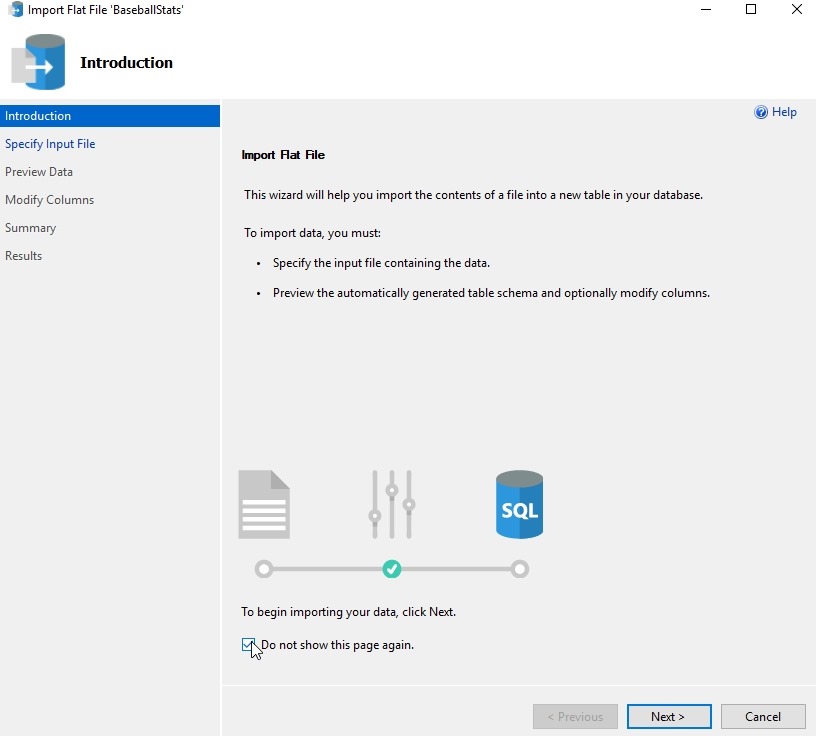
    I have a database of some baseball statistics, but wanted a few updates. I started using this wizard to quickly update about 10 tables. Here’s how this works. When you select the option, a wizard starts with this screen.

    2018-08-27 09_54_42-Microsoft Edge

    There’s no reason to look at this more than once, so check the “Do not show” box, as I did. Click Next.

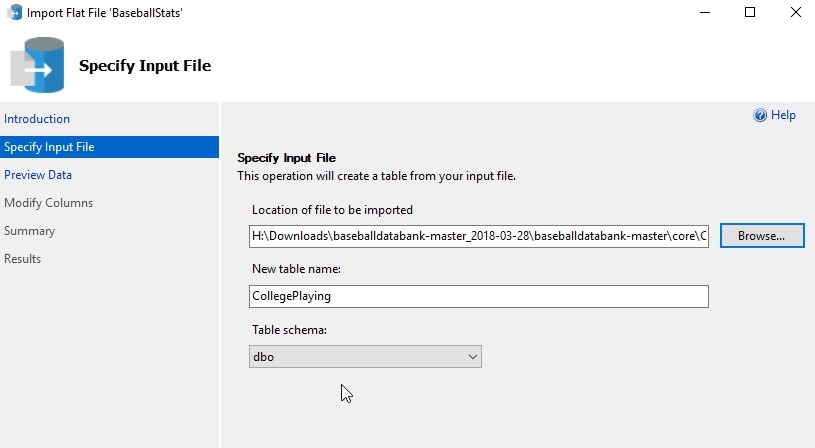
    Once you do that, you need to pick the source of your data. There’s a Browse button, and when you pick the file, you get a filter for Data files, which are .csv and .txt files. The file you pick will be used for the table name in the dbo schema, but those can be changed in the text boxes.

    2018-08-27 09_55_39-Microsoft Edge

    Note that this wizard only works with new tables, so if your plan is to update another table, you need to stage this data in its own space first.

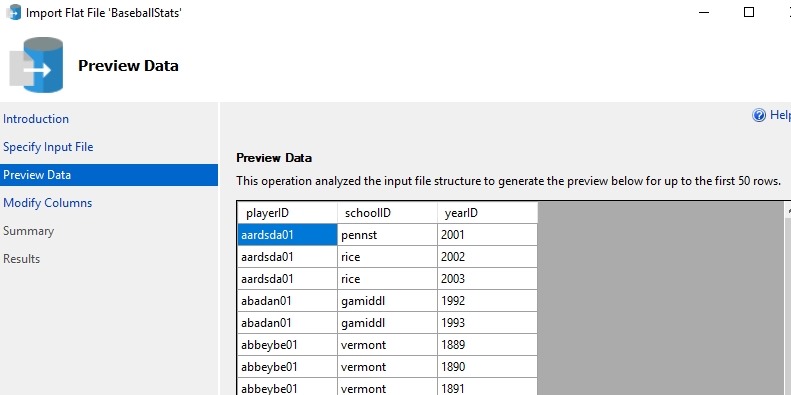
    The next step in the wizard is a preview of the data. This is handy, and for me I glance to get an idea of what the data is. This is useful and you can use the “Previous” button at the bottom to get back here from the next screen.

    2018-08-27 09_56_46-Microsoft Edge

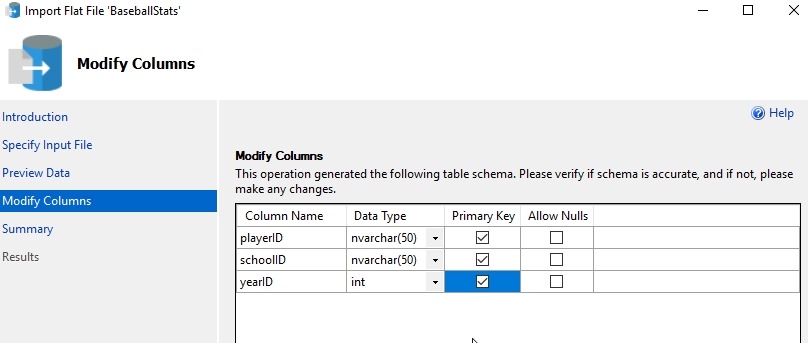
    This next screen is the reason I love this wizard. I can get the data types and the PK for the table. This designer makes it easy to import the data. I can fix the table, which is nice. In a few of these files, I want to change from nvarchar to smallint for data, and allow nulls for some fields. Plus, being able to set the PK here is great.

    2018-08-27 09_58_14-Microsoft Edge

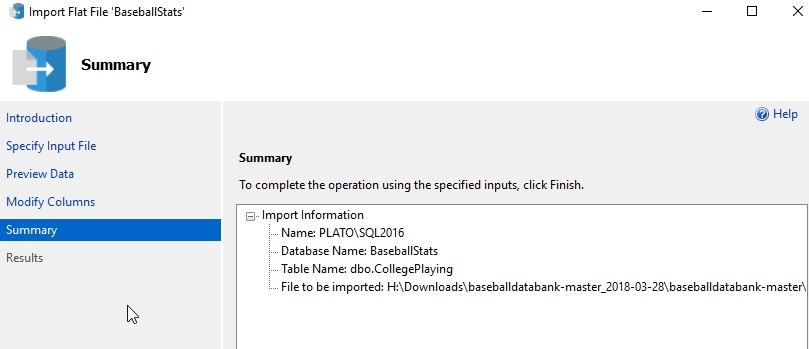
    The next step is a summary. I usually quickly click the Next button to import data.

    2018-08-27 09_58_21-Microsoft Edge

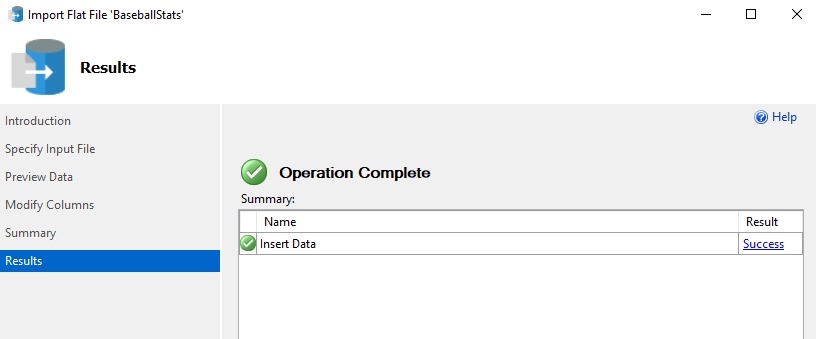
    If things work well, you get a green checkmark here. If not, you can go back and change settings, like adjust the PK or allow nulls. I even go back twice to preview data sometimes.

    2018-08-27 09_58_28-Microsoft Edge

    One note here. If you go back, the table exists, and you’ll need to drop it.

    If you care, you can get the baseball statistics from here: http://www.seanlahman.com/baseball-archive/statistics/

  • ETL or ELT

    I was reading a piece on ETL patterns and found it interesting that the author noted that one way to reduce the challenge of ETL processes keeping up with changing schemas is to move to an ELT process. That’s an interesting perspective, and I wonder what those who work with the relational model think. IS this a pattern you like?

    In a traditional ETL pattern, we get data from a source (Extract), manipulate it to suit the target schema (Transform) and then Load it into the target. The hassles here, and the reason this is hard, is that the transformations are often complex. We deal with ragged rows, various delimiters and terminators, and more. Lots of consultants have made quite a bit of money by building these transformational applications and processes and maintaining them as requirements change.

    The flip of the last two parts, moving from TL to LT, looks to defer some of the transform work until the data is in the destination. This means that the transformation could be a schema-on-read, as the article proposes. The idea here is that all data is ingested into the target system as is. This means that structured CSVs reside alongside spatial data and Word documents.  Then, once you have the data, you can transform it as needed, to suit whatever requirements exist at that time.

    Certainly this sounds appealing, but for many of us in organiztions, the challenge is still determining how to transform the data. This is often dependent on what the data is and how it can be used. We still need to do the work to understand how this data is structured and change something to make data available to the end user. Whether we do this in the middle or after the data is in a target system doesn’t matter. I know some products, like the MarkLogic one in the post and Azure Data Lake want to reduce must of the ETL effort, but I’m not sure that will work for really important data. For some, sure, we can collect it and sort out the transformations later. However, for useful data, data that the business wants regularly and quickly, most of us need to just get a flow working that will move data on a regular basis.

    I’ll admit that I often prefer to transform data inside of a SQL Server target, OLTP or DW database. The reason is that mass changes are often easier with T-SQL, working sets of data rather than row by row. I recognize that doesn’t always work, but I know that for most data that business people do find useful, I’d rather have an ETL process build sooner rather than later.

    Steve Jones

    The Voice of the DBA Podcast

    Listen to the MP3 Audio ( 3.8MB) podcast or subscribe to the feed at iTunes and Libsyn.