Tag: GDPR

  • A Large GDPR Victim

    During the last two years, Redgate has been preparing for the GDPR to take effect in the European Union. As a company based in the UK, we recognized that there were both challenges and opportunities for our business. We needed to ensure we were compliant with the regulations, which would likely require us to change processes and educate our employees. At the same time, our customers would face similar challenges and there was an opportunity to help them achieve their own compliance with software tools.

    The GDPR enforcement began last May, though fairly slowly with few fines and decisions being handed down. Across the EU, it seems to have been a quiet period with few companies told they were non compliant. Most organizations likely think all their preparation has been worth the effort and likely believe that they are prepared for any complaints from customers or investigations from regulatory authorities.That confidence may have been shaken in the last week as Google was assessed a fine over $50 million for violations. In particular, the EU regulators in France found that Google had not obtained the consent needed for using certain data in personalizing ads. They also decreed that Google had not clearly presented information about how users data would be handled and stored, as well as creating a difficult process to opt out.

    This fine isn’t much for the tech giant, but it’s just the start and will likely force Google to change the way they handle data. It may also have implications for other tech companies of all sizes. Google is appealing the decision, and this will be an interesting case to follow for data professionals since we may need to ensure that we can comply with the final ruling. Many of us view the data in our organizations as belonging to our employer, with free reign in how we handle, process, and store it. That may change quickly if the ruling is upheld.

    Much of the decisions about how companies will deal with data is made by others, but data professionals often need to ensure that we do comply with whatever rules our organizations decide to use. This means a number of practices that we must consider. At a high level, we need to know what data is affected by the GDPR, or any other privacy regulation. This requires that organizations have a data catalog that allows them to track which data is sensitive and must be handled carefully. Few organizations have a comprehensive data catalog already, so this will be an area in which to focus resources during 2019.

    Once we are aware of where our sensitive data is stored, we must take precautions to protect this data throughout our organization. Most companies have implemented security in their production environments, but their data handling practices in test and development areas are often not the same. The GDPR calls for anonymization, randomized data, encryption, and other protections, which data professionals will need to implement in a consistent manner throughout their IT infrastructure.

    Finally, accidents and malicious attacks will take place. This means that every organization really needs a process to detect data loss and a plan for disclosing the issues to customers. Auditing of activity, forensic analysis, and communication plans need to be developed, practiced, and distributed to the employees that may be involved in security incidents.

    There may be other preparations needed, and the larger the company, the more work that will be required. Tools are critical to ensuring this process can be completed in a timely manner, both to save time in implementing processes and also to show regulators that actions are underway to better protect data. Fine levels aren’t mandated, and the more effort put into achieving compliance, the less likely that regulators will assess a fine equivalent to 4% of your annual revenue.

    There will be plenty of other GDPR fines in the future, and it is worth following this case with Google to see how stringently the regulations will be enforced. The world of data handling practices is changing and all organizations need to get used to better disclosure of practices, tooling for customers, and protection of the data assets they hold.

    Steve Jones

    The Voice of the DBA Podcast

    Listen to the MP3 Audio ( 5.5MB) podcast or subscribe to the feed at iTunes and Libsyn.

  • Republish: Data Breach Danger

    In Seattle today, delivering two talks, so you get a republish of Data Breach Danger.

  • Data Classification in SQL Server 2019

    One of the areas that Redgate is working on is making data classification easier. Microsoft added some capabilities to SSMS 17.5 and Redgate has an EAP out for the next version of our data catalog tool.

    Azure SQL Database has had some advanced options they were building into the database engine, and we get our first look in the on-premises version with SQL Server 2019 CTP 2.0.

    The ADD SENSITIVITY CLASSIFICATION and DROP SENSITIVITY CLASSIFICATION DDL is now available, and here are few examples of how this works.

    Let’s look at a database that has some potential data to classify. I’ve got a sample database with a few tables. In fact, if I look at the data classification suggestions in SSMS, I see 7 columns.

    2018-10-23 11_56_48-Data Classification - SimpleTalkDev_Steve - Microsoft SQL Server Management Stud

    I can accept any of these, but if I do, these are written to extended properties, which isn’t the best way of storing this data.

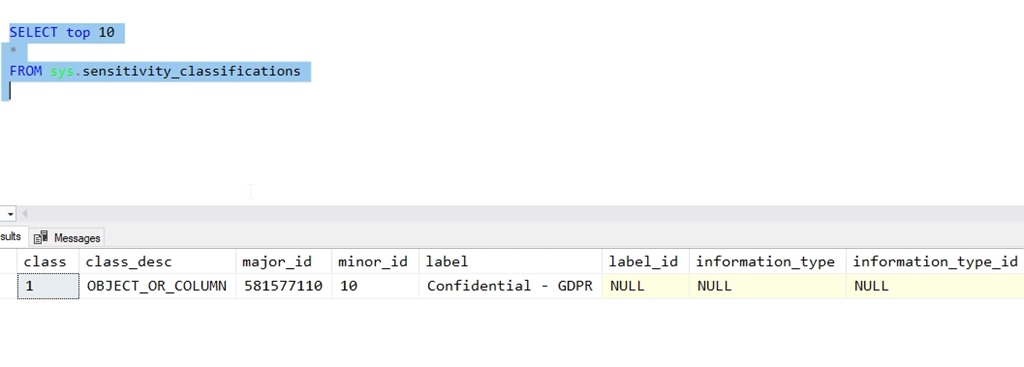
    However, the ADD SENSITIVITY CLASSIFICATION syntax works well. If I take that dbo.Contacts.Email column and decide this is Confidential according to the GDPR, I can do this:

    ADD SENSITIVITY CLASSIFICATION TO
      dbo.Contacts.Email
      WITH (LABEL = 'Confidential - GDPR')

    If I then query my meta data table, I’ll see this:

    2018-10-23 12_01_04-SQLQuery4.sql - Plato_SQL2019.SimpleTalkDev_Steve (PLATO_Steve (61))_ - Microsof

    There are other items I can add, such as the information type and then IDs for the label and type. I can, however, update that data like this:

    ADD SENSITIVITY CLASSIFICATION TO
       dbo.Contacts.Email
       WITH (INFORMATION_TYPE = 'Contact', INFORMATION_TYPE_ID = '5BFAE3B8-4549-4989-BEB6-F9BF6434DAD1')

    Note I still haven’t given the Label_ID a value, but that’s OK. This allows me to add human readable metadata to columns, as well as add IDs that I might get from some external auditing system.

    2018-10-23 12_04_01-SQLQuery4.sql - Plato_SQL2019.SimpleTalkDev_Steve (PLATO_Steve (61))_ - Microsof

    This feels primitive, but it’s slightly better than extended properties, and it’s somewhat built into the engine, so we can code this as a part of development and ensure classification is added to our sensitive data.

    If this is an area you’re interested in, we’d love to have you try the Redgate tool and give us feedback. We’re working on this problem and trying to find ways that are both useful and sustainable over time.

  • We Need Data Privacy Consistency

    For most of the last year, I’ve had quite a bit of my time devoted to the GDPR and related topics. My company is affected, as it’s based in the UK. Not only must we comply, but we know many other companies must as well. As a result, some of our product focus was aimed at helping companies solve their data privacy issues, especially with regards to data.

    That continues to be a good idea as the GDPR isn’t the only regulation out there affecting organizations’ data handling practices. There are other laws around the world, but the US is a big market, one of the biggest we have, and we are seeing increased need in the US for the same types of data privacy and protection solutions mandated by the GDPR.

    California recently passed their own data protection legislation, and it’s leading the way in the US. Tim Ford wrote a short piece on how this affects his company. He notes that as a consumer, he’s glad to see stricter data handling practices being required. However, as a business owner, he’s concerned and I think there is some basis to be worried.

    There are other laws that might pass soon in the US. New York has a bill, Colorado has signed a weaker, but still new, law. Other states are considering items, but the US Congress has yet to really move forward on any legislation, which might lead us to have multiple data handling practices that are required. That would be a nightmare, much more difficult than the hiring and tax practices of different states.

    I couldn’t imagine having to work with different processes, and certainly wouldn’t want to have more restrictive laws being passed in the future that might cause us to change practices multiple times. I can only hope that the US gets a common law for all our states, and that the practices are in line with what the GDPR requires. Other countries have used that as a basis for their laws, and I can only hope the US does the same.

    Steve Jones