Tag: Microsoft

  • SQL Server Should Work for Us

    failI ran across a post the other day from someone that was trying to find out why their maintenance plan failed. This person had received a failure notice from SQL Agent, which is good. We should all be aware of failed jobs from some sort of monitoring system. Like any good DBA, this person checked the job history, saw an error, couldn’t figure it out and posted a question at SQLServerCentral, looking for help. That’s a good plan for most anyone 😉

    Experienced DBAs know that to debug this issue, you need to look at the maintenance plan log, which has more details. The job history contains a minimal amount of information and usually doesn’t help. If you examine the maintenance plan log, it’s usually easy to determine which part of the plan failed since the plans are fairly simple constructs. The really exceptional DBAs don’t use maintenance plans and instead would rely on some sort of tool or well known script instead to handle their maintenance.

    However why do we need to go to the maintenance plan’s log? SQL Server includes the job history. It includes maintenance plans. Why doesn’t the job understand there is a maintenance plan, read it’s log, and return the information? Or give us a button on the job history that loads up the maintenance plan log? That’s a simple thing to do, and isn’t the job of software to make tasks easier?

    This is one of those places where SQL Server feels a bit immature and unrefined. I understand the complexity of the entire product and the limited resources that are devoted to enhancing and growing the product. However, where are the resources that make SQL Server easier for the average and accidental DBAs to use? Those are the majority of the people using the platform.

    SQL Server led the industry in producing tools that made it easy to manage and use. Other platforms are quickly catching up, however, and if SQL Server can’t continue to improve its toolset, in addition to its features, people will consider other platforms. The cost of SQL Server has risen, but so has the revenue. Do us, and yourself, a favor, Microsoft. Put a team of 50 people to work on usability and improving the tooling. It will be a great investment for the future.

    Steve Jones


    The Voice of the DBA Podcasts

    We publish three versions of the podcast each day for you to enjoy.

  • Helping MS Help Us

    Vote today! See if we can help MS help us.
    Vote today! See if we can help MS help us.

    I think SQL Server is a fantastic product. I’ve been using the platform over 20 years, across 8+ versions and 2 operating systems. It’s provided me with a great career, and one I’ve enjoyed. However the software isn’t perfect, with numerous bugs and holes. The Connect system was introduced years ago as a way for people to submit bugs and suggestions, vote on them, and provide feedback for Microsoft.

    Does it work? I think Connect is broken, and while I sympathize with the volume of suggestions that Microsoft must deal with, I’d hope that they actually listen, consider, and act on something other than documentation bugs. Those seem to be the only ones acted on lately.

    Most of the items submitted are sent in by individuals, and they get one or two votes, but that’s usually from the submitter’s friends. Many of the items are, IMHO, not important enough to submit to Connect. My guess is they cause plenty of people in Microsoft to view Connect as a slop bucket where most users toss every complaint they have about the product. I sometimes wonder if items are submitted by users before they even spend a few minutes on a search engine trying to resolve their problem.

    However there are some great suggestions, and this is one. It’s asking for a new virtual table: Errors. This is in addition to the inserted and deleted tables. It’s not just that I think so, but there are over 300 people that have voted it up. It’s the number 6 highest voted item on Connect. Users see value in this, especially data warehousing users. If you read the comments, this thread, or this blog, you might agree. If so, then I’d encourage you to vote it up. If not, vote it down. Either way, leave a comment on why this would help (or not help) your work. I don’t know if this will change Microsoft’s mind on the issue, but it would be interesting to see if they respond with anything other than there are “resource constraints” preventing this from being implemented.

    While you are at it, look over the list of top voted on items. There are some good ones, like fixing this errorcreate or replace, and enhancing the OVER clause. If any of them would make your job easier, let Microsoft know. They always say that customer problems and situations give them reasons to enhance the product or fix issues. Let’s give them a chance to actually prove that statement is true. Participate in our experiment and vote today.

    Steve Jones


    The Voice of the DBA Podcasts

    We publish three versions of the podcast each day for you to enjoy.

  • Morphing Microsoft


    Microsoft has come a long way, and still has far to go. Which way will they go?
    Microsoft has come a long way, and still has far to go. Which way will they go?

    Microsoft is trying to change from a software vendor to a devices and services company? They are trying, according to this piece from Mary Jo Foley. With a Developer and Platform Evangelism group that is trying to bridge the gap between internal Microsoft developers and those external professionals in the real world, it appears this group will try to provide more code, samples, and frameworks that others can use. Perhaps they will even give us strong architectural examples that stand up to the real world.

    Personally I’d like to see them disclose code that works in real situations. Give us the code behind MSDN or the Microsoft Store. Prove to us you have code that not only works, but it written to meet your standards and needs. If you want to start with something that’s not open to the Internet because of security concerns, how about showing us how one of the internal MS systems really works? Maybe the annual employee review app?

    If the code isn’t enterprise ready, or of the quality that should be used as an example, why not? I know there are the same pressures building systems at Microsoft that many of us face, but if that’s the case, I’d hope Microsoft would tackle some of those issues in their tooling and platforms. They could then show us not only how to do things, but prove it can be done as well.

    I do think there is some truth to the fact that in many of the applications we build, the platform developers use is not just be the OS and local APIs. There is a richness gained by including data from services, data that exists outside of the organization. Whether that’s on the open web or from business partners, we need architectures that help us build applications that can survive some workload burst, tolerate individual machine failures, and do so at a reasonable cost. That doesn’t necessarily mean cloud services to me, but it does me better software patterns, practices, and models for developers.

    Steve Jones


    The Voice of the DBA Podcasts

    We publish three versions of the podcast each day for you to enjoy.

  • The Platform Problem

    A fantastic platform. If I had a choice of where to run it.
    A fantastic platform. If I had a choice of where to run it.

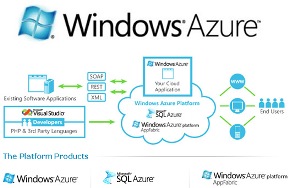
    I really like the idea of Azure providing a Platform-as-a-Service (PaaS) for applications to be built on. As I’ve evolved in my career, I’ve learned I prefer not to manage individual machines or deal with the complexities of configuring anything outside of SSMS for SQL Server. Working with Hyper-V recently has cemented the idea that I don’t become more productive by dealing with the complexity of the Windows host.

    However I can’t see many customers migrating the majority of their applications to the PaaS Azure service for one reason: there’s no competition.

    Moving to Azure means placing a big bet that Microsoft will continue to offer the same or more features, more powerful machines, and stability at a reasonable price. Moving to Azure also assumes that you are comfortable working with only Microsoft for the foreseeable future, using their data centers, staff, and products. Any code you write will be specific to Azure.

    If you were to use the IaaS services from another vendor, like AWS and their virtual machines, a migration might still require some code changes. However, I’m sure if I contracted for virtual machines from Rackspace or some other provider, I could easily redeploy my application elsewhere. Well, perhaps not easily, but certainly easier than if all my code depended on a platform I can’t run inside my own data center. A platform nobody outside of Microsoft can run.

    My view is that Azure is a great platform, and one that could explode in usage. If we have choice.

    Microsoft should sell us the code to run inside our own data centers, or at least license it for a number of large providers that might want to offer Azure services. Ultimately the success of the platform depends on people choosing Microsoft because it’s the best choice, not because it’s the only one.

    Steve Jones


    The Voice of the DBA Podcasts

    We publish three versions of the podcast each day for you to enjoy.