Tag: PASS

  • Argenis Without Borders – v2

    Last year at the PASS Summit, Kristen Benzel and Argenis Fernandez put on a fundraiser to raise money for Doctors Without Borders. It was very successful, bringing over $13,000 to the charitable work this organization does.

    We had fun with it, with some great rainbow costumes that were displayed at the PASS Summit, including me.

    doctorswithoutbordersrainbow

    This year, 2015, there’s a new campaign. Once again, we’re raising money for Doctors without Borders. The goal is $20k, but we’re already close to $1,000 raised. That means that Argenis will be dressed like Ted.

    Halloween Steve

    My costume has yet to be chosen. I’m not usually a Halloween person, but in this case I’ll make an exception. The last day of the PASS Summit this year is Halloween, so I’m thinking that’s the day to

    However, I’m not sure what to commit to. Should I be a super hero? A classic horror look? What would make you donate a little to the campaign? I’m looking for a few ideas, thoughts, things that you think would bring a smile to your face, and the willingness to help raise some money for a great cause.

    Donate today and post your costume suggestions below. Feel free to see if you can come up with something that might embarrass me.

  • Congrats Summit 2015 Speakers

    I'm Speaking Graphic_SmallThe PASS Summit 2015 Speaker list has been released and I wanted to congratulate everyone that was accepted. It’s a great honor and I’m proud to be on the list once again.

    I also apologize to everyone that submitted and wasn’t accepted. I hadn’t planned on submitted, but part of my job is speaking to the community. I was asked to submit sessions, which I did. Of the three I submitted, one was accepted.

    I saw a post from Mark Broadbent (@retracement) today that talks about his submission experience this year. He’s spoken at the Summit before the Rally, and numerous SQL Saturdays. He’s got experience and success as a speaker. It’s hard to call a single session selection a failure, and I hope Mark doesn’t feel that way.

    It’s Not You

    One of the things I’d like to say is that if you submitted a session and weren’t picked, it’s not necessarily you. This is certainly true for the Summit, but the same thing can apply at SQL Saturdays or other events.

    I’m sure you doubt I know what I’m talking about, and that might be true, but I certainly understand how you feel. I’ve received two rejections this year from events that didn’t like my submissions. It’s tough, and it can be a blow to your self-confidence, but it’s not necessarily you.

    Don’t get me wrong. It could be. Please solicit feedback from the organizers and friends about your submissions. There might be things that you are doing poorly, and if so, you should learn to do a better job at writing abstracts, and a better job of speaking. I regularly ask people what they thought of my talks, and I’m happy to go watch and give feedback to others as well.

    I’m sure some of you have heard of, or seen spoofs, of medical school grading where professors start a test letting students know that there will be x As, y Bs, z Cs, i Ds, and j Fs. In other words, a forced ranking where you must compete in order to succeed. That’s the PASS Summit submissions, but in a more complex scenario.

    You might submit a great abstract, on an outstanding topic. Maybe you’re a SQL Server memory guru and you want to put in a 400 level internals talk on memory pressure. Great. But if Adam Machanic submits on a similar topic, I bet you don’t get picked.

    In the various areas, sessions are ranked, and no matter how good a job you do, it’s possible you’ll get beat out by someone else. That’s not to say it’s hopeless. I believe that some slots are reserved for first time speakers (to the Summit, not in general), but it does mean that your abstract needs to be good AND not have great competition in your topic area.

    Submitting to the Summit and getting picked is a bit of a lottery. It helps to speak at multiple other events (user groups, SQL Saturdays, etc), and get some reputation, but it’s also important to pick topics that will be both interesting and don’t have lots of competition. It also becomes important to write a great abstract, and if you need help, read Adam Machanic’s post on this topic.

    Above all, don’t get discouraged. Get help in putting your submission together. Ask friends, ask colleagues, ask your family and read what others have done. Pick a topic area you’re comfortable with and try to find a niche that minimizes competition. Above all, make sure you get feedback from PASS and try to use that to tailor the next submission.

    You can do it. We see more and more new speakers every year, and you have a better chance if you think about how to best present yourself to the world.

  • PSA: Update Your PASS Profile

    I got my annual two emails from the PASS organization with the notification to update my profile to vote. I’m not sure why I get two emails to two different email addresses when I’ve only logged into one profile account in the last six or seven years, but I’m sure the data pros at PASS will deupe their list one of these days.

    Last year there were issues with voting and eligibility as many PASS members never logged into their profiles and weren’t seen as eligible to vote.

    This is your Public Service Announcement.

    If you didn’t get the email, or ignored it, go to sqlpass.org and log into your profile. I assume you can do that.

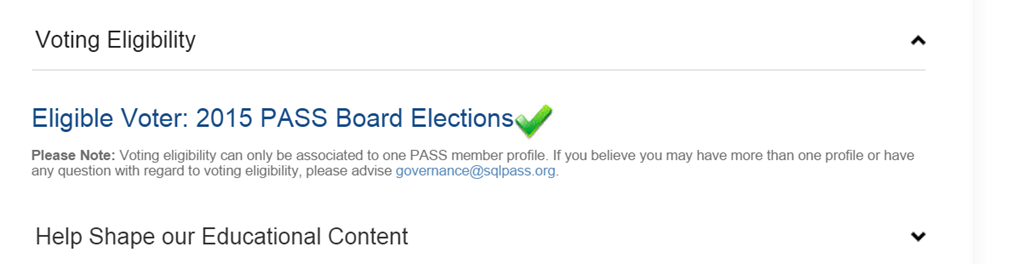
    Once you do that, you should see this checkbox in your profile. If you don’t, contact PASS

    passvote

    This is what  the email says.

    pass_update

    If you didn’t get one and think you can vote, contact PASS and let them know.

  • PASS Keynote–Dr. Rimma Nehme

    I missed the PASS welcome, but I did arrive to see Cloud Databases from Dr. Rimma Nehme.

    We begin with a few references to Dr. DeWitt, who has given amazing keynotes. It’s a tough act to follow, but Dr. Nehme goes in her own direction. Dr. Nehma is highly qualified. An MA and PhD, working with Microsoft Research and EMC as her career has grown. She’s currently at the Gray System Lab.

    We start with the Blind Men and the Cloud – Lot of different views on what the “cloud” means. People have Shiny Object Syndrome, and think that the cloud is something new and might solve their problems. That’s certainly been true for many companies.

    Cloud computing – Computing resources and software delivered on demand, as a service. That’s a good definition, but it’s also what I want to see from my database. It’s a service. It’s not a box, not a server, but it’s a service I ensure developers can use. I think as we move to that mindset, we’ll also start to manage our on-premises boxes differently and perhaps perform our jobs differently.

    Charcteristics of the cloud

    • on demand self-service
    • location transparent resource pooling
    • unbiquitous network access
    • rapid elasticiity
    • measured service, pay per use

    It’ a little scary to think about that last one, and I certainly that has people concerned. Do we really know what we use, or even need to use? Often we don’t get elastic revenue even if we go to elastic cost. It’s a scary balance.

    One big thing, which I wonder how many IT people realize, is that IT eliminates, or reduces, CAPEX. If you don’t know what that is, you should. It’s important.

    I truly think that many DBAs and other IT staff need to be thinking more widely, considering the impact on the business of our work. The positive and negative.The more we can phrase, discuss, and couch out benefits and costs in terms that business people understand. That alone will help us advance our careers, and our industry.

    Data centers

    Where do they live? For Microsoft, they’re all over. They have over 100 in 40 countries, and over 1mm servers. Dr. Nehme moves to efficiency, since that’s one of the reasons the cloud matters.

    What’s the efficiency of a data center? Traditional centers spend according to this chart.

    Photo Nov 06, 8 50 18 AM

    Why do we care? Certainly you could look at climate change, but perhaps more importantly, we want to remember resources are not infinite and the limits, or races to reduce costs and raise efficiency drive companies towards innovation.

    PUE = Facility Power / IT Eqiupment Power, usually in a data center, this is 2. So half our power is spent on non-computing resources. Modular data centers have gotten down to a 1.12 – 1.2 PUE. The fifth generation data centers, integrated ones, are in the 1.07 range.

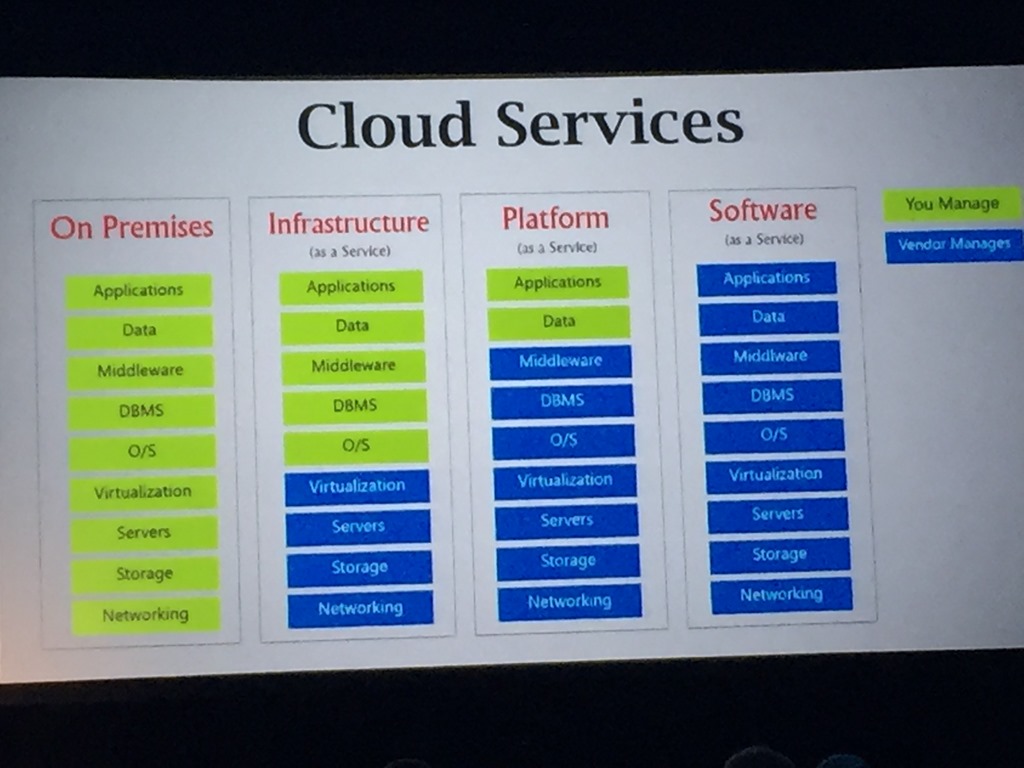
    We now move to the cloud, and how the services may differ. We get a picture of the various cloud service levels, it’s a complex picture.

    Photo Nov 06, 8 58 02 AM

    Pizza as a service, a good analogy.

    Photo Nov 06, 8 58 54 AM

    Life and ship your database to the cloud? I’m not sure it’s that easy. If you are IaaS, then it probably is, though load is an issue. II f you go to PaaS, then because the “surface” of what’s available as a database, you probably need code changes.

    The focus shifts to cloud specific services for data management, looking at areas that do not exist for the “earthed” databases. That’s a better term than on-premises, and I’ll start using it. It might help us differentiate the two types of databases that I suspect more and more of us will deal with.

    Virtualization came about because it’s better for using resources, but it does bring issues. Bottlenecks and delays for the various services using the hardware. The abstraction of resources (CPU, memory, network, disk) mean that there are indirect paths to use those resources, which can cause performance issues.

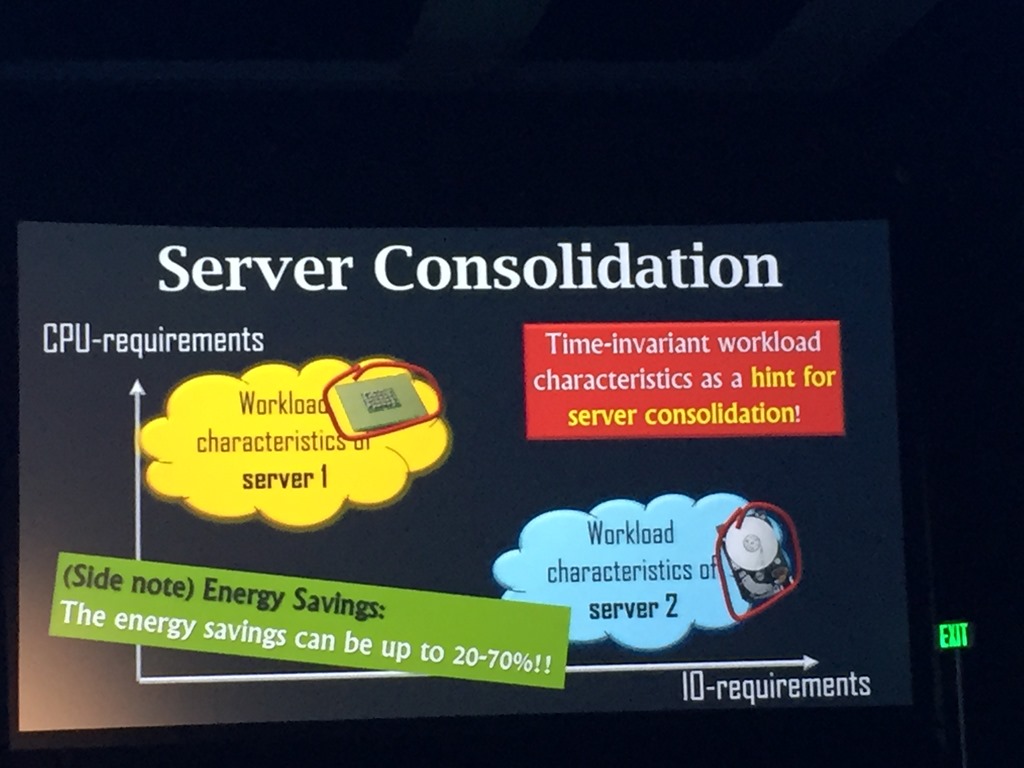
    There is a good slide, showing the ways you might look at consolidation. I’ve often looked at the timing of workloads, but understanding IO v CPU v memory (for the buffer pool), might be good.

    Photo Nov 06, 9 09 12 AM

    If you don’t use virtualization, I’d be surprised, but I certainly think you should start to understand it. Even if only on your own desktop, start to learn about how things work.

    We get a slide on multi-tenancy – four main approaches, with examples.

    Photo Nov 06, 9 11 07 AM

    This is interesting. It’s good to build comparison on the differences. I typically hadn’t considered the right two, though the third one I one I’ve one for auditing or ETL.

    Inside Azure

    It’s designed with HA in mind, with 2 secondary replicas of the data. We’ve heard this before, but we’re building a base here.  We get a little architecture, layers for routing and billing sit between clients and databases. However there’s a twist.

    Each machine has a SQL Server instance (not the edition you buy) with a master, msdb, model db. However with that is one SQL DB of some sort. Inside of this SQLDB is the primary for one of the databases you create, along with secondaries for other SQL databases from other customers. That’s an interesting concept.

    Somehow we share a database, but we can each build whatever schemas we want. There must be some sort of “virtual schema” that separates those things but we don’t get details.

    The DBA’s Role

    Photo Nov 06, 9 23 01 AM

    Dr. Nehme sees the cloud as not a threat to DBA. Demand grows for apps and capacity increases, but DBAs don’t grow as quickly. You could argue that the low growth of DBAs (relatively) is because we need less.

    However we still need data quality, security, HA, provisioning, tuning and more from DBAs. Arguably we might need more of those things in the cloud, so I don’t think the cloud matters, unless you are unwilling to learn. If you build your skills, and get away from the simple aspects of managing databases, I suspect you’ll be fine.


    Watch the keynote. It’s interesting and should make you think. Whether you agree or not, there is something here.