Tag: postgresql

  • Creating a PostgreSQL Docker Container with a Volume on Windows

    This post looks at how to set up a PostgreSQL container on Windows using Docker for Windows. I’ve seen a few posts, but I had to cobble together some instructions from places, so I decided to make my own post to help me remember and keep things simple.

    tl;dr: do this:

    • Create a folder c:\docker\pgdev
    • get the Docker image: docker pull postgresql:latest
    • Run the container, command below:
    docker run --name pgdev -e POSTGRES_PASSWORD=Str0ngP@ssword -d -p 5432:5432 -v C:\Docker\pgdev:/var/lib/postgresql/data  postgres

    That’s it. Then you have a PostgreSQL instance running on port 5432 (default) with a user, postgresql, and a password, Str0ngP@ssword.

    More detailed instructions below

    Create a place for data

    Containers are ephemeral, which isn’t what we want for a database. We want to keep data around, so let’s make a place for this. This will be a volume for our container, which we will map to a particular location inside the container. Then if the container dies, we can map this to another PostgreSQL container and have our data appear.

    Create a c:\Docker folder on your machine. This is a good spot for any Docker related volumes.

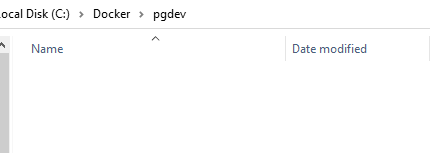
    Now create a pgdev folder under c:\docker. This is the place we’ll keep data for this PostgreSQL container. It should be empty.

    2022-12-27 10_04_37-pgdev

    Get the Image

    Container images are available from Docker. I won’t cover installing Docker or setting up Linux containers, but you do need to do this. I used Windows 10, and I have WSL v2, as you can see:

    2022-12-27 10_06_23-cmd

    Docker Desktop is running Linux containers. You can see that since it say “Switch to Windows containers”.

    2022-12-27 10_07_40-

    Next, use Docker Pull. I assume you are working with the default Docker registry, so this command should work:

    Docker image pull postgres:latest

    This will start downloading the image.

    2022-12-26 13_16_43-cmd - docker  image pull postgres_latest

    When this completes, move on.

    Starting the container

    Once we have the image, we can start the container. You could do this without the folder above, but your data would be in the container and if the container were ever deleted, then the data is lost.

    The basic command for starting the container requires a few parameters. Here is a list of what I provided in the command at the beginning:

    • –name – This is a name you can use in docker commands to refer to the container. You can put anything. I chose “pgdev”.
    • The password in the database system for the postgres user. This is a default user and you send this in as an environment variable with -e. The password I used here is: Str0ngP@ssword
    • -d runs this detached, rather than interactively. This means your command shell can return command to you. Otherwise, all output from the container appears in the shell and you can’t type anything.
    • -p is the port mapping. This is host:container. In this case, we map 5432 on the host (where we use some postgreSQL driver to connect) to 5432 inside the container. You can choose any unused port for the first number, but 5432 is needed for the second number as the postgresql service is listening on 5432.
    • -v is the volume mapping. Here we map our host folder to a container folder (host:container). We enter the folder we created above and then map this to the place where postgresql stores data. That’s in /var/lib/postrgresql/data
    • postgres is the image name.

    Here is the command again:

    docker run --name pgdev -e POSTGRES_PASSWORD=Str0ngP@ssword -d -p 5432:5432 -v C:\Docker\pgdev:/var/lib/postgresql/data  postgres

    Once this executes, we should see a long hex code returned, which is the container identifier.

    2022-12-27 10_22_58-cmd

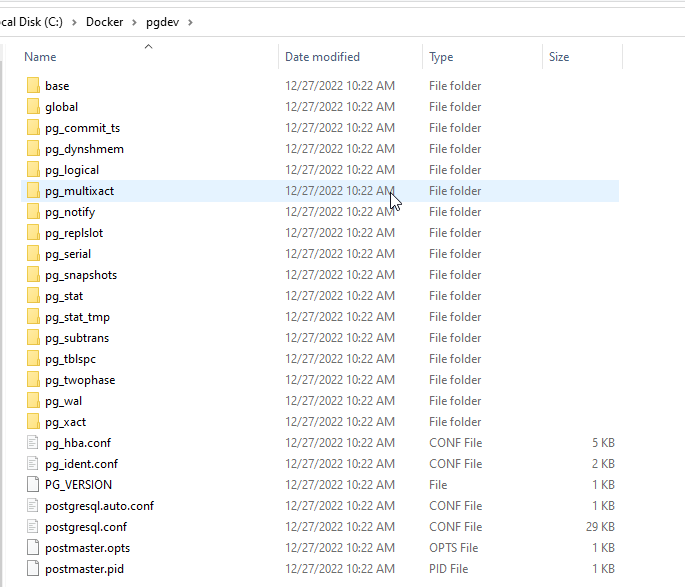
    We also see our folder is now filled with postgresql specific data files and folders:

    2022-12-27 10_23_05-pgdev

    That’s it, our container is running.

  • Pgadmin Environment Variables

    I’ve had to do some work on PostgreSQL, and I wrote an article at SQLServerCentral about getting started. Once I had things working, and could connect from Azure Data Studio(ADS), I also wanted to get pgadmin working in a container for admin tasks.

    I downloaded the container and ran it with this:

    docker container run -p 5050:5050 \
    -e 'PGADMIN_DEFAULT_EMAIL=sjones@sqlservercentral.com' \
    -e 'PGADMIN_DEFAULT_PASSWORD=Str0ngPwd!' \
    --name="pgadmin4" --hostname="pgadmin4" -d dpage/pgadmin4

    However, when I checked status, it would always be down. When I checked the logs (docker container logs pgadmin4), I’d see this:

    2020-09-29 13_54_02-cmd

    Ugh. I kept looking through docs and checking different posts. Lots of different options with quotes that I kept trying, but eventually when I went with double quotes, things worked.

    Leaving off the –d let me see this was actually starting up.

    2020-09-29 13_55_27-cmd

    This was on Docker for Windows, with Linux containers for me.

    I would swear that I tried just double quotes before this, but I bet I kept adding single quotes and double quotes in different ways, like this:

    docker container run -p 5050:5050 \
    -e 'PGADMIN_DEFAULT_EMAIL="sjones@sqlservercentral.com"' \
    -e 'PGADMIN_DEFAULT_PASSWORD="Str0ngPwd!"' \
    --name="pgadmin4" --hostname="pgadmin4" -d dpage/pgadmin4

    In any case, I got it working. I couldn’t connect for some reason to the PostgreSQL server, but that’s for another post.