Tag: syndicated

  • Knowing String Defaults in T-SQL–#SQLNewBlogger

    For years I’ve assumed I knew the string defaults, but I realized that’s not right. This post looks at what I learned.

    Another post for me that is simple and hopefully serves as an example for people trying to get blogging as #SQLNewBloggers.

    Declaring VARCHAR variables

    I learned a couple things. First, this is invalid code:
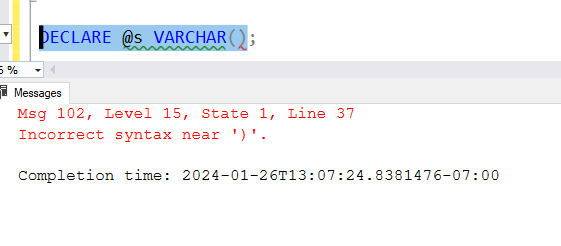
    2024-01-26 13_07_31-SQLQuery8.sql - ARISTOTLE_SQL2022.sandbox (ARISTOTLE_Steve (52))_ - Microsoft SQ

    The parenthesis aren’t needed, and cause an error. But if I declare just the word, I can add a string. The string in this code is more than 30 characters, which I’ve always assumed is the default length.

    DECLARE @s VARCHAR;
    SELECT @s = 'this is a test of a fairly long string'
    SELECT @s

    When I run this, however, I only get one character back.

    2024-01-26 13_09_00-SQLQuery8.sql - ARISTOTLE_SQL2022.sandbox (ARISTOTLE_Steve (52))_ - Microsoft SQ

    Why is that? Well, the default length is on, according to the docs.

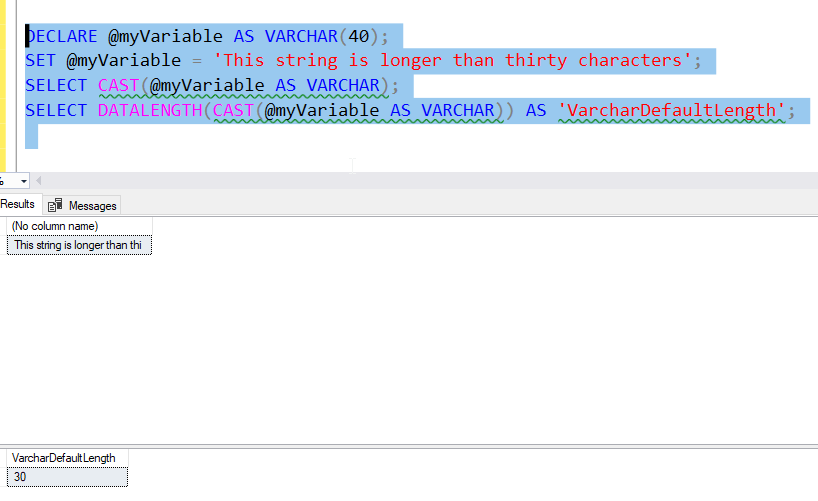
    When is it 20? When we use CAST/CONVERT. In that case, it’s 30. Code from the docs shows this:
    2024-01-26 13_10_55-SQLQuery8.sql - ARISTOTLE_SQL2022.sandbox (ARISTOTLE_Steve (52))_ - Microsoft SQ

    I’ve known this happens with CAST, but I didn’t realize the default length was 1. That’s interesting, and hopefully something no one lets slip into production when it would cause a problem.

    A good lesson is to always declare your length, and don’t make that MAX if you don’t need it.

    SQL New Blogger

    This post took me about 10 minutes to write, once I realized the issue. I spent a few minutes grabbing links, as I’d had some of the code written once I was testing what I’d read.

    You could do the same thing. Show some learning, show some code, show how you change things.

  • T-SQL Tuesday #171–Helping a Customer Fix Something

    t-sql tuesday logoIt’s that time of the month for a new blog party at T-SQL Tuesday. This month we have Brent Ozar hosing, and it’s a good topic. I wondered what he might ask when he agreed to host and he has surprised me.

    If you haven’t participated in this, start a blog, start building your brand, and write a post that answers Brent’s invitation. If you enjoy this and want to host, ping me for a date.

    Closing Tickets

    I don’t get tickets per se. I get copied on a few of them from customers, but often the things that I fix are things I’ve broken at SQL Saturday or T-SQL Tuesday or one of the sites I run.

    However, I do consult with customers and our Solutions Engineers at Redgate on architectures and challenges that customers are facing. Sometimes I even come up with a solution. This was the most recent one, which I found interesting.

    I walked into a conversation at a Redgate office one day. A few engineers were talking about a requirement that a customer had to stop a deployment if a particular configuration file had changed. They allow changes, but by few people, however, the configuration file is in the repository with other code and controls some of the deployment parameters.

    Our engineers were looking at git hooks or  moving the file to another repo, or rearchitecting the pipeline to change the configuration. There were other solutions, but all of them were adding complexity to the situation.

    Having grown up in the era of limited RAM and unreliable networks, I immediately thought about detecting changes with a file checksum. It’s a computer science technique used in lots of places, including many database drivers. I thought the simple thing is to store the checksum in a variable in the pipeline, and then add a step that runs something like Get-FileHash and compares that to the variable. Then fail the pipeline if it’s wrong.

    If the file needs to change, the privileged users can change the file, run this, and update the variable with the results.

    A simple way to detect changes and limit them inside the repo, from outside it.

    I have to say I haven’t seen this particular issue before, but I have seen lots of people worry about how to ensure deployments don’t happen in prod if they haven’t happened in test. That’s another whole issue, and a complex solution that I saw a customer implement. It worked great, but that’s for another day.

  • Friday Flyway Tips–Dark Mode

    I saw a post that Flyway Desktop has a dark mode and I had to try it out.

    I’ve been working with Flyway Desktop for work more and more as we transition from older SSMS plugins to the standalone tool. This series looks at some tips I’ve gotten along the way.

    Dark Mode

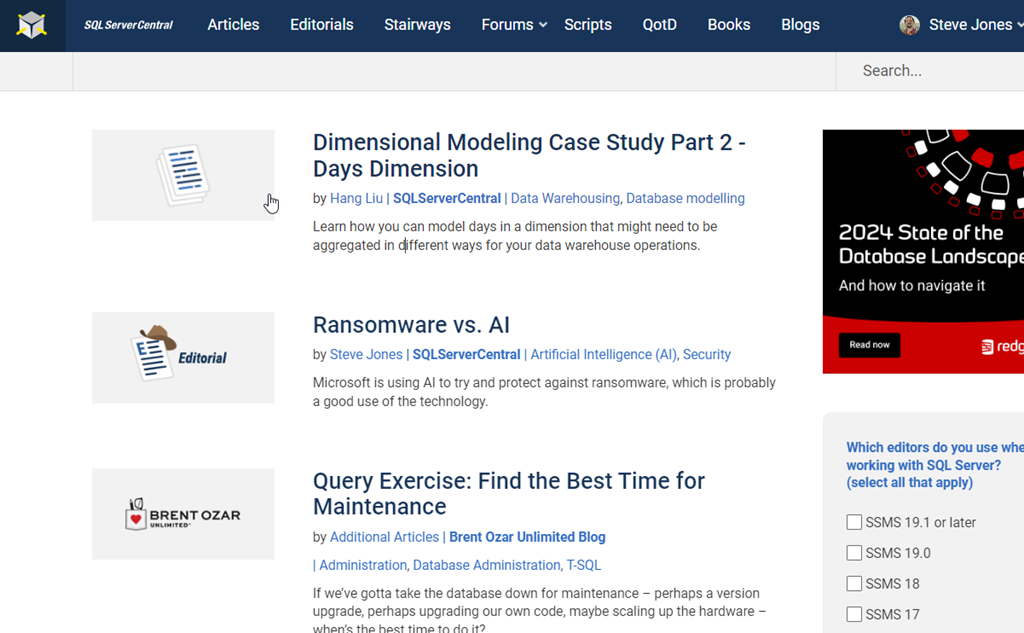
    In general, I’m not a big dark mode person. I tend to use browsers in light mode, like this:

    2024-02-07 15_17_17-SQLServerCentral – The #1 SQL Server community

    I regularly work in VSCode, which is light for me.

    2024-02-07 15_17_28-SQLSat1076.yml - sqlsatwebsite - Visual Studio Code

    And of course, SSMS is light. I know lots of people have wanted a dark mode, and you can configure that, but it’s a mess. To me, I just like light mode.

    2024-02-07 15_18_10-SQLQuery9.sql - ARISTOTLE.DMDemo_1_Dev (ARISTOTLE_Steve (55))_ - Microsoft SQL S

    However, someone posted a note internally a Redgate thanking engineers for dark mode.

    Wha??? I had to try it.

    It looks interesting.

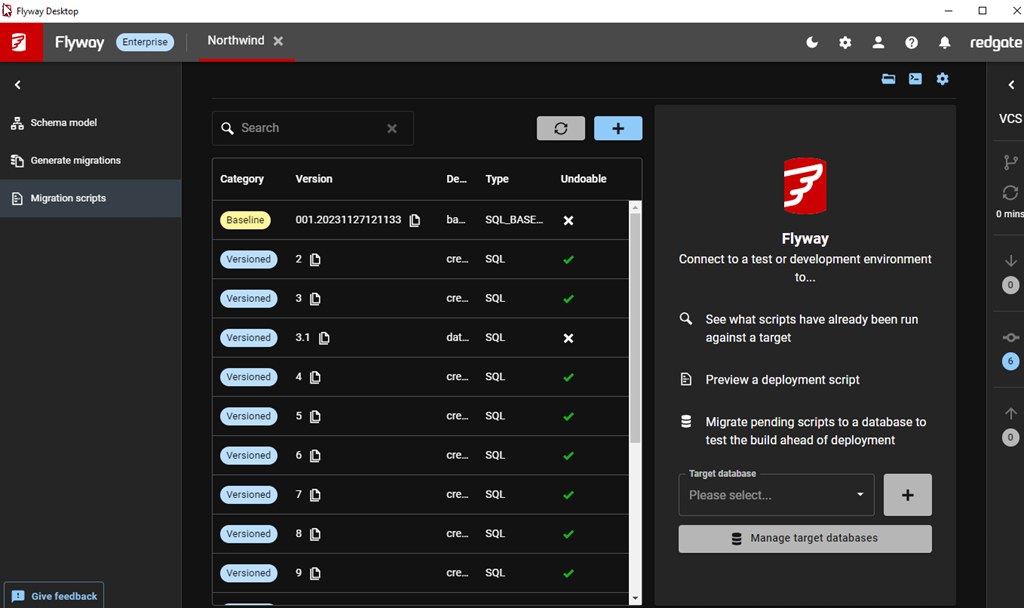
    2024-02-07 15_20_57-Flyway Desktop

    I don’t know if I’ll use it, but it’s easy to enable, and I can switch anytime. In the top bar, there are a number of icons. There’s a moon for one, which you see above and below, because I’m in dark mode.

    2024-02-07 15_21_45-Flyway Desktop

    If I click the left-most one above, I see this:

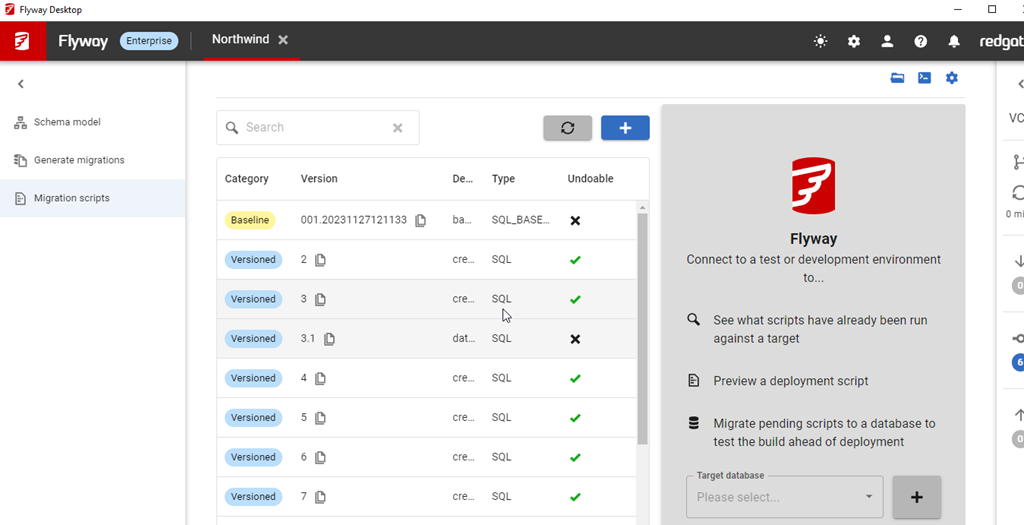
    2024-02-07 15_22_05-Flyway Desktop

    Now I have a sun, and a light mode.

    2024-02-07 15_22_18-Flyway Desktop

    This works on all tabs, on the VCS blade, and it gives you the option to work with either a white or dark background.

    That’s pretty cool. I don’t care so much, but I know lots of people do, so they now get the option.

    Try Flyway Enterprise out today. If you haven’t worked with Flyway Desktop, download it today. There is a free version that organizes migrations and paid versions with many more features.

    Video Walkthrough

    I made a quick video showing this as well. You can watch it below, or check out all the Flyway videos I’ve added:

  • A New Word: Wellium

    wellium – n. an excuse you come up with to rationalize a disappointing outcome – telling yourself that you weren’t in the mood for that sold-out show anyway, that your safety school is actually a better fit, that your dream job might have been too stressful.

    I come up with wellium all the time. I think it’s a very human reaction to try and make yourself feel better with some justification of why you are OK something didn’t work out.

    As I’ve gotten older, I do try to just feel bad or disappointed, and then move on. I tell myself that often decisions made by others aren’t necessarily a rejection. Often it can be a preference for something else, or the competition was better.

    It’s OK if others beat you at something if they’re better. That’s what we all want from competitive situations in sports, in jobs, in music. If they win, they win.

    Hopefully that also spurs you to learn to be better.

    From the Dictionary of Obscure Sorrows